Idaho Social Studies 9-12.WC.22
The Standard
Explain the importance of Christian monasteries and convents as centers of education, missionary activity, economic productivity, and political power, including, but not limited to the contributions of St. Benedict and Pope Gregory the Great.
Idaho Content Standards: K-12 Social Studies · The Middle Ages (c. 330 AD – 1450 AD)
Teacher's field guide
What This Standard Means
What Students Need to Do
- Students explain how monasteries and convents taught people, sent missionaries, produced goods, and influenced rulers. They connect Benedict's Rule to daily life in these communities and Gregory's support to missions in England.
What Mastery Looks Like
- A student can use a copied book, farm record, or land grant to explain a religious community's work beyond worship. They can distinguish Benedict's guidance for monastic life from Gregory's support for missions.
Common Misconceptions
- Students may think monks and nuns only prayed, or that convents had no role in learning or work. They may credit Benedict with Gregory's mission to England or assume every monastery had the same political power.
How to Assess It
- Ask students to write four sentences explaining how a monastery or convent supported learning, missions, work, and political power. Have them include one contribution each from Benedict and Gregory.
Lesson moves
Ways to Teach It
Give groups four cards labeled copied book, mission map, farm record, and land grant; have them sort the cards by community role.
Ask, 'How could owning farmland give an abbess or abbot a say in a ruler's decisions?'
Play a matching game: students pair Benedict with a prayer and work schedule, and Gregory with a mission map of England.
Show a local school website and a farm stand flyer; ask how a convent or monastery could serve both roles.
Free download
Printable 9-12.WC.22 Worksheet
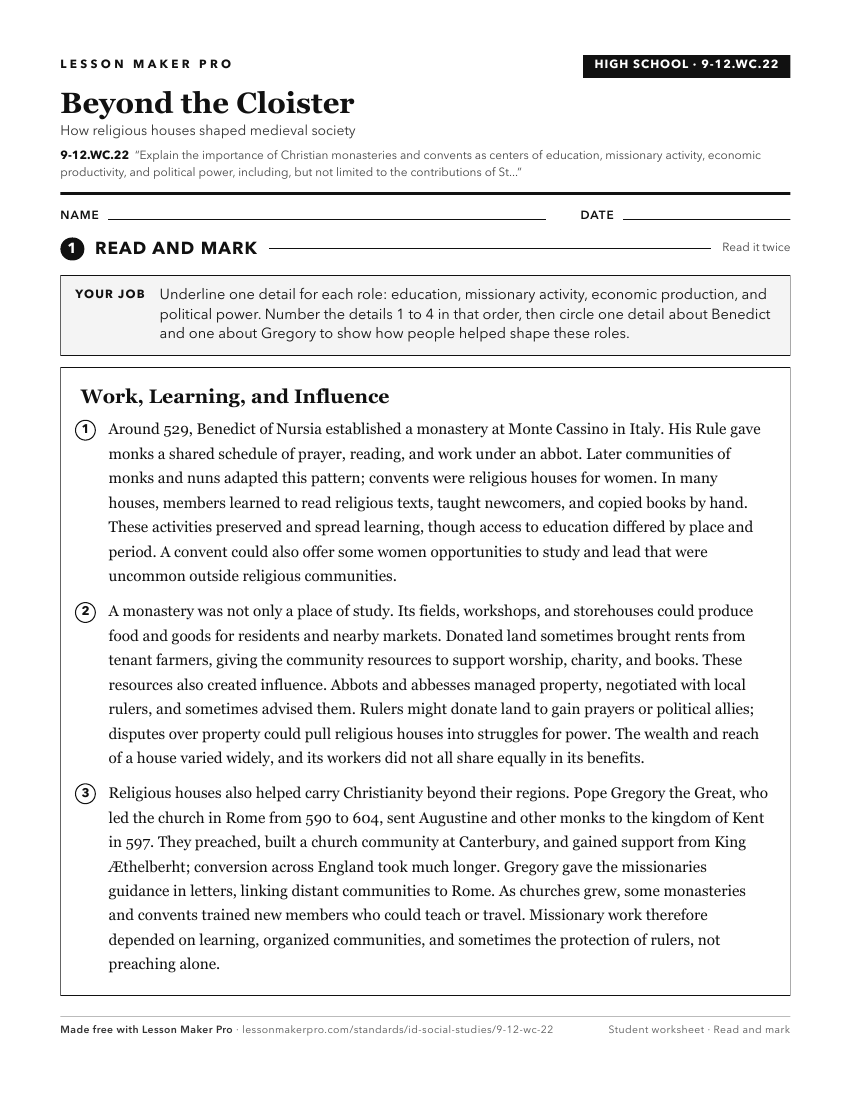
A ready-to-print activity worksheet aligned to 9-12.WC.22, with an answer key for the teacher on its own page. No account needed.
PDF, US Letter, prints cleanly in black and white.
Download the worksheetKeep exploring
Related Standards
- 9-12.WC.19
Analyze the impact of Christianity on Classical culture and society and the formation of the Catholic Church.
- 9-12.WC.23
Identify key figures, artistic and intellectual achievements of the medieval period in Western Europe, (e.g. Thomas Aquinas, Hildegard von Bingen, Dante, Gothic...
- 9-12.WC.20
Identify key figures of the Byzantine Empire, including but not limited to Justinian and Theodora, and explain their contributions to its history and culture.
- 9-12.WC.29
Analyze the relationships between the Papacy and the European monarchs.
Turn this exact standard into a lesson
Grade, subject, topic, and the complete standard are prefilled. Create one free, no account needed.
Also for this standard:Make a WorksheetMake a QuizMake a Sub Lesson