Idaho Social Studies 6-12.US1.28
The Standard
Compare and contrast various defenses of slavery offered by apologists and various anti-slavery movements including, but not limited to a discussion of: • American Colonization Society (Henry Clay) • Gradualist abolitionist movements • Radical abolitionist movements • Frederick Douglass • John Brown • Angelina Grimke • William Lloyd Garrison • Sojourner Truth • Harriet Tubman • Theodore Weld
Idaho Content Standards: K-12 Social Studies · Geographic Expansion and Political and Social Changes 1820-1860
Teacher's field guide
What This Standard Means
What Students Need to Do
- Students identify claims used to defend slavery, including claims about the economy, religion, and property rights. They compare colonization, gradual emancipation, immediate abolition, escape networks, and armed resistance. They connect each approach to the people who supported or carried it out.
What Mastery Looks Like
- A student can explain how a proslavery claim tried to justify slavery and how an abolitionist challenged it. They can distinguish Henry Clay’s colonization plan from Garrison’s call for immediate abolition, Tubman’s rescue work, and Brown’s armed resistance.
Common Misconceptions
- Students may think the American Colonization Society sought to free all enslaved people immediately. Its plan centered on resettling free Black people in Africa, and some supporters opposed immediate abolition. Students may also treat speeches, escape networks, and armed raids as the same tactic.
How to Assess It
- Exit ticket: A slaveholder claims slavery benefits enslaved people. Explain how Garrison or Douglass would challenge that claim, then describe one way Clay’s plan differed.
Lesson moves
Ways to Teach It
Give pairs four short source cards from Clay, Garrison, Douglass, and a proslavery speaker; have them sort the claims by goal and method.
Ask students to write why Douglass might reject Clay’s colonization plan, using one quote from each man’s writing.
Play “Who said or did it?” Read clues about Truth, Grimké, Weld, Brown, and Tubman; teams name the person and method.
Read the National Park Service’s Harriet Tubman Underground Railroad site page, then compare her actions with a proslavery claim from class.
Free download
Printable 6-12.US1.28 Worksheet
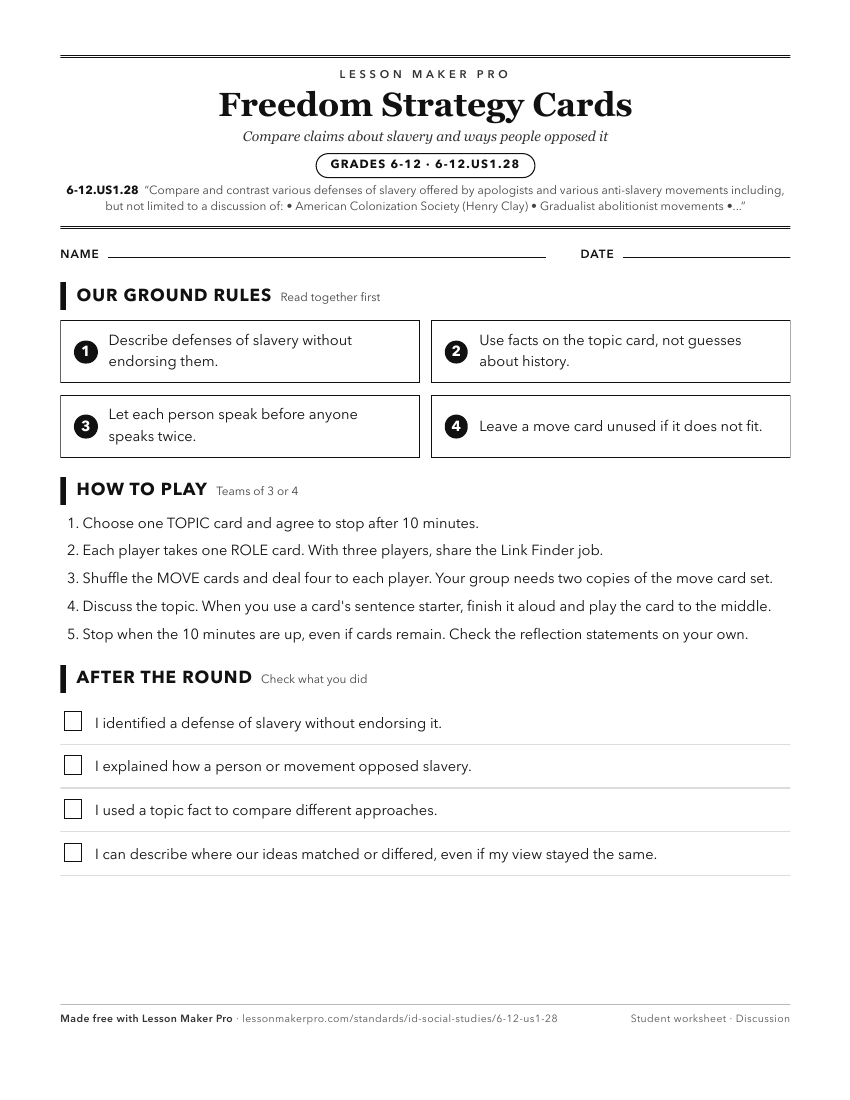
A ready-to-print activity worksheet aligned to 6-12.US1.28, with an answer key for the teacher on its own page. No account needed.
PDF, US Letter, prints cleanly in black and white.
Download the worksheetKeep exploring
Related Standards
- 6-12.US1.27
Compare and contrast the various manifestations of slavery in this time period, for example, ownership patterns, labor divisions, and geographic differences.
- 6-12.US1.15
Analyze the arguments and outcomes of the ratification debate between leading Federalists and Anti-Federalists, including, but not limited to:
- 6-12.US1.4
Explain the differences with economic systems between New England, and the Mid-Atlantic and Southern colonies, including indentured servitude and slavery as lab...
- 6-12.US1.19
Explain the social and economic motivations and developments surrounding the enslavement of peoples in the northern and southern states and territories.
Turn this exact standard into a lesson
Grade, subject, topic, and the complete standard are prefilled. Create one free, no account needed.
Also for this standard:Make a WorksheetMake a QuizMake a Sub Lesson