Idaho Social Studies 6-12.US1.27
The Standard
Compare and contrast the various manifestations of slavery in this time period, for example, ownership patterns, labor divisions, and geographic differences.
Idaho Content Standards: K-12 Social Studies · Geographic Expansion and Political and Social Changes 1820-1860
Teacher's field guide
What This Standard Means
What Students Need to Do
- Students compare how small farm owners, plantation owners, and town households used enslaved labor. They explain how field, household, and skilled work varied across places.
What Mastery Looks Like
- A student can compare a small Virginia farm with a large Mississippi cotton plantation, naming differences in ownership size and work. They can explain that both relied on forced labor.
Common Misconceptions
- Students often picture every enslaved person picking cotton on a large plantation. Some assume household or skilled workers were free, or that slavery existed only in the Deep South.
How to Assess It
- Exit ticket: Compare a small Virginia farm and a large Mississippi cotton plantation. Name one difference in ownership size, one difference in work, and one thing they shared.
Lesson moves
Ways to Teach It
Hand pairs four cards with place, owner size, and work: Virginia farm, Mississippi plantation, Charleston home, Richmond workshop; sort and map them.
Ask: How could a small Virginia farm and a large Mississippi plantation differ while both depended on forced labor?
Play a matching round: connect work descriptions to field, household, or skilled labor, then name a place where each occurred.
Show a cotton T-shirt and an 1860 cotton map; ask how enslaved field labor supplied cotton for nineteenth-century clothing.
Free download
Printable 6-12.US1.27 Worksheet
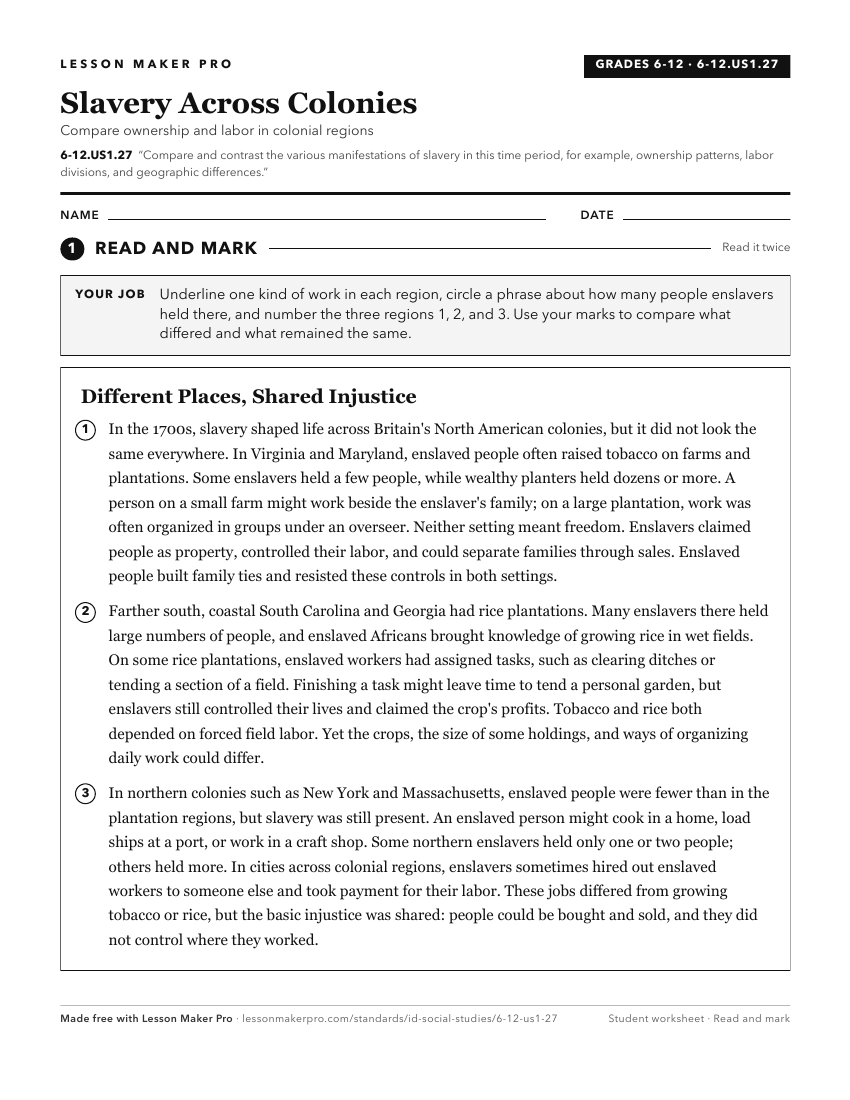
A ready-to-print activity worksheet aligned to 6-12.US1.27, with an answer key for the teacher on its own page. No account needed.
PDF, US Letter, prints cleanly in black and white.
Download the worksheetKeep exploring
Related Standards
- 6-12.US1.28
Compare and contrast various defenses of slavery offered by apologists and various anti-slavery movements including, but not limited to a discussion of:
- 9-12.EC.6
Compare and contrast the characteristics of different economic systems and economic philosophies.
- 6-12.US1.4
Explain the differences with economic systems between New England, and the Mid-Atlantic and Southern colonies, including indentured servitude and slavery as lab...
- 6-12.US1.19
Explain the social and economic motivations and developments surrounding the enslavement of peoples in the northern and southern states and territories.
Turn this exact standard into a lesson
Grade, subject, topic, and the complete standard are prefilled. Create one free, no account needed.
Also for this standard:Make a WorksheetMake a QuizMake a Sub Lesson