Idaho Social Studies 6-12.US1.15
The Standard
Analyze the arguments and outcomes of the ratification debate between leading Federalists and Anti-Federalists, including, but not limited to: • Federalists (John Jay, Alexander Hamilton, and James Madison) • Anti-Federalists (Patrick Henry, Sam Adams, Elbridge Gerry, George Mason, Brutus)
Idaho Content Standards: K-12 Social Studies · Founding a New Government 1776-1791
Teacher's field guide
What This Standard Means
What Students Need to Do
- Students explain why Hamilton, Madison, and Jay backed the Constitution. They compare those arguments with objections from Patrick Henry, George Mason, Elbridge Gerry, Sam Adams, and Brutus. They explain how promises to add rights helped win support for ratification.
What Mastery Looks Like
- A student can explain why Madison thought a large republic could control factions and why Brutus feared distant rulers. They can explain that the Constitution was ratified before the Bill of Rights was added.
Common Misconceptions
- Students may think Federalists wanted national power with no limits, or that Anti-Federalists opposed any national government. Some think the Bill of Rights was in the original Constitution.
How to Assess It
- Exit ticket: Why did Madison support a large republic while Brutus feared one? How did the promise of a bill of rights address an objection to ratification?
Lesson moves
Ways to Teach It
Give pairs four claim cards: 'checks and balances,' 'large republic,' 'distant rulers,' and 'missing rights.' Have them sort the cards by side.
Ask students to write a two-sentence ratification speech using one argument from Madison and one objection from Mason.
Play a vote game: read 'national tax power' and 'no listed rights'; students vote to ratify or reject and defend each choice.
Show a school handbook's student rights page; ask which protections students would demand before approving new school rules.
Free download
Printable 6-12.US1.15 Worksheet
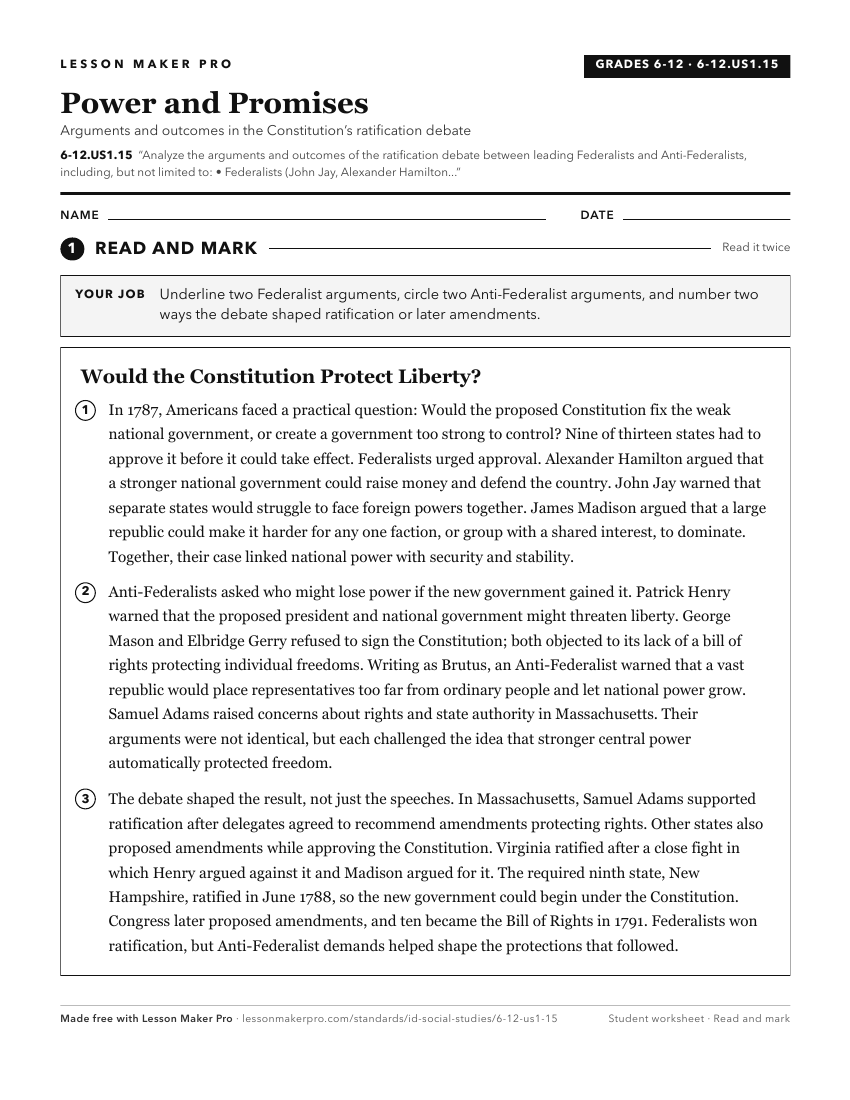
A ready-to-print activity worksheet aligned to 6-12.US1.15, with an answer key for the teacher on its own page. No account needed.
PDF, US Letter, prints cleanly in black and white.
Download the worksheetKeep exploring
Related Standards
- 9-12.GOV.4
Analyze the Constitutional Convention of 1787, including the Great Compromise and the ensuing debate over ratification between the Federalists and Anti-Federali...
- 9-12.GOV.5
Evaluate the arguments presented in the Federalist Papers, particularly Essay 10 and Essay 51, and evaluate the arguments in the Anti-Federalist Papers.
- 6-12.US1.14
Explain the key concerns and compromises that emerged at the Constitutional Convention of 1787, including arguments over the Bill of Rights and its eventual ado...
- 6-12.US1.16
Analyze the original Constitution by comparing the powers of government branches, assessing its response to Revolutionary causes and alignment with Declaration ...
Turn this exact standard into a lesson
Grade, subject, topic, and the complete standard are prefilled. Create one free, no account needed.
Also for this standard:Make a WorksheetMake a QuizMake a Sub Lesson