Idaho Social Studies 6-12.US1.16
The Standard
Analyze the original Constitution by comparing the powers of government branches, assessing its response to Revolutionary causes and alignment with Declaration of Independence ideals, and addressing failures of the Articles of Confederation.
Idaho Content Standards: K-12 Social Studies · Founding a New Government 1776-1791
Teacher's field guide
What This Standard Means
What Students Need to Do
- Students compare what Congress, the president, and federal courts could do under the original Constitution. They explain how it answered complaints about British rule and problems under the Articles of Confederation. They also identify where it fell short of the Declaration’s ideals.
What Mastery Looks Like
- A student can explain that Congress gained tax and trade powers the Articles lacked, while the president could veto bills and federal courts could hear cases. They can explain how taxes passed by elected lawmakers addressed a colonial complaint and how the three-fifths clause conflicted with the Declaration’s equality claim.
Common Misconceptions
- Students may think the Articles had no national government. It had a Congress, but Congress could not levy taxes directly. Students may also think the original Constitution gave everyone a vote or ended slavery.
How to Assess It
- Exit ticket: For a new federal tax, name one role each for Congress, the president, and federal courts. Then name one Articles weakness the Constitution fixed and one Declaration ideal it did not meet.
Lesson moves
Ways to Teach It
Give pairs excerpts from Articles I, II, and III and sticky notes; have them mark powers to make laws, enforce them, and hear cases.
Write four sentences comparing taxes passed by elected lawmakers with British taxation, then explain why the three-fifths clause conflicted with equality.
Race to match cards showing Articles weaknesses, such as no direct tax power, with powers granted to the new government.
Use a recent federal budget headline to trace Congress’s spending role, the president’s approval or veto, and a possible court dispute.
Free download
Printable 6-12.US1.16 Worksheet
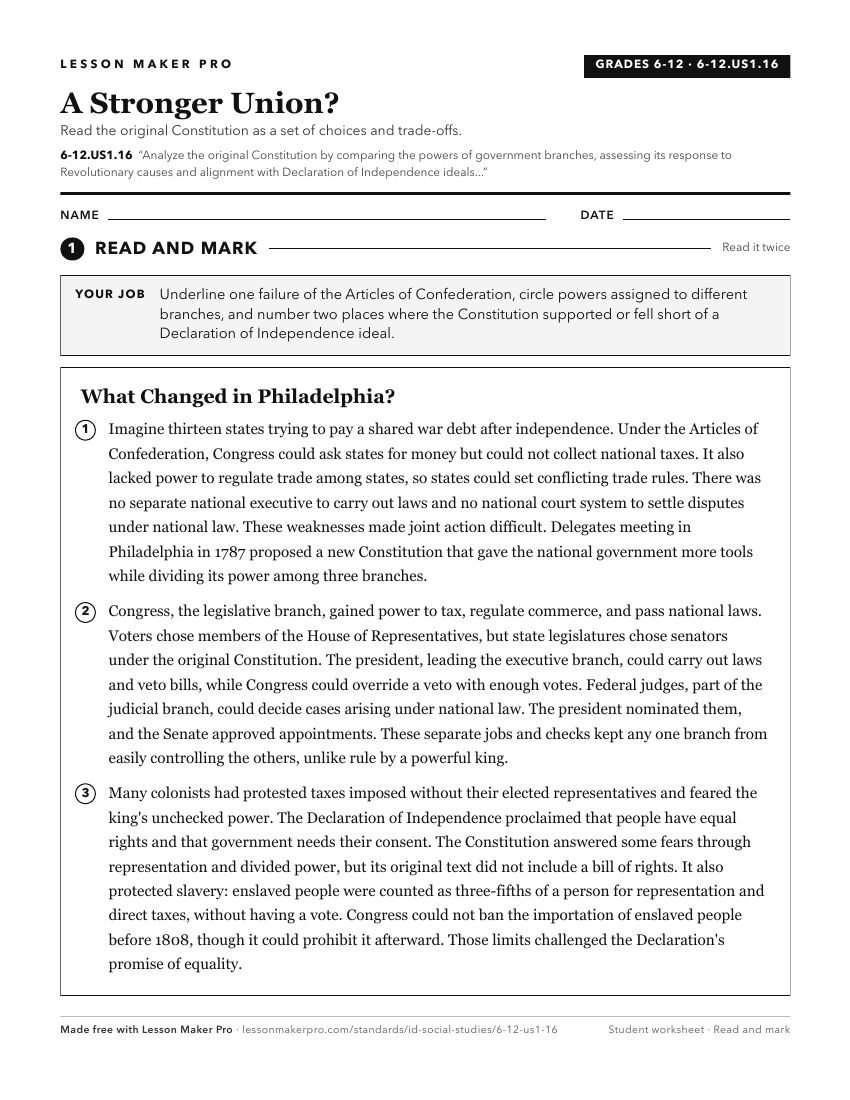
A ready-to-print activity worksheet aligned to 6-12.US1.16, with an answer key for the teacher on its own page. No account needed.
PDF, US Letter, prints cleanly in black and white.
Download the worksheetKeep exploring
Related Standards
- 9-12.GOV.4
Analyze the Constitutional Convention of 1787, including the Great Compromise and the ensuing debate over ratification between the Federalists and Anti-Federali...
- 9-12.GOV.12
Evaluate the arguments within the Declaration of Independence and its definition of an ideal government.
- 6-12.US1.13
Analyze the successes and failures of the Articles of Confederation and the events that led to the Constitutional Convention of 1787.
- 9-12.GOV.3
Identify the strengths and weaknesses of the Articles of Confederation.
Turn this exact standard into a lesson
Grade, subject, topic, and the complete standard are prefilled. Create one free, no account needed.
Also for this standard:Make a WorksheetMake a QuizMake a Sub Lesson