Georgia SS5H7.a
The Standard
- SS5H7
- Trace important developments in America from 1975 to 2001.
Describe the collapse of the Soviet Union, including the role of Ronald Reagan.
Georgia Standards of Excellence for Social Studies · Trace important developments in America from 1975 to 2001.
Teacher's field guide
What This Standard Means
What Students Need to Do
- Students explain why the Soviet Union weakened and broke apart in 1991. They describe how Reagan applied pressure through military spending and public criticism, then worked with Gorbachev on arms agreements.
What Mastery Looks Like
- Students can place Reagan’s presidency, Gorbachev’s reforms, the fall of the Berlin Wall, and the 1991 breakup in order. They explain that Reagan influenced events but did not cause the collapse alone.
Common Misconceptions
- Students may think Reagan single-handedly ended the Soviet Union or defeated it in a war. They may treat Russia and the Soviet Union as the same country. They may also confuse the fall of the Berlin Wall with the Soviet breakup.
How to Assess It
- Use this exit ticket: Name one Reagan action, name two problems inside the Soviet Union, and explain why the collapse had several causes.
Lesson moves
Ways to Teach It
Have pairs arrange event cards showing Reagan’s policies, Soviet economic problems, Gorbachev’s reforms, Eastern European protests, and the 1991 breakup.
Ask students to write: Did Reagan cause the Soviet collapse, influence it, or both? Support your answer with two facts.
Play a cause-and-effect matching game using cards for military spending, shortages, reforms, protests, arms talks, and Soviet republic independence.
Compare a 1985 Soviet map with a current map, then label three former Soviet republics that became independent countries.
Free download
Printable SS5H7.a Worksheet
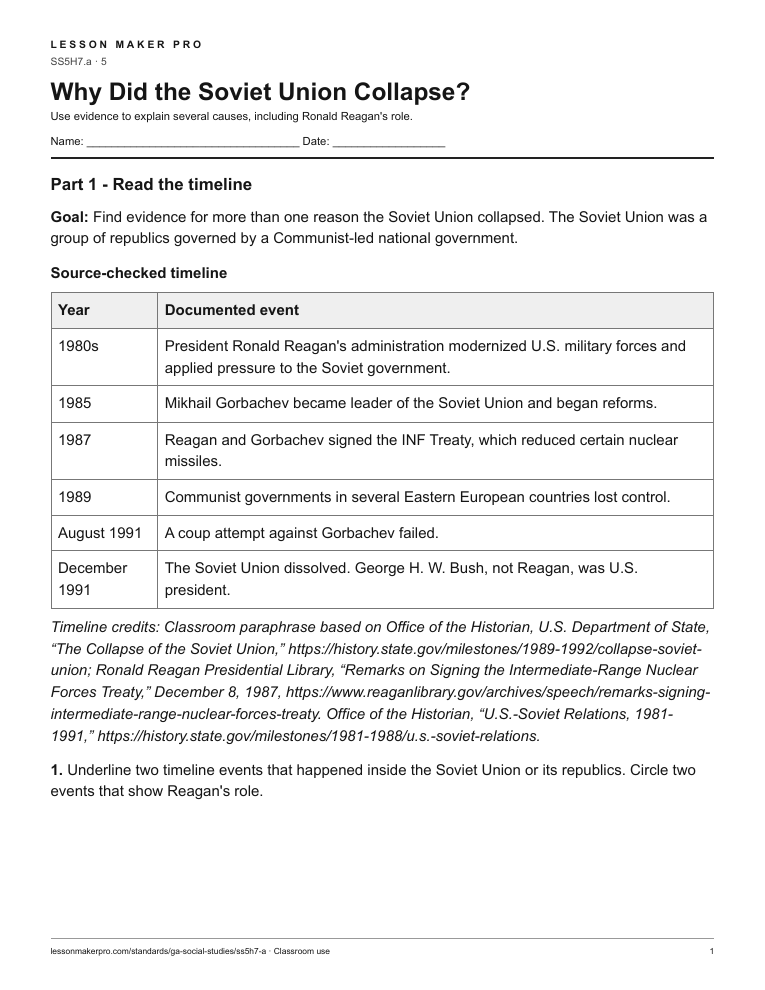
A ready-to-print activity worksheet aligned to SS5H7.a, with an answer key for the teacher on its own page. No account needed.
PDF, US Letter, prints cleanly in black and white.
Download the worksheetKeep exploring
Related Standards
- SS5H5
Discuss the origins and consequences of the Cold War.
- SS6H3.c
Explain how German reunification contributed to the collapse of the Soviet Union and led to the end of the Cold War.
- SS5H5.b
Explain how the United States sought to stop the spread of communism through the Berlin airlift, the Korean War, and the North Atlantic Treaty Organization.
- SS6H3.a
Describe the aftermath of World War I: the rise of communism, the Treaty of Versailles, the rise of Nazism, and worldwide depression.
Turn this exact standard into a lesson
Grade, subject, topic, and the complete standard are prefilled. Create one free, no account needed.
Also for this standard:Make a WorksheetMake a QuizMake a Sub Lesson