Georgia SS5H5.a
The Standard
- SS5H5
- Discuss the origins and consequences of the Cold War.
Explain the origin and meaning of the term "Iron Curtain."
Georgia Standards of Excellence for Social Studies · Discuss the origins and consequences of the Cold War.
Teacher's field guide
What This Standard Means
What Students Need to Do
- Students explain that Winston Churchill popularized the phrase in a 1946 speech after World War II. They describe it as a symbolic division between Soviet-controlled Eastern Europe and democratic Western Europe.
What Mastery Looks Like
- Students identify Churchill, the postwar setting, and the growing conflict between the Soviet Union and Western nations. They explain that the phrase described political and ideological separation, not a real curtain.
Common Misconceptions
- Students may think the Iron Curtain was a physical wall or another name for the Berlin Wall. They may also think Churchill created the division rather than using a phrase to describe one that was forming.
How to Assess It
- Give students this exit prompt: Who popularized the phrase "Iron Curtain," and what did the phrase mean in Europe after World War II?
Lesson moves
Ways to Teach It
Place red yarn across a 1946 Europe map, then label Soviet-controlled countries on one side and Western democracies on the other.
Read a short excerpt from Churchill's Fulton speech and write: What picture does "Iron Curtain" create, and why was it effective?
Sort cards into accurate and inaccurate claims, including physical wall, symbolic boundary, Soviet influence, Churchill speech, and Berlin Wall.
Compare the Iron Curtain with a present-day divided border, naming one similarity and one difference without treating them as identical.
Free download
Printable SS5H5.a Worksheet
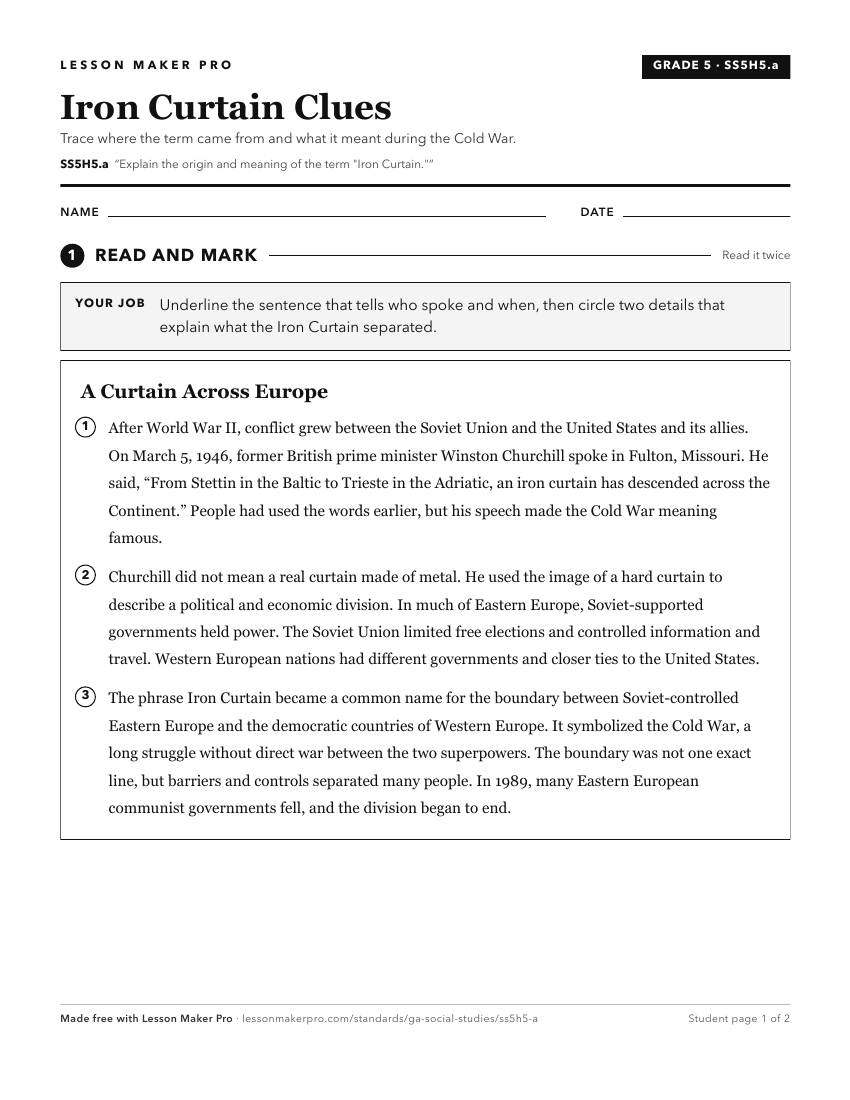
A ready-to-print activity worksheet aligned to SS5H5.a, with an answer key for the teacher on its own page. No account needed.
PDF, US Letter, prints cleanly in black and white.
Download the worksheetKeep exploring
Related Standards
- SS5H5
Discuss the origins and consequences of the Cold War.
- SS6H3
Explain conflict and change in Europe.
- SS7H2.a
Explain how European partitioning in the Middle East following WWI led to regional conflict.
- SS6H3.c
Explain how German reunification contributed to the collapse of the Soviet Union and led to the end of the Cold War.
Turn this exact standard into a lesson
Grade, subject, topic, and the complete standard are prefilled. Create one free, no account needed.
Also for this standard:Make a WorksheetMake a QuizMake a Sub Lesson