Georgia SS4E2
The Standard
Identify the elements of a personal budget (income, expenditures, and saving) and explain why personal spending and saving decisions are important.
Georgia Standards of Excellence for Social Studies
Teacher's field guide
What This Standard Means
What Students Need to Do
- Students sort money into what comes in, what gets spent, and what gets saved. They explain how each choice affects what money remains for later needs and wants.
What Mastery Looks Like
- A student can create a simple budget that does not spend more money than is available. The student can justify a spending choice and a saving choice using the budget.
Common Misconceptions
- Students may treat savings as money left over instead of a planned amount. They may confuse income with current cash or think expenditures include only optional purchases.
How to Assess It
- Give this exit ticket: “Maya earns $20, spends $8 on lunch, and saves $5. Label each amount and explain one benefit of saving.”
Lesson moves
Ways to Teach It
Give pairs play money and three labeled envelopes, then have them divide $30 among planned purchases, surprise costs, and savings.
Ask students to write which choice is wiser: buy a $12 game now or save toward a $25 bicycle helmet, and explain why.
Play Budget Match by having students match income cards with spending and saving plans that stay within the available amount.
Use a sample allowance or pet care budget to decide how much to spend weekly and how much to save for a larger purchase.
Free download
Printable SS4E2 Worksheet
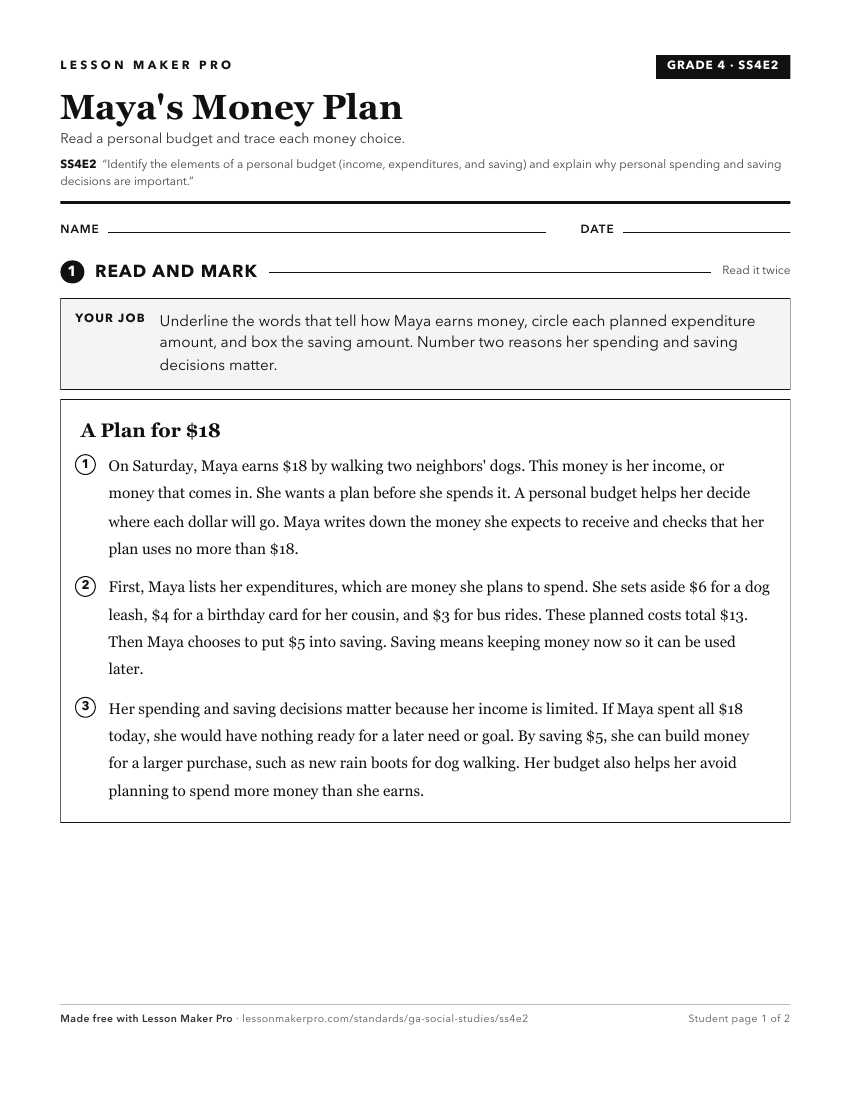
A ready-to-print activity worksheet aligned to SS4E2, with an answer key for the teacher on its own page. No account needed.
PDF, US Letter, prints cleanly in black and white.
Download the worksheetKeep exploring
Related Standards
- SS8E3
Explain the principles of effective personal money management.
- SS7E10.b
Understand that a budget is a tool to plan the spending and saving of income.
- SS5E4
Identify the elements of a personal budget (income, expenditures, and saving) and explain why personal spending and saving decisions are important.
- SS2E4
Describe the costs and benefits of personal saving and spending choices.
Turn this exact standard into a lesson
Grade, subject, topic, and the complete standard are prefilled. Create one free, no account needed.
Also for this standard:Make a WorksheetMake a QuizMake a Sub Lesson