Georgia SS3G3.a
The Standard
- SS3G3
- Describe how physical systems affect human systems.
Explain why American Indian groups occupied the areas they did (SS3H1a), with emphasis on why some developed permanent villages and others did not.
Georgia Standards of Excellence for Social Studies · Describe how physical systems affect human systems.
Teacher's field guide
What This Standard Means
What Students Need to Do
- Students connect climate, landforms, water, plants, and animals to where American Indian groups lived. They explain how reliable local resources supported permanent villages, while seasonal resources sometimes required groups to move.
What Mastery Looks Like
- Students can study a regional map and predict how a group found food, water, and shelter there. They support a claim about permanent or seasonal settlement with two geographic details.
Common Misconceptions
- Students may think groups chose locations randomly or that every group lived in a tipi. They may assume mobile groups wandered without purpose instead of following seasonal food, water, or animal herds. They may also treat permanent villages as more advanced.
How to Assess It
- Give students a region with a river, fertile soil, forests, and cold winters. Ask them to explain whether permanent settlement was likely, using two map details.
Lesson moves
Ways to Teach It
Give pairs a physical map and resource cards, then have them match food, water, climate, and shelter materials to likely settlement locations.
Ask students to write: “Why might a farming community stay while a hunting community moves seasonally?” Require two environmental details.
Play Settlement Detective: read clues about climate and resources, then teams identify the region and decide whether a village would be permanent.
Compare the town’s location with a nearby river, forest, or farmland, then discuss why people still choose places near useful resources.
Free download
Printable SS3G3.a Worksheet
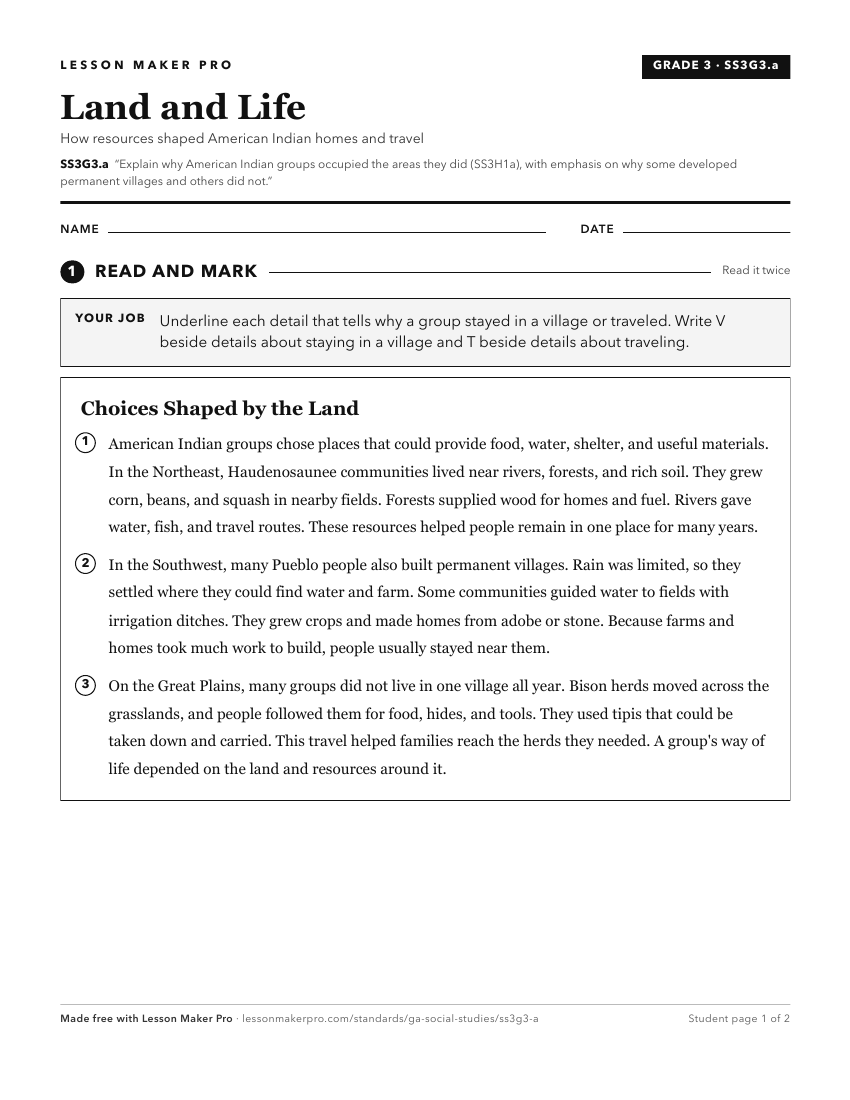
A ready-to-print activity worksheet aligned to SS3G3.a, with an answer key for the teacher on its own page. No account needed.
PDF, US Letter, prints cleanly in black and white.
Download the worksheetKeep exploring
Related Standards
- SS3H1
Describe early American Indian cultures and their development in North America.
- SS3G3.b
Describe how the early explorers (SS3H2a) adapted, or failed to adapt, to the various physical environments in which they traveled.
- SS3H1.a
Locate the regions where American Indians settled in North America: Arctic, Northwest Southwest, Plains, Northeast, and Southeast.
- SS3H1.b
Compare and contrast how American Indians in each region used their environment to obtain food, clothing, and shelter.
Turn this exact standard into a lesson
Grade, subject, topic, and the complete standard are prefilled. Create one free, no account needed.
Also for this standard:Make a WorksheetMake a QuizMake a Sub Lesson