Georgia L6-8RHSS3
The Standard
Identify key steps in a text’s description of a process related to history/social studies (e.g., how a bill becomes law, how interest rates are raised or lowered).
Georgia Standards of Excellence for Social Studies
Teacher's field guide
What This Standard Means
What Students Need to Do
- Students find the main actions and decisions in a history or civics process. They place those steps in order and explain how one leads to the next.
What Mastery Looks Like
- Given a short passage, students can list the key steps in the correct sequence. They leave out background details and identify points where a decision changes what happens next.
Common Misconceptions
- Students may list every detail instead of selecting key steps. They may confuse causes with steps, overlook decision points, or rely only on words such as first and next.
How to Assess It
- Exit ticket: “A resident reports a problem. A council member proposes a rule. The council debates and votes. If approved, the mayor signs it.” List the four steps in order and circle the decision point.
Lesson moves
Ways to Teach It
Give pairs mixed step cards showing how a bill becomes law, then have them arrange and check the sequence against a short passage.
Ask students to write which step in a described process matters most and support their choice with one detail from the text.
Play Process Relay, where teams race to arrange mixed step strips and explain why each step belongs in that position.
Have students read a city website explanation of voter registration and create a numbered checklist for a first-time voter.
Free download
Printable L6-8RHSS3 Worksheet
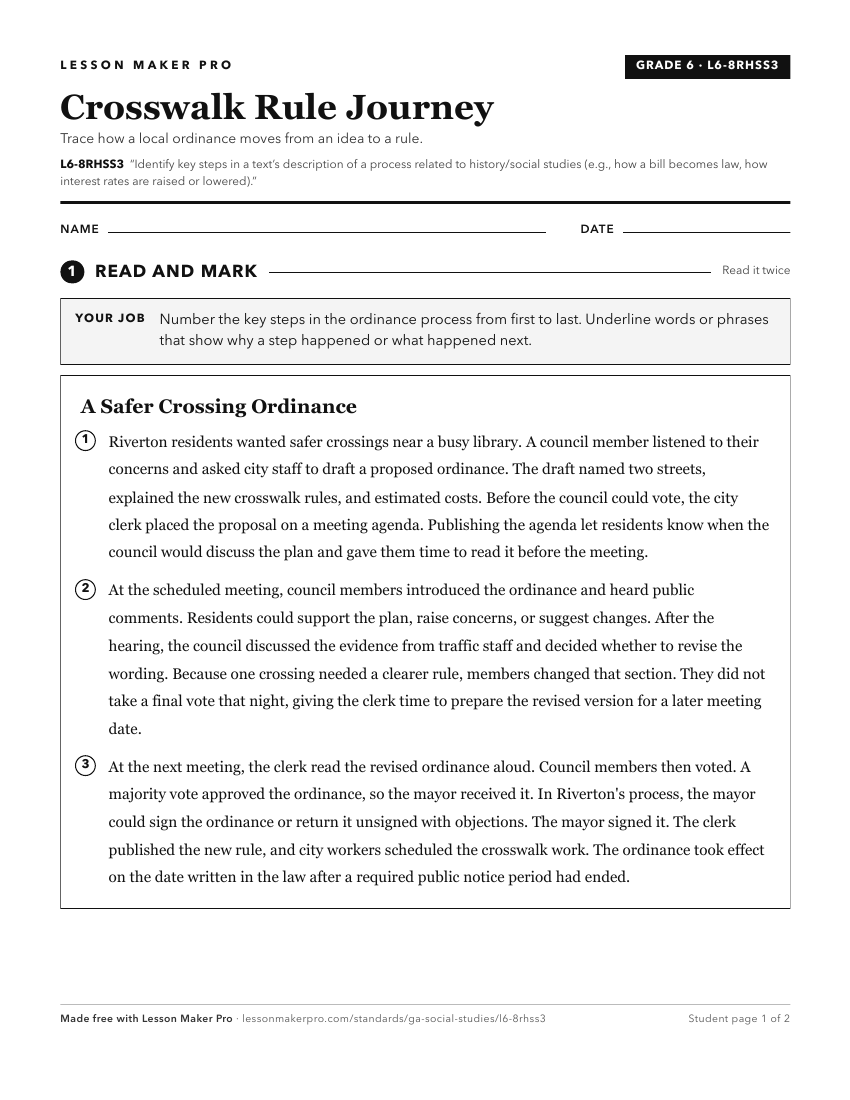
A ready-to-print activity worksheet aligned to L6-8RHSS3, with an answer key for the teacher on its own page. No account needed.
PDF, US Letter, prints cleanly in black and white.
Download the worksheetKeep exploring
Related Standards
- L6-8RHSS4
Determine the meaning of words and phrases as they are used in a text, including vocabulary specific to domains related to history/social studies.
- L6-8WHST9
Draw evidence from informational texts to support analysis reflection, and research.
- L6-8RHSS5
Describe how a text presents information (e.g., sequentially, comparatively, causally).
- L6-8WHST2
Write informative/explanatory texts, including the narration of historical events, scientific procedures/experiments, or technical processes.
Turn this exact standard into a lesson
Grade, subject, topic, and the complete standard are prefilled. Create one free, no account needed.
Also for this standard:Make a WorksheetMake a QuizMake a Sub Lesson