Georgia S5P2.a
The Standard
- S5P2
- Obtain, evaluate, and communicate information to investigate electricity.
Obtain and combine information from multiple sources to explain the difference between naturally occurring electricity (static) and human-harnessed electricity.
Georgia Standards of Excellence for Science · Obtain, evaluate, and communicate information to investigate electricity.
Teacher's field guide
What This Standard Means
What Students Need to Do
- Students gather facts from at least two sources about static electricity and electricity people capture and use. They combine the evidence to compare how each builds, moves, and is used.
What Mastery Looks Like
- A student can explain that static charge builds up on an object and may discharge suddenly, while usable electric current flows through a closed circuit. The student cites details from more than one source and gives examples such as lightning, a rubbed balloon, batteries, or outlets.
Common Misconceptions
- Students may think static electricity is not real electricity, or that all electricity comes from outlets. They may confuse a brief static discharge with continuous current, or assume lightning can safely power ordinary devices.
How to Assess It
- Give students two short source cards, one about lightning and one about a battery circuit. Ask, "Using one fact from each source, explain one difference between static electricity and electric current."
Lesson moves
Ways to Teach It
Rub a balloon on wool, test its effect on paper bits, then compare the brief charge with a battery-powered bulb circuit.
Write a claim answering, "Why can a battery keep a bulb lit while a static spark lasts only a moment?"
Sort picture cards into static charge or harnessed current, then defend each choice using clues about buildup, discharge, circuits, and power sources.
Trace electricity from a power plant to a classroom outlet, then contrast that steady flow with lightning during a storm.
Free download
Printable S5P2.a Worksheet
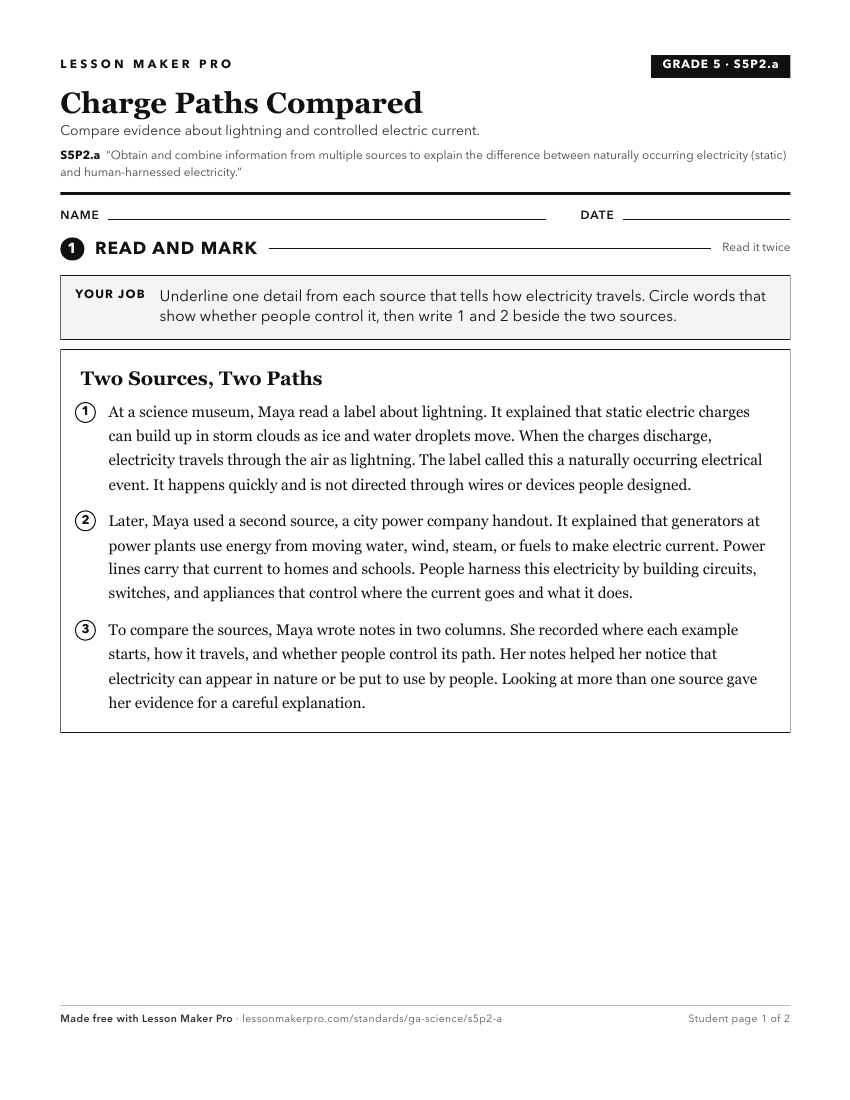
A ready-to-print activity worksheet aligned to S5P2.a, with an answer key for the teacher on its own page. No account needed.
PDF, US Letter, prints cleanly in black and white.
Download the worksheetKeep exploring
Related Standards
- S8P4.a
Ask questions to develop explanations about the similarities and differences between electromagnetic and mechanical waves.
- S8P5
Obtain, evaluate, and communicate information about gravity, electricity, and magnetism as major forces acting in nature.
- S5P2
Obtain, evaluate, and communicate information to investigate electricity.
- S5P3
Obtain, evaluate, and communicate information about magnetism and its relationship to electricity.
Turn this exact standard into a lesson
Grade, subject, topic, and the complete standard are prefilled. Create one free, no account needed.
Also for this standard:Make a WorksheetMake a QuizMake a Sub Lesson