Georgia S2P1.b
The Standard
- S2P1
- Obtain, evaluate, and communicate information about the properties of matter and changes that occur in objects.
Construct an explanation for how structures made from small pieces (linking cubes, building blocks) can be disassembled and then rearranged to make new and different structures.
Georgia Standards of Excellence for Science · Obtain, evaluate, and communicate information about the properties of matter and changes that occur in objects.
Teacher's field guide
What This Standard Means
What Students Need to Do
- Students take apart an object built from small pieces and use those same pieces to build something different. They explain how rearranging the pieces changed the structure without changing the pieces themselves.
What Mastery Looks Like
- A student can build two different structures using the same set of blocks or cubes. The student uses drawings, labels, or words to explain what was moved and how the result changed.
Common Misconceptions
- Students may think taking a structure apart destroys its pieces or changes the amount of material. They may also add or remove pieces instead of rearranging the same set.
How to Assess It
- Give each student eight linking cubes and ask them to build two different structures. Have them draw both and explain how they know the same pieces were used.
Lesson moves
Ways to Teach It
Give pairs ten linking cubes to build a tower, take it apart, and use every cube to make a bridge.
Ask students to draw two objects made from the same six blocks and write how the block arrangement changed.
Play Build, Break, Rebuild by calling out shapes students must create with the same set of cubes each round.
Show pictures of brick walls and brick paths, then discuss how the same kind of pieces can form different structures.
Free download
Printable S2P1.b Worksheet
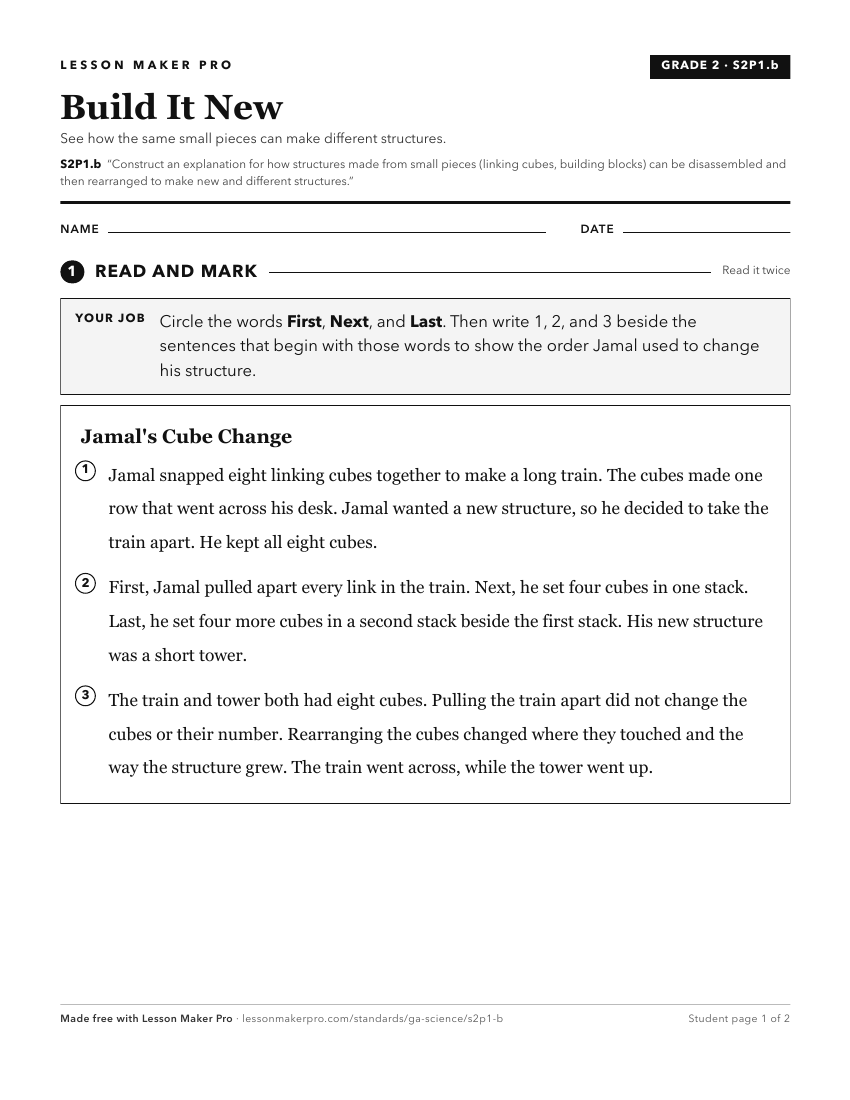
A ready-to-print activity worksheet aligned to S2P1.b, with an answer key for the teacher on its own page. No account needed.
PDF, US Letter, prints cleanly in black and white.
Download the worksheetKeep exploring
Related Standards
- S1P1.d
Construct an explanation supported by evidence that vibrating materials can make sound and that sound can make materials vibrate.
- SKL1.a
Construct an explanation based on observations to recognize the differences between organisms and non-living objects.
- S1P2.a
Construct an explanation of how magnets are used in everyday life.
- S7L4.a
Construct an explanation for the patterns of interactions observed in different ecosystems in terms of the relationships among and between organisms and abiotic...
Turn this exact standard into a lesson
Grade, subject, topic, and the complete standard are prefilled. Create one free, no account needed.
Also for this standard:Make a WorksheetMake a QuizMake a Sub Lesson