Georgia 8.NR.2
Georgia Standard (Expectation Cluster)
Solve problems involving radicals and integer exponents including relevant application situations; apply place value understanding with scientific notation and use scientific notation to explain real phenomena.
Georgia's K-12 Mathematics Standards
Cluster contents
Expectations in This Standard
8.NR.2 is a Georgia mathematics standard. These are the expectations under it.
- 8.NR.2.1
Apply the properties of integer exponents to generate equivalent numerical expressions.
- 8.NR.2.2
Use square root and cube root symbols to represent solutions to equations. Recognize that x² = p (where p is a positive rational number and |x| ≤ 25) has two so...
- 8.NR.2.3
Use numbers expressed in scientific notation to estimate very large or very small quantities, and to express how many times as much one is than the other.
- 8.NR.2.4
Add, subtract, multiply and divide numbers expressed in scientific notation, including problems where both decimal and scientific notation are used. Interpret s...
Teacher's field guide
What This Cluster Means
What Students Need to Do
- Students evaluate and compare expressions with square roots, cube roots, and positive or negative integer exponents. They rewrite very large and very small numbers in scientific notation. They use these forms to solve and explain applied problems.
What Mastery Looks Like
- A student applies exponent rules accurately, estimates radicals when needed, and keeps track of signs. They convert between standard and scientific notation and justify whether an answer is reasonable in context.
Common Misconceptions
- Students often treat a negative exponent as a negative value, or multiply exponents when multiplying like bases. They may move the decimal in the wrong direction or use an invalid coefficient in scientific notation. Some assume every radical equals an integer.
How to Assess It
- Use this exit ticket: evaluate 2⁻³, estimate √50 to the nearest tenth, and write 0.000072 in scientific notation. Ask students to explain one decimal-point move.
Lesson moves
Ways to Teach It
Give pairs number cards to match expressions such as 2⁻³, √49, and 6.2 × 10⁵ with equivalent values.
Ask students to write which is larger, √70 or 8.3, then defend their estimate without using a calculator.
Run a relay where teams convert cards between standard notation and scientific notation, checking coefficient size before passing.
Use planet distances or cell sizes to calculate and explain how many times larger one measurement is than another.
Free download
Printable 8.NR.2 Worksheet
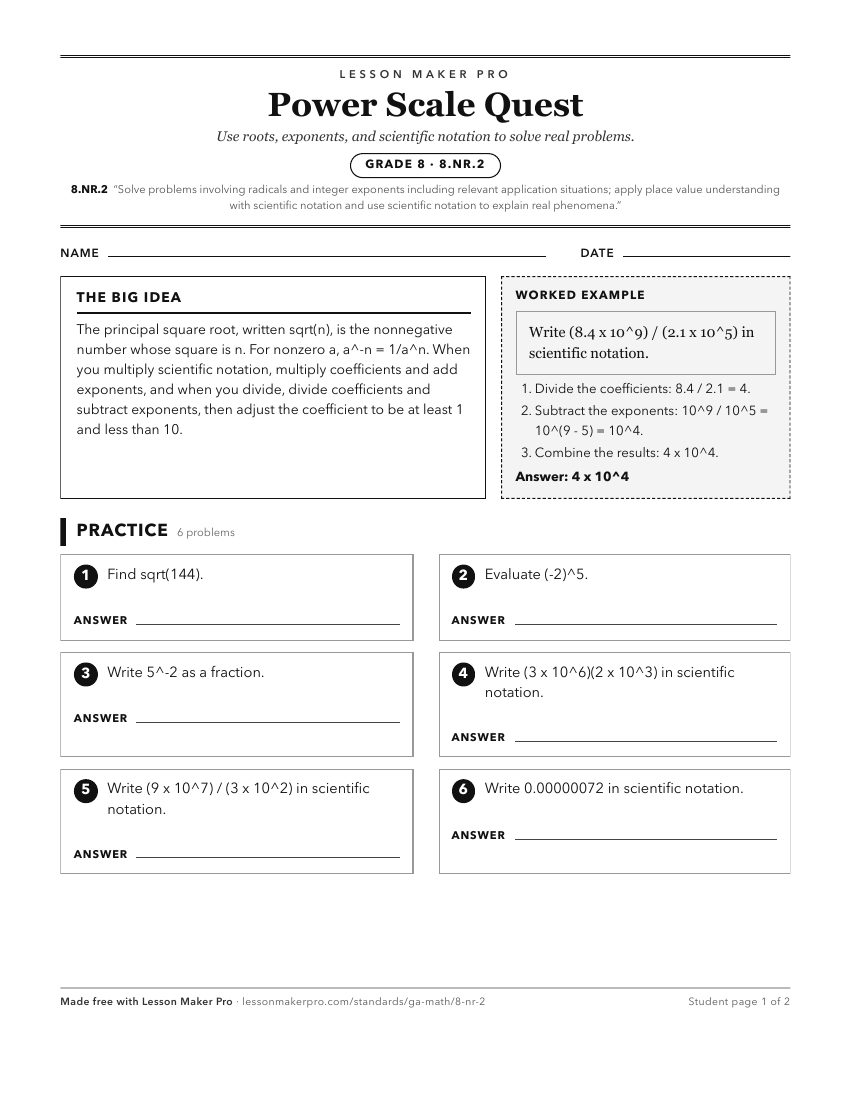
A ready-to-print activity worksheet aligned to 8.NR.2, with an answer key for the teacher on its own page. No account needed.
PDF, US Letter, prints cleanly in black and white.
Download the worksheetKeep exploring
Related Standards
- 6.NR.1
Solve relevant, mathematical problems involving operations with whole numbers, fractions, and decimal numbers.
- 7.NR.1
Solve relevant, mathematical problems, including multi-step problems, involving the four operations with rational numbers and quantities in any form (integers, ...
- 8.NR.1
Solve problems involving irrational numbers and rational approximations of irrational numbers to explain realistic applications.
- 6.PAR.6.1
Write and evaluate numerical expressions involving rational bases and whole-number exponents.
Turn this cluster into a lesson
Grade, subject, topic, and the complete cluster are prefilled. Create one free, no account needed.
Also for this cluster:Make a WorksheetMake a QuizMake a Sub Lesson