Georgia 8.NR.2.2
The Standard
Use square root and cube root symbols to represent solutions to equations. Recognize that x² = p (where p is a positive rational number and |x| ≤ 25) has two solutions and x³ = p (where p is a negative or positive rational number and |x| ≤ 10) has one solution. Evaluate square roots of perfect squares ≤ 625 and cube roots of perfect cubes ≥ -1000 and ≤ 1000.
Georgia's K-12 Mathematics Standards · Solve problems involving radicals and integer exponents including relevant application situations; apply place value understanding with scientific notation and use scientific notation to explain real phenomena.
Teacher's field guide
What This Standard Means
What Students Need to Do
- Students use square root and cube root symbols to write exact solutions to equations. They identify both solutions of x² = p and the single solution of x³ = p. They evaluate roots of perfect squares and perfect cubes within the given ranges.
What Mastery Looks Like
- A student writes x = ±√p for a square equation and x = ∛p for a cube equation. They evaluate roots such as √625 = 25 and ∛-1000 = -10. They correctly state that square equations have two solutions while cube equations have one.
Common Misconceptions
- Students often write only the positive solution to x² = p because the square root symbol gives the principal root. They may think a negative number has no cube root or give both positive and negative cube roots. Some confuse √p with p ÷ 2 or ∛p with p ÷ 3.
How to Assess It
- Give this exit ticket: Solve x² = 10, evaluate √196, solve x³ = -343, and explain why the first equation has two solutions.
Lesson moves
Ways to Teach It
Build square arrays and cube models with tiles and linking cubes, then record each side length using square root or cube root notation.
Write why x² = 81 has two solutions but x³ = 27 has one, then compare explanations with a partner.
Play root match with cards showing equations, radical forms, and values, including negative cubes and nonperfect square equations.
Use a square 144-square-foot patio and a cubic 216-cubic-foot crate to find missing side lengths and label units.
Free download
Printable 8.NR.2.2 Worksheet
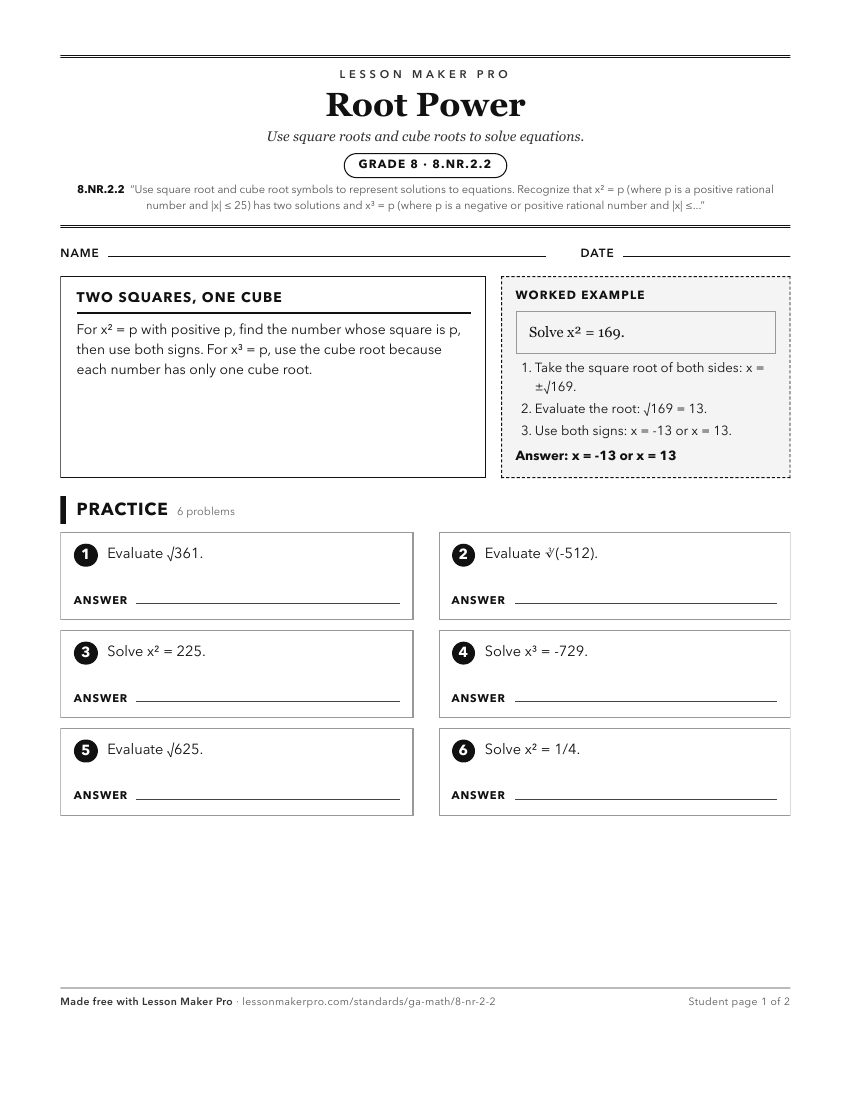
A ready-to-print activity worksheet aligned to 8.NR.2.2, with an answer key for the teacher on its own page. No account needed.
PDF, US Letter, prints cleanly in black and white.
Download the worksheetKeep exploring
Related Standards
- 8.NR.2
Solve problems involving radicals and integer exponents including relevant application situations; apply place value understanding with scientific notation and ...
- 7.PAR.3.1
Construct algebraic equations to solve practical problems leading to equations of the form px + q = r and p(x + q) = r, where p, q, and r are specific rational ...
- 7.PAR.3.2
Construct algebraic inequalities to solve problems, leading to inequalities of the form px ± q > r, px ± q < r, px ± q ≤ r, or px ± q ≥ r, where p, q, and r are...
- 6.PAR.7.3
Solve problems by writing and solving equations of the form x + p = q, px = q and x/p = q for cases in which p, q and x are all nonnegative rational numbers.
Turn this exact standard into a lesson
Grade, subject, topic, and the complete standard are prefilled. Create one free, no account needed.
Also for this standard:Make a WorksheetMake a QuizMake a Sub Lesson