Georgia 7.GSR.5
Georgia Standard (Expectation Cluster)
Solve practical problems involving angle measurement, circles, area of circles, surface area of prisms and cylinders, and volume of cylinders and prisms composed of cubes and right prisms.
Georgia's K-12 Mathematics Standards
Cluster contents
Expectations in This Standard
7.GSR.5 is a Georgia mathematics standard. These are the expectations under it.
- 7.GSR.5.1
Measure angles in whole nonstandard units.
- 7.GSR.5.2
Measure angles in whole number degrees using a protractor.
- 7.GSR.5.3
Use facts about supplementary, complementary, vertical, and adjacent angles in a multi-step problem to write and solve equations for an unknown angle in a figur...
- 7.GSR.5.4
Explore and describe the relationship between pi, radius, diameter, circumference, and area of a circle to derive the formulas for the circumference and area of...
- 7.GSR.5.5
Given the formula for the area and circumference of a circle, solve problems that exist in everyday life.
- 7.GSR.5.6
Solve realistic problems involving surface area of right prisms and cylinders.
- 7.GSR.5.7
Describe the two-dimensional figures (cross sections) that result from slicing three-dimensional figures, as in the plane sections of right rectangular prisms, ...
- 7.GSR.5.8
Explore volume as a measurable attribute of cylinders and right prisms. Find the volume of these geometric figures using concrete problems.
Teacher's field guide
What This Cluster Means
What Students Need to Do
- Students identify the needed measurement, choose the correct relationship or formula, and solve problems from diagrams and practical situations. They break composite prisms into simpler solids and label answers with correct units.
What Mastery Looks Like
- Given a diagram or context, students select a formula without being told which one and show substitutions clearly. They find missing angles, use the radius correctly, decompose composite solids, and report reasonable answers with correct units.
Common Misconceptions
- Students often use the diameter as the radius or confuse circumference with area. They may mix square and cubic units, omit faces in surface area, or double-count overlapping parts of composite solids.
How to Assess It
- Give a four-item exit ticket: find the supplement of 127 degrees and the area of a circle with diameter 10 cm. Then find the surface area of a closed cylinder with radius 3 cm and height 8 cm, and the total volume of two attached, nonoverlapping prisms measuring 8 by 4 by 3 cm and 3 by 2 by 2 cm.
Lesson moves
Ways to Teach It
Build L-shaped solids with centimeter cubes, sketch two prism sections, calculate each volume, and compare the sum with the cube count.
Post a solution using diameter as radius, then ask students to identify the error and write a corrected explanation.
Run a card match with context cards, diagrams, formulas, units, and answers for angles, circles, prisms, and cylinders.
Measure a soup can and cereal box, then estimate packaging material and capacity for each, stating assumptions about lids and flaps.
Free download
Printable 7.GSR.5 Worksheet
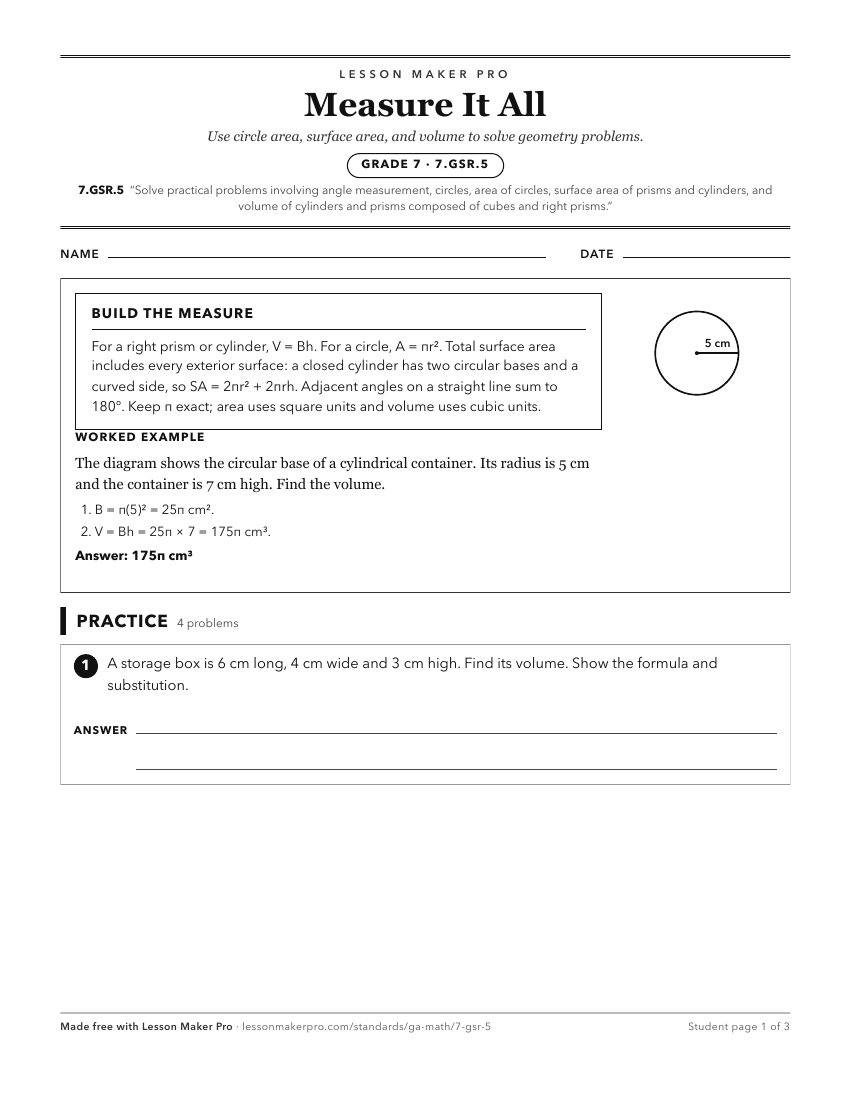
A ready-to-print activity worksheet aligned to 7.GSR.5, with an answer key for the teacher on its own page. No account needed.
PDF, US Letter, prints cleanly in black and white.
Download the worksheetKeep exploring
Related Standards
Turn this cluster into a lesson
Grade, subject, topic, and the complete cluster are prefilled. Create one free, no account needed.
Also for this cluster:Make a WorksheetMake a QuizMake a Sub Lesson