Georgia 7.GSR.5.7
The Standard
Describe the two-dimensional figures (cross sections) that result from slicing three-dimensional figures, as in the plane sections of right rectangular prisms, right rectangular pyramids, cones, cylinders, and spheres.
Georgia's K-12 Mathematics Standards · Solve practical problems involving angle measurement, circles, area of circles, surface area of prisms and cylinders, and volume of cylinders and prisms composed of cubes and right prisms.
Teacher's field guide
What This Standard Means
What Students Need to Do
- Students identify and describe the flat shape exposed when a solid is sliced. They predict how changing the cut's position or angle changes that shape.
What Mastery Looks Like
- Given a solid and a pictured cutting plane, students can name and sketch the resulting flat shape. They explain how the cut intersects the solid's faces or curved surface.
Common Misconceptions
- Students may name a visible face instead of the new surface made by the cut. They may assume every cylinder gives a circle, or mistake a tilted drawing of a circle for an ellipse.
How to Assess It
- Show a cylinder cut once parallel to its bases and once perpendicular to them. Ask students to name, sketch, and justify both resulting shapes.
Lesson moves
Ways to Teach It
Slice clay models of a prism, pyramid, cone, cylinder, and sphere with plastic knives, then trace each exposed cross section.
Ask: How can the same cylinder produce a circle, rectangle, or ellipse, and what cutting direction creates each result?
Run a card sort matching solid-and-slice diagrams to cross-section names and sketches, then have pairs defend one disputed match.
Examine CT scan images or sliced foods, then identify the solid, cutting direction, and resulting two-dimensional shape.
Free download
Printable 7.GSR.5.7 Worksheet
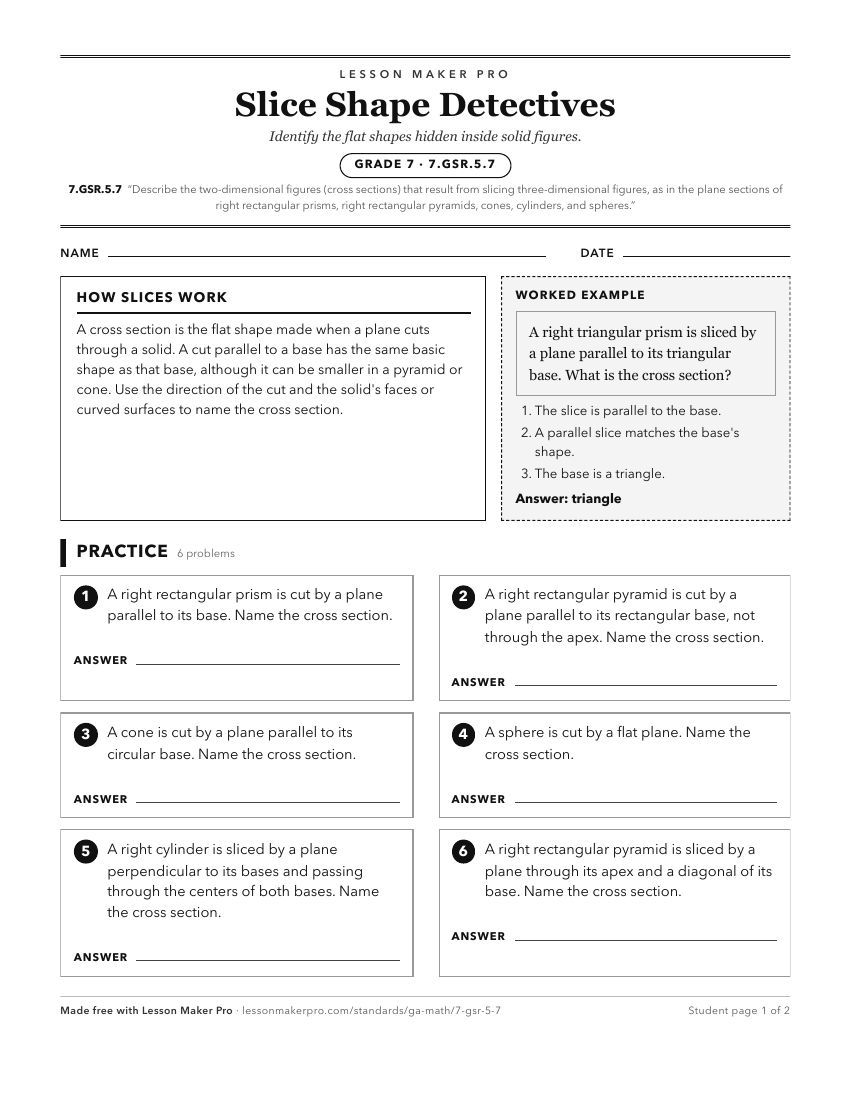
A ready-to-print activity worksheet aligned to 7.GSR.5.7, with an answer key for the teacher on its own page. No account needed.
PDF, US Letter, prints cleanly in black and white.
Download the worksheetKeep exploring
Related Standards
- 1.GSR.4.2
Compose two-dimensional shapes (rectangles, squares, triangles, half-circles, and quarter-circles) and three-dimensional figures (cubes, rectangular prisms, con...
- 6.GSR.5.2
Given the net of three-dimensional figures with rectangular and triangular faces, determine the surface area of these figures.
- 4.GSR.8.1
Explore, investigate, and draw points, lines, line segments, rays, angles (right, acute, obtuse), perpendicular lines, parallel lines, and lines of symmetry. Id...
- 2.GSR.7.1
Describe, compare and sort 2-D shapes including polygons, triangles, quadrilaterals, pentagons, hexagons, and 3-D shapes including rectangular prisms and cones,...
Turn this exact standard into a lesson
Grade, subject, topic, and the complete standard are prefilled. Create one free, no account needed.
Also for this standard:Make a WorksheetMake a QuizMake a Sub Lesson