Georgia 3.GSR.7.1
The Standard
Investigate area by covering the space of rectangles presented in realistic situations using multiple copies of the same unit, with no gaps or overlaps, and determine the total area (total number of units that covered the space).
Georgia's K-12 Mathematics Standards · Identify area as a measurable attribute of rectangles and determine the area of a rectangle presented in real-life, mathematical problems.
Teacher's field guide
What This Standard Means
What Students Need to Do
- Students cover a rectangle with equal-sized units so the units fill the space without gaps or overlaps. They count the units to find and name the rectangle's area.
What Mastery Looks Like
- Students cover a rectangle completely with equal-sized square units, without gaps or overlaps. They count the units and state the area in square units.
Common Misconceptions
- Students may count only the tiles around the edge, confusing area with perimeter. They may leave gaps, overlap tiles, or mix unit sizes and still count each tile as one square unit.
How to Assess It
- Give students a 4-by-6 rectangle and paper square tiles. Ask them to cover it without gaps or overlaps, then write its area with correct units.
Lesson moves
Ways to Teach It
Give pairs square tiles and cardboard rectangles, then have them cover each rectangle and record the number of square units.
Show two tiled rectangles and ask students to explain which has greater area and how the tiles prove it.
Play Area Match by having students pair tiled rectangle cards with cards showing the correct number of square units.
Measure a desk mat by covering it with equal paper squares, then discuss how many squares are needed to make another mat.
Free download
Printable 3.GSR.7.1 Worksheet
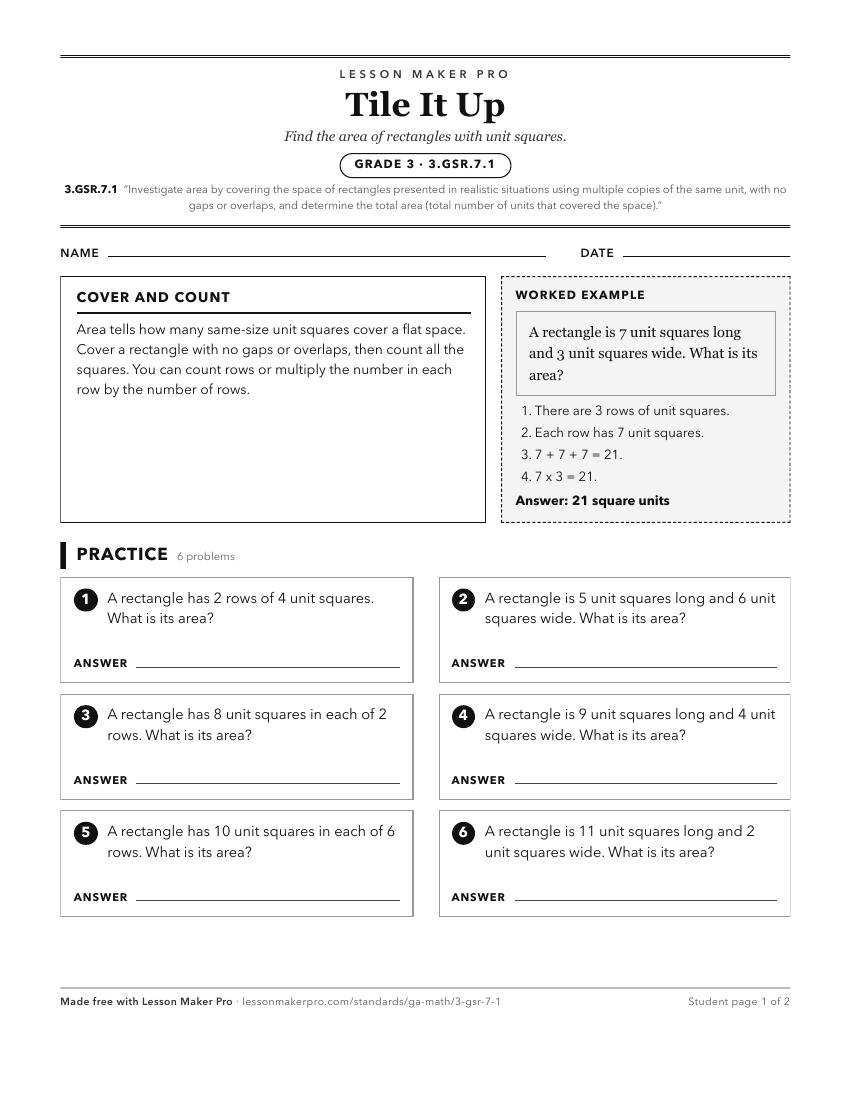
A ready-to-print activity worksheet aligned to 3.GSR.7.1, with an answer key for the teacher on its own page. No account needed.
PDF, US Letter, prints cleanly in black and white.
Download the worksheetKeep exploring
Related Standards
- 5.GSR.8.3
Investigate volume of right rectangular prisms by packing them with unit cubes without gaps or overlaps. Then, determine the total volume to solve problems.
- 3.GSR.7.2
Determine the area of rectangles (or shapes composed of rectangles) presented in relevant problems by tiling and counting.
- 3.GSR.7
Identify area as a measurable attribute of rectangles and determine the area of a rectangle presented in real-life, mathematical problems.
- 3.GSR.8.2
Investigate and describe how rectangles with the same perimeter can have different areas or how rectangles with the same area can have different perimeters.
Turn this exact standard into a lesson
Grade, subject, topic, and the complete standard are prefilled. Create one free, no account needed.
Also for this standard:Make a WorksheetMake a QuizMake a Sub Lesson