Georgia 3.GSR.8.2
The Standard
Investigate and describe how rectangles with the same perimeter can have different areas or how rectangles with the same area can have different perimeters.
Georgia's K-12 Mathematics Standards · Determine the perimeter of a polygon presented in real-life, mathematical problems.
Teacher's field guide
What This Standard Means
What Students Need to Do
- Students build or draw rectangles and calculate each area and perimeter. They compare the results to find rectangles that share one measurement but not the other.
What Mastery Looks Like
- Students calculate area and perimeter accurately from labeled sides or grid models. They create and compare rectangles, then explain why matching one measurement does not guarantee matching the other.
Common Misconceptions
- Students often mix up perimeter and area, or use the same formula for both. They may assume equal perimeters always produce equal areas, or equal areas always produce equal perimeters.
How to Assess It
- Give students a 24-square-unit rectangle and ask them to draw another rectangle with the same area but a different perimeter. Have them label side lengths and show both calculations.
Lesson moves
Ways to Teach It
Give pairs 24 square tiles to build different rectangles, then record each rectangle's side lengths, area, and perimeter.
Ask students to explain in writing why 1 by 12 and 3 by 4 rectangles have equal areas but different perimeters.
Play Rectangle Match, where students pair rectangle cards that share an area or perimeter and justify each match.
Plan two rectangular dog pens using 20 meters of fencing, then compare how much ground each design covers.
Free download
Printable 3.GSR.8.2 Worksheet
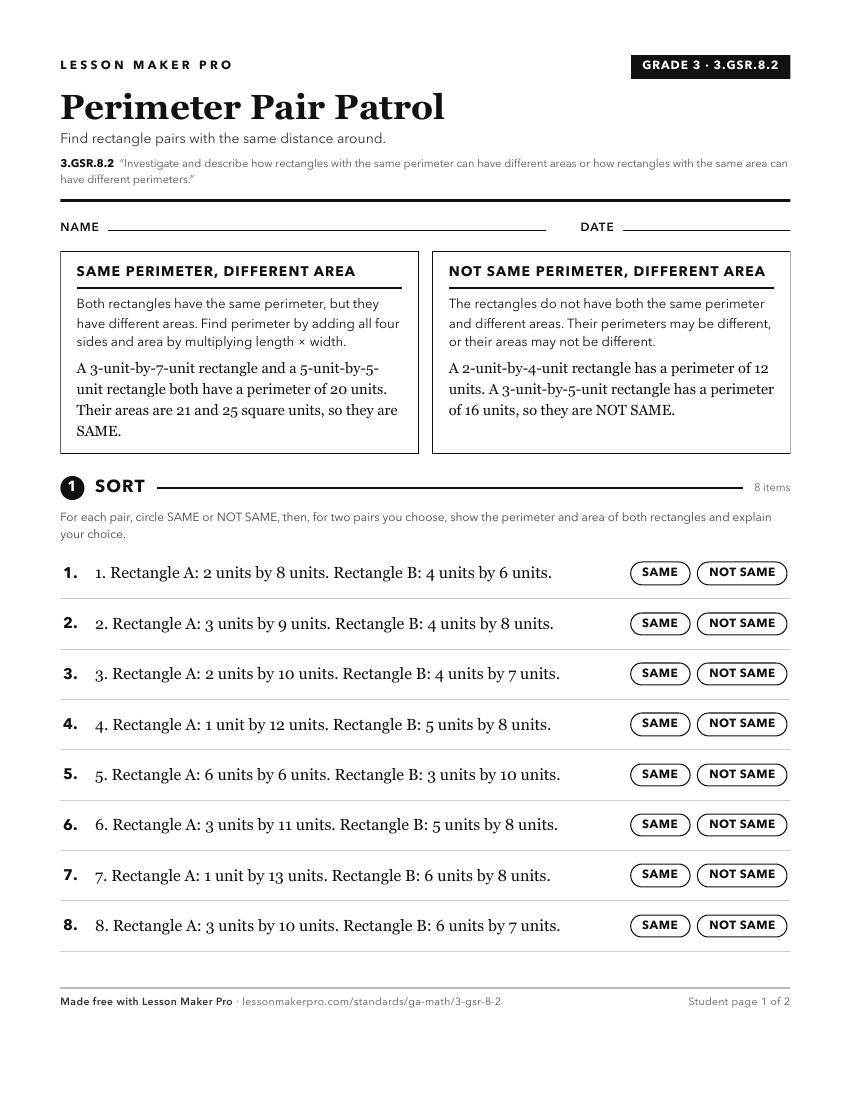
A ready-to-print activity worksheet aligned to 3.GSR.8.2, with an answer key for the teacher on its own page. No account needed.
PDF, US Letter, prints cleanly in black and white.
Download the worksheetKeep exploring
Related Standards
- 3.GSR.7.1
Investigate area by covering the space of rectangles presented in realistic situations using multiple copies of the same unit, with no gaps or overlaps, and det...
- 3.GSR.7
Identify area as a measurable attribute of rectangles and determine the area of a rectangle presented in real-life, mathematical problems.
- 4.GSR.8.3
Solve problems involving area and perimeter of composite rectangles involving whole numbers with known side lengths.
- 3.GSR.7.3
Discover and explain how area can be found by multiplying the dimensions of a rectangle.
Turn this exact standard into a lesson
Grade, subject, topic, and the complete standard are prefilled. Create one free, no account needed.
Also for this standard:Make a WorksheetMake a QuizMake a Sub Lesson