Georgia 2.NR.3.1
The Standard
Determine whether a group (up to 20) has an odd or even number of objects. Write an equation to express an even number as a sum of two equal addends.
Georgia's K-12 Mathematics Standards · Work with equal groups to gain foundations for multiplication through real-life, mathematical problems.
Teacher's field guide
What This Standard Means
What Students Need to Do
- Students arrange or count up to 20 objects to decide whether the amount can be split into pairs with none left over. For an even amount, they write an equation such as 12 = 6 + 6.
What Mastery Looks Like
- A student pairs objects with none left over for an even set and one left over for an odd set. For 16 objects, they write 16 = 8 + 8.
Common Misconceptions
- Students may decide odd or even from the last spoken number without understanding pairs. They may confuse two addends with two equal addends, writing 14 = 10 + 4.
How to Assess It
- Show 15 dots and 18 dots. Ask students to label each odd or even, circle pairs, and write an equal-addend equation for the even set.
Lesson moves
Ways to Teach It
Give students 1 to 20 counters, call out a number, and have them make pairs to test whether one counter remains.
Ask, “How does making pairs prove that 13 is odd?” Students draw and explain their reasoning in two sentences.
Play Odd or Even Sort with number cards 1 to 20, requiring a paired-counter model before placing each card.
Set out pretend socks from a laundry basket and ask students which totals can make complete pairs and which leave one sock unmatched.
Free download
Printable 2.NR.3.1 Worksheet
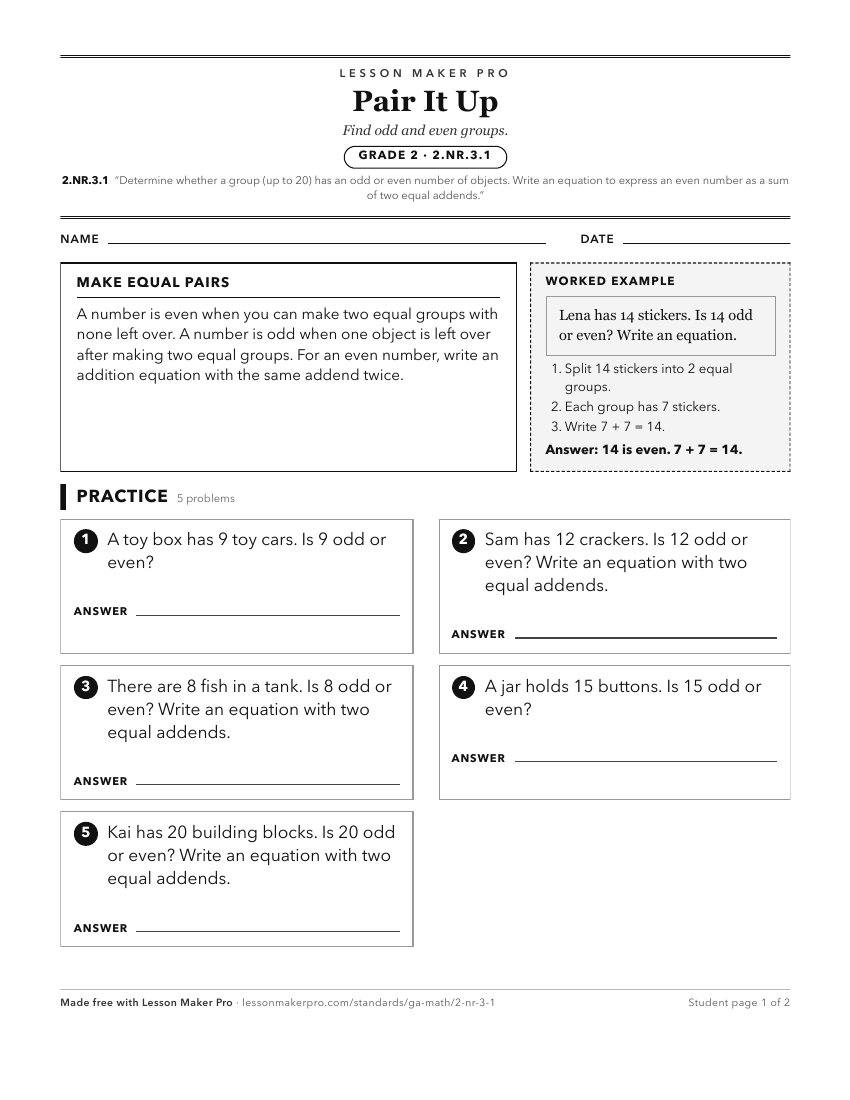
A ready-to-print activity worksheet aligned to 2.NR.3.1, with an answer key for the teacher on its own page. No account needed.
PDF, US Letter, prints cleanly in black and white.
Download the worksheetKeep exploring
Related Standards
- 2.PAR.4.2
Identify, describe, and create growing patterns and shrinking patterns involving addition and subtraction up to 20.
- 2.NR.3.2
Use addition to find the total number of objects arranged in rectangular arrays with up to 5 rows and up to 5 columns; write an equation to express the total as...
- 2.PAR.4.1
Identify, describe, and create a numerical pattern resulting from repeating an operation such as addition and subtraction.
- K.NR.4.2
Compare two sets of up to 10 objects and identify whether the number of objects in one group is more or less than the other group, using the words “greater than...
Turn this exact standard into a lesson
Grade, subject, topic, and the complete standard are prefilled. Create one free, no account needed.
Also for this standard:Make a WorksheetMake a QuizMake a Sub Lesson