Georgia K.NR.4.2
The Standard
Compare two sets of up to 10 objects and identify whether the number of objects in one group is more or less than the other group, using the words “greater than,” “less than,” or “the same as”.
Georgia's K-12 Mathematics Standards · Identify, write, represent, and compare numbers up to 20.
Teacher's field guide
What This Standard Means
What Students Need to Do
- Students count or match objects in two groups to decide how the amounts relate. They describe the comparison using greater than, less than, or the same as.
What Mastery Looks Like
- A student accurately counts or matches objects in each group. The student names the relationship correctly, even when objects differ in size, spacing, or arrangement.
Common Misconceptions
- Students may think larger or more spread-out objects mean a larger amount. They may also reverse the comparison words or count an object twice.
How to Assess It
- Show 7 dots beside 5 dots. Ask, “Which group has greater than, less than, or the same number of dots? Explain how you know.”
Lesson moves
Ways to Teach It
Give partners two ten-frames and counters, then call out two numbers for them to build and compare aloud.
Display two groups of dots and ask, “Which group has more, and how could matching prove it?”
Play Compare War with number cards 0 to 10, requiring players to build each amount and state the comparison before collecting cards.
Set out two classroom supply bins, then have students compare the numbers of pencils, glue sticks, or crayons using a complete sentence.
Free download
Printable K.NR.4.2 Worksheet
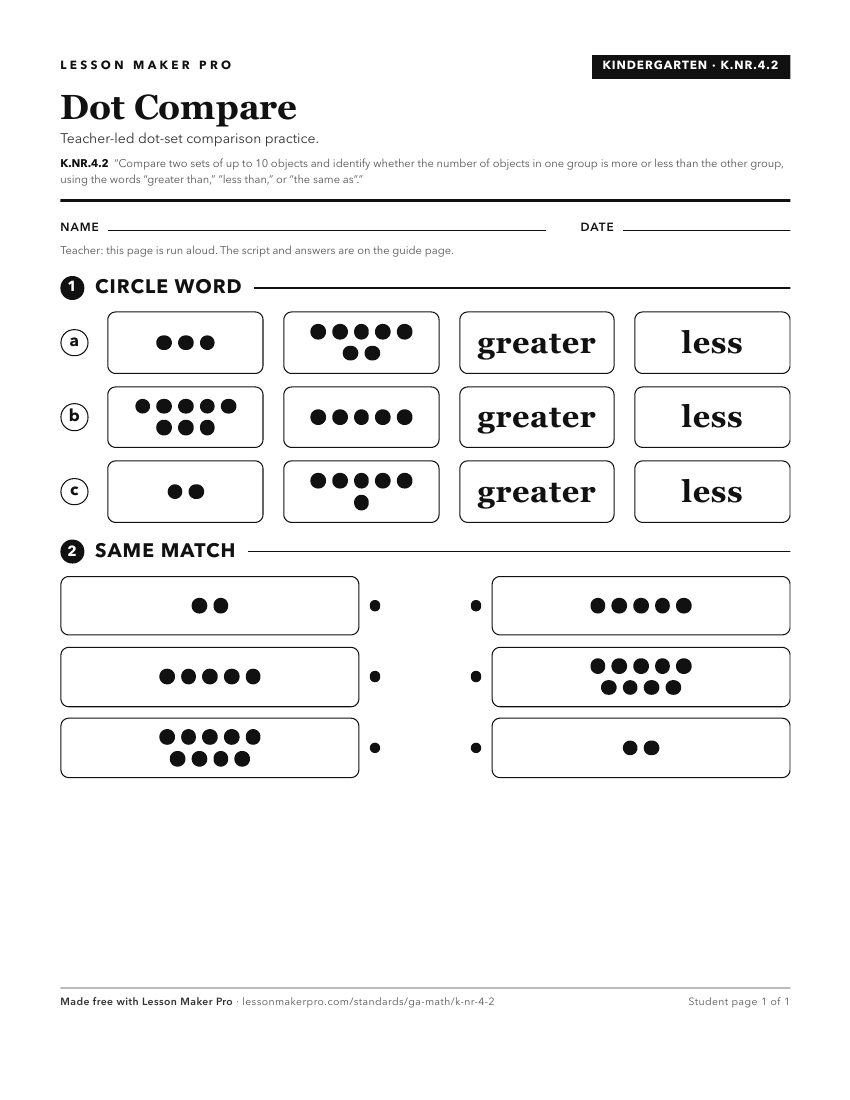
A ready-to-print activity worksheet aligned to K.NR.4.2, with an answer key for the teacher on its own page. No account needed.
PDF, US Letter, prints cleanly in black and white.
Download the worksheetKeep exploring
Related Standards
- K.MDR.7.2
Classify and sort up to ten objects into categories by an attribute; count the number of objects in each category and sort the categories by count.
- K.NR.1.1
Count up to 20 objects in a variety of structured arrangements and up to 10 objects in a scattered arrangement.
- 2.NR.3.1
Determine whether a group (up to 20) has an odd or even number of objects. Write an equation to express an even number as a sum of two equal addends.
- K.MDR.7.1
Directly compare, describe, and order common objects, using measurable attributes (length, height, width, or weight) and describe the difference.
Turn this exact standard into a lesson
Grade, subject, topic, and the complete standard are prefilled. Create one free, no account needed.
Also for this standard:Make a WorksheetMake a QuizMake a Sub Lesson