Georgia 2.NR.3.2
The Standard
Use addition to find the total number of objects arranged in rectangular arrays with up to 5 rows and up to 5 columns; write an equation to express the total as a sum of equal addends.
Georgia's K-12 Mathematics Standards · Work with equal groups to gain foundations for multiplication through real-life, mathematical problems.
Teacher's field guide
What This Standard Means
What Students Need to Do
- Students organize or read objects in rows and columns, then find the total using repeated addition. They write an equation with one equal addend for each row or column.
What Mastery Looks Like
- A student can find the total in any array no larger than 5 by 5 without counting objects one by one. The student writes a matching equation, such as 4 + 4 + 4 = 12 for three rows of four.
Common Misconceptions
- Students may count rows and columns but forget to count every object. They may mix unequal addends, reverse the number of rows and columns, or write only the total without an equation.
How to Assess It
- Show four rows with three dots in each row. Ask, “How many dots are there, and what addition equation matches the rows?”
Lesson moves
Ways to Teach It
Give pairs 25 counters and grid paper, then have them build, draw, and label three different arrays with matching addition equations.
Show 3 rows of 5 dots and ask, “How does 5 + 5 + 5 describe this picture?”
Students roll two number cubes labeled 1 through 5, draw the matching array, and earn a point for a correct addition equation.
Have students find arrays in classroom objects, such as window panes or chair rows, then sketch one and write its addition equation.
Free download
Printable 2.NR.3.2 Worksheet
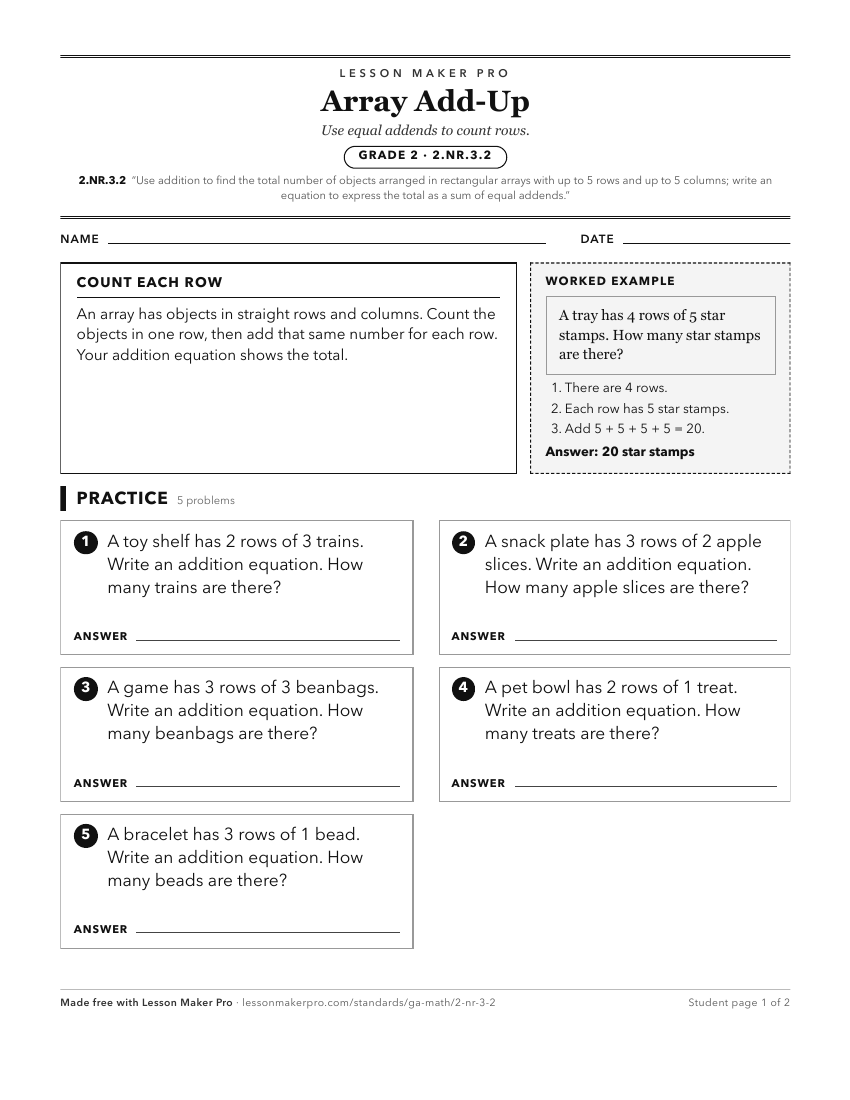
A ready-to-print activity worksheet aligned to 2.NR.3.2, with an answer key for the teacher on its own page. No account needed.
PDF, US Letter, prints cleanly in black and white.
Download the worksheetKeep exploring
Related Standards
- K.NR.1.1
Count up to 20 objects in a variety of structured arrangements and up to 10 objects in a scattered arrangement.
- 2.PAR.4.2
Identify, describe, and create growing patterns and shrinking patterns involving addition and subtraction up to 20.
- 2.NR.3.1
Determine whether a group (up to 20) has an odd or even number of objects. Write an equation to express an even number as a sum of two equal addends.
- 2.PAR.4.1
Identify, describe, and create a numerical pattern resulting from repeating an operation such as addition and subtraction.
Turn this exact standard into a lesson
Grade, subject, topic, and the complete standard are prefilled. Create one free, no account needed.
Also for this standard:Make a WorksheetMake a QuizMake a Sub Lesson