Georgia 1.MDR.6
Georgia Standard (Expectation Cluster)
Use appropriate tools to measure, order, and compare intervals of length and time, as well as denominations of money to solve real-life, mathematical problems and analyze graphical displays of data to answer relevant questions.
Georgia's K-12 Mathematics Standards
Cluster contents
Expectations in This Standard
1.MDR.6 is a Georgia mathematics standard. These are the expectations under it.
- 1.MDR.6.1
Estimate, measure, and record lengths of objects using non-standard units, and compare and order up to three objects using the recorded measurements. Describe t...
- 1.MDR.6.2
Tell and write time in hours and half-hours using analog and digital clocks, and measure elapsed time to the hour on the hour using a predetermined number line.
- 1.MDR.6.3
Identify the value of quarters and compare the values of pennies, nickels, dimes, and quarters.
- 1.MDR.6.4
Ask questions and answer them based on gathered information, observations, and appropriate graphical displays to compare and order whole numbers.
Teacher's field guide
What This Cluster Means
What Students Need to Do
- Students choose and use tools to solve problems involving length, time, and money. They order and compare measurements, then read picture graphs or bar graphs to answer questions.
What Mastery Looks Like
- Students select a ruler, clock, calendar, or coins for a given problem. They measure accurately, compare results, and explain answers using numbers and units. They also read graph titles, labels, and keys.
Common Misconceptions
- Students may start measuring at 1 instead of 0 or leave gaps between units. They may judge coins by size, confuse clock hands, or ignore a graph key.
How to Assess It
- Give a four-part exit ticket: measure a pictured crayon, compare two times, total three pictured coins, and answer one question from a picture graph.
Lesson moves
Ways to Teach It
Set up stations to measure classroom objects, time short tasks, sort coins by value, and record results on a class graph.
Ask students to write which is greater, 12 centimeters, 12 minutes, or 12 cents, and explain why the units cannot be compared.
Play a matching game where students pair problem cards with rulers, clocks, calendars, coins, or graphs.
Create a pretend store where students measure items, pay with coins, track shopping time, and graph the class purchases.
Free download
Printable 1.MDR.6 Worksheet
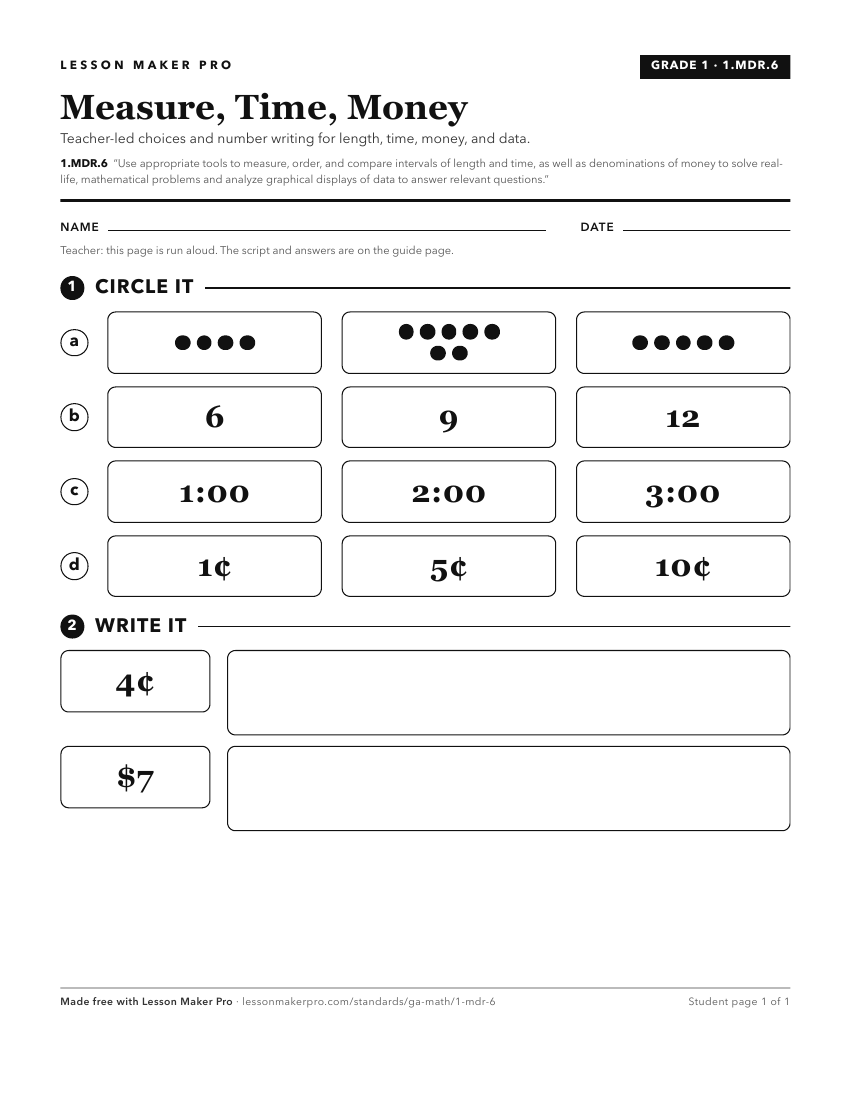
A ready-to-print activity worksheet aligned to 1.MDR.6, with an answer key for the teacher on its own page. No account needed.
PDF, US Letter, prints cleanly in black and white.
Download the worksheetKeep exploring
Related Standards
- 3.MDR.5
Solve real-life, mathematical problems involving length, liquid volume, mass, and time and analyze graphical displays of data to answer relevant questions.
- 4.MDR.6
Measure time and objects that exist in the world to solve real-life, mathematical problems and analyze graphical displays of data to answer relevant questions.
- 2.MDR.5
Estimate and measure the lengths of objects and distance to solve problems found in real-life using standard units of measurement, including inches, feet, and y...
- 5.MDR.7
Solve problems involving customary measurements, metric measurements, and time and analyze graphical displays of data to answer relevant questions.
Turn this cluster into a lesson
Grade, subject, topic, and the complete cluster are prefilled. Create one free, no account needed.
Also for this cluster:Make a WorksheetMake a QuizMake a Sub Lesson