Georgia K.F.P.2.e
The Standard
Identify and distinguish between words that are spelled similarly by identifying the sounds of the letters that differ.
Georgia's K-12 English Language Arts Standards · Foundations (F) · Phonics
Teacher's field guide
What This Standard Means
What Students Need to Do
- Students compare word pairs such as “cat” and “cap” or “map” and “mop.” They read each word, find the changed letter, and say the sound it represents.
What Mastery Looks Like
- Given two similar-looking words, a student reads both accurately and points to the letter that changes. The student says each letter’s sound and tells where the change occurs.
Common Misconceptions
- Students may look only at the first letter, guess from a picture, or treat similar-looking words as the same. They may say letter names instead of sounds or carry one word’s pronunciation into the next word.
How to Assess It
- Show the words “fan” and “fin.” Ask each student to read both words, circle the changed letters, and say the two vowel sounds.
Lesson moves
Ways to Teach It
Use letter tiles to build “cat,” change the final letter to make “cap,” then read both words and say the changed sounds.
Display “pig” and “pug,” then ask partners to explain which letter changed and how that change affected the word.
Play Sound Switch Bingo by calling paired words such as “map” and “mop” while students cover the matching printed word.
Match labels such as “pen” and “pin” to real objects or pictures, then identify the letter and sound that changes.
Free download
Printable K.F.P.2.e Worksheet
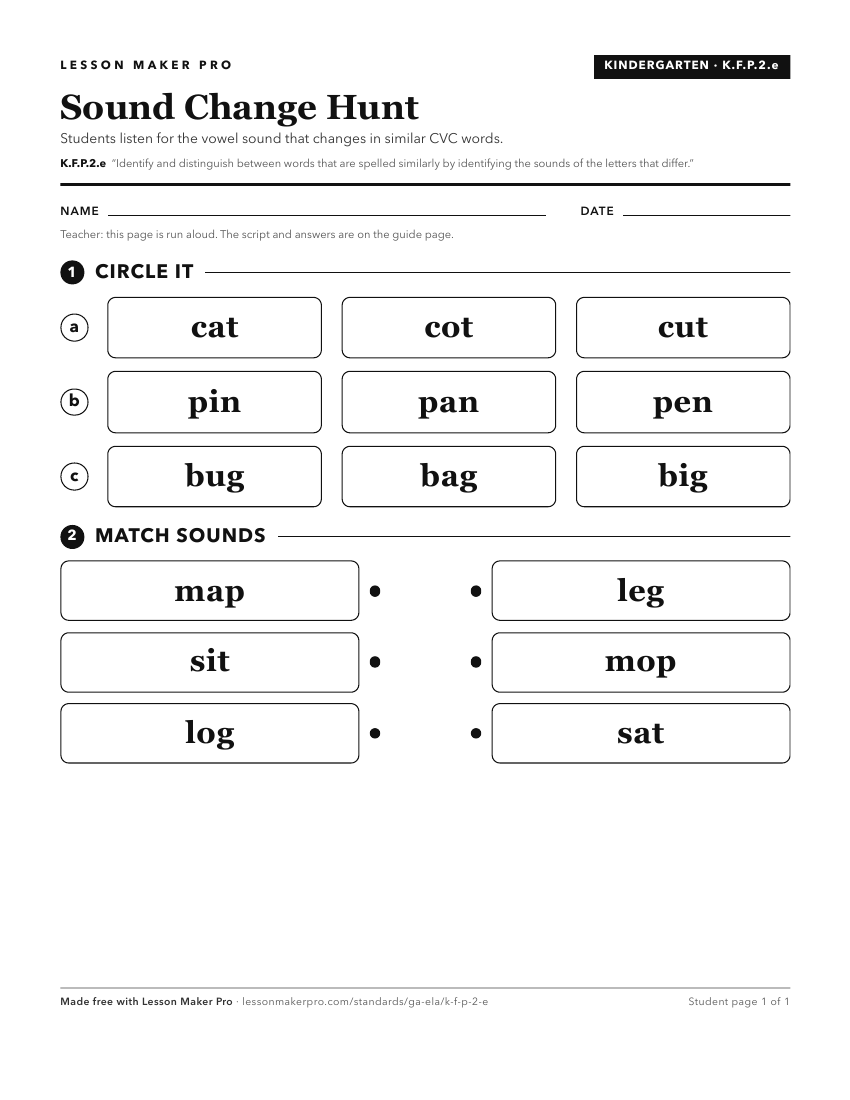
A ready-to-print activity worksheet aligned to K.F.P.2.e, with an answer key for the teacher on its own page. No account needed.
PDF, US Letter, prints cleanly in black and white.
Download the worksheetKeep exploring
Related Standards
- K.F.P.2.b
Identify and decode parts of irregularly spelled high-frequency words.
- 2.F.P.2.b
Identify and decode parts of irregularly spelled words, including high-frequency words.
- 1.F.P.2.b
Identify and decode parts of irregularly spelled words, including high-frequency words.
- K.F.PA.1.a
Identify and pair words that rhyme in spoken language, distinguishing them from those that do not.
Turn this exact standard into a lesson
Grade, subject, topic, and the complete standard are prefilled. Create one free, no account needed.
Also for this standard:Make a WorksheetMake a QuizMake a Sub Lesson