Georgia 8.T.C.2.b
The Standard
Identify an author’s bias and determine how that bias impacts text credibility. (I)
Georgia's K-12 English Language Arts Standards · Texts (T) · Context
Teacher's field guide
What This Standard Means
What Students Need to Do
- Students infer a writer’s viewpoint from word choice, selected facts, missing perspectives, and connections to the topic. They explain whether those choices make particular claims more or less trustworthy.
What Mastery Looks Like
- A student can name the position a writer favors and cite exact words, facts, or omissions that reveal it. The student can explain how those choices strengthen or weaken the trustworthiness of specific claims.
Common Misconceptions
- Students often treat any strong opinion as proof that a source is unreliable. They may dismiss a whole text instead of judging specific claims and evidence. Some confuse disagreeing with the writer with finding evidence of bias.
How to Assess It
- Give students a short editorial with loaded language and an unsupported claim. Ask: What position does the writer favor, what phrase shows it, and how does it affect your trust?
Lesson moves
Ways to Teach It
Give pairs two reports on the same event, then have them highlight loaded words, selected facts, and missing viewpoints in different colors.
Ask students to write: Which claim deserves the most trust, and how does the writer’s viewpoint affect your judgment?
Play Credibility Sort with claim cards, evidence cards, and author background cards, then require teams to defend each placement.
Compare a sponsored social media post with an independent product review, noting who benefits and which claims can be checked.
Free download
Printable 8.T.C.2.b Worksheet
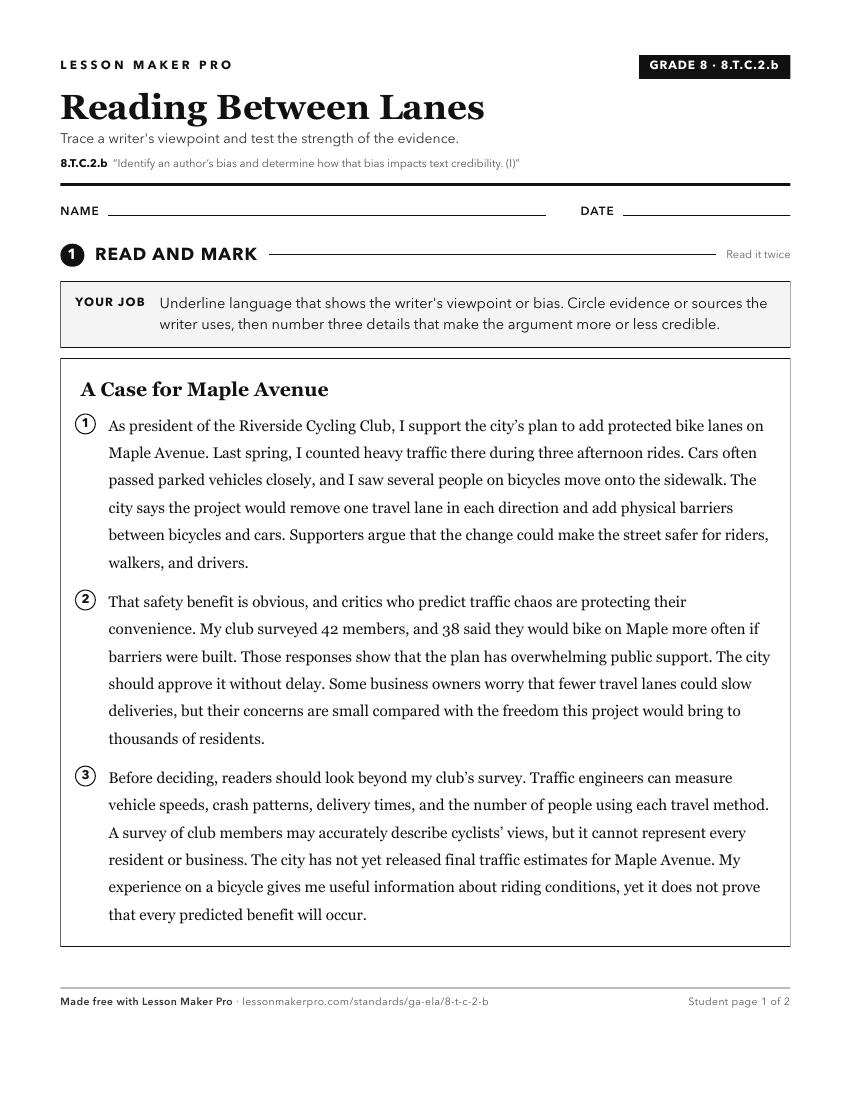
A ready-to-print activity worksheet aligned to 8.T.C.2.b, with an answer key for the teacher on its own page. No account needed.
PDF, US Letter, prints cleanly in black and white.
Download the worksheetKeep exploring
Related Standards
- 4.T.RA.2.b
Determine the credibility and relevance of a source text based on known information about the author and/or organization. (I)
- 5.T.RA.2.b
Determine credibility and relevance by assessing the strengths and weaknesses of source texts to support a topic or message. (I)
- 9.T.C.2.b
Identify the impact of the speaker’s reliability or credibility on the text. (I)
- 7.T.C.2.b
Analyze how evidence and tone reveal the author’s perspective and impact credibility. (I)
Turn this exact standard into a lesson
Grade, subject, topic, and the complete standard are prefilled. Create one free, no account needed.
Also for this standard:Make a WorksheetMake a QuizMake a Sub Lesson