Georgia 9.T.C.2.b
The Standard
Identify the impact of the speaker’s reliability or credibility on the text. (I)
Georgia's K-12 English Language Arts Standards · Texts (T) · Context
Teacher's field guide
What This Standard Means
What Students Need to Do
- Students judge how much a reader should trust a speaker by examining contradictions, bias, expertise, motives, and supporting evidence. They explain how that judgment affects the message’s meaning or persuasive power.
What Mastery Looks Like
- Students cite specific details that reveal the speaker’s knowledge, motives, bias, or contradictions. They explain how those details shape the reader’s trust and understanding of the message.
Common Misconceptions
- Students may treat confidence, likability, or strong emotion as proof that a speaker is trustworthy. They may identify bias or a contradiction but fail to explain how it changes the meaning or persuasiveness of the text.
How to Assess It
- Use this exit prompt: Is the speaker fully trustworthy, partly trustworthy, or unreliable? Cite two details and explain how they affect one claim.
Lesson moves
Ways to Teach It
Give pairs evidence cards from an unreliable narrator passage, then have them sort each clue under trustworthy, questionable, or contradictory.
Ask students to write: Which speaker detail most changes your trust, and how does it alter your reading of the main claim?
Play Credibility Court: teams examine short speeches, present two evidence-based arguments, and vote on how much each speaker should be trusted.
Compare a verified buyer’s product review with a sponsored influencer post, then identify how each source’s motives shape audience trust.
Free download
Printable 9.T.C.2.b Worksheet
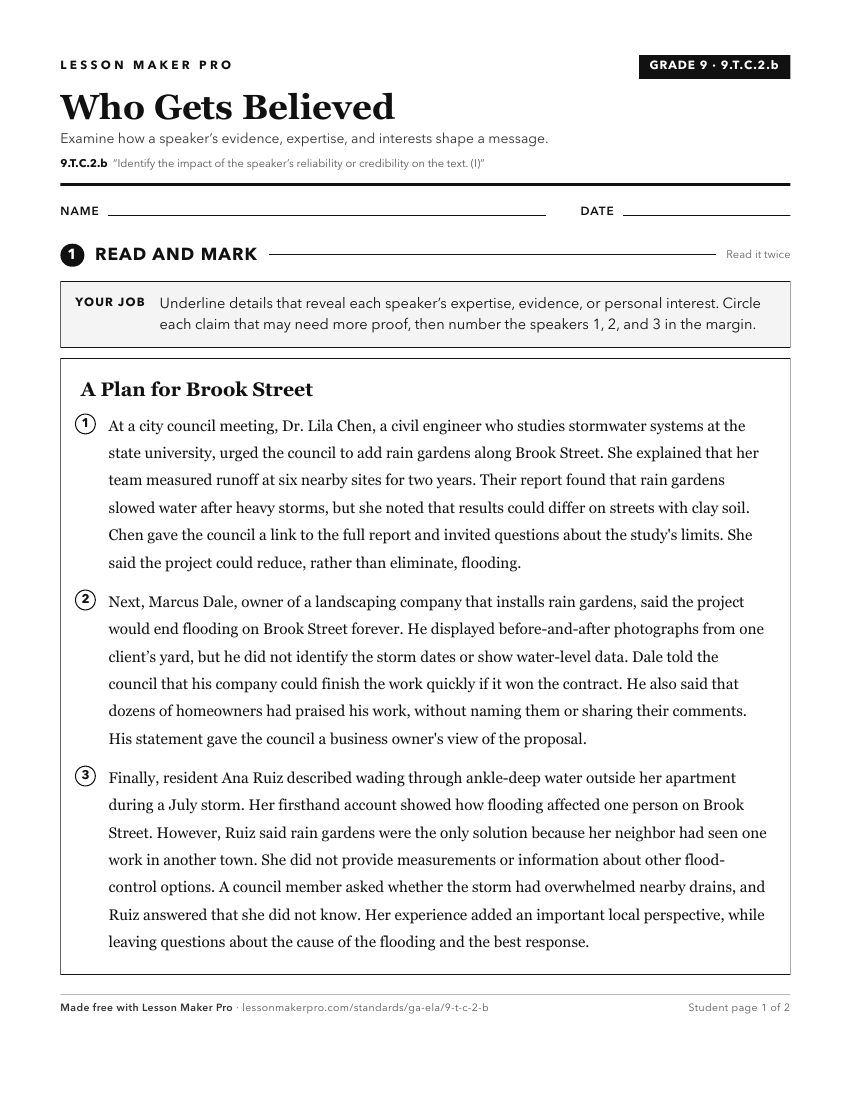
A ready-to-print activity worksheet aligned to 9.T.C.2.b, with an answer key for the teacher on its own page. No account needed.
PDF, US Letter, prints cleanly in black and white.
Download the worksheetKeep exploring
Related Standards
- 12.T.C.1.b
Evaluate the impact of voice and tone on a text’s reception by the audience. (I)
- 8.T.C.2.b
Identify an author’s bias and determine how that bias impacts text credibility. (I)
- 5.T.RA.2.b
Determine credibility and relevance by assessing the strengths and weaknesses of source texts to support a topic or message. (I)
- 7.T.C.2.b
Analyze how evidence and tone reveal the author’s perspective and impact credibility. (I)
Turn this exact standard into a lesson
Grade, subject, topic, and the complete standard are prefilled. Create one free, no account needed.
Also for this standard:Make a WorksheetMake a QuizMake a Sub Lesson