Georgia 4.T.RA.2.b
The Standard
Determine the credibility and relevance of a source text based on known information about the author and/or organization. (I)
Georgia's K-12 English Language Arts Standards · Texts (T) · Research & Analysis
Teacher's field guide
What This Standard Means
What Students Need to Do
- Students use details about an author or organization to judge whether a source can be trusted. They also decide whether the source provides information that fits their research question.
What Mastery Looks Like
- Students select sources whose authors or organizations have suitable knowledge and a trustworthy purpose. They explain whether each source directly supports the research question with specific evidence.
Common Misconceptions
- Students may assume the first search result or a polished website is trustworthy. They may also confuse relevance with credibility, treating an accurate source as useful even when it does not answer the research question.
How to Assess It
- Give students two short source descriptions for a report on sea turtles. Ask them to choose the stronger source and explain its credibility and relevance using author or organization details.
Lesson moves
Ways to Teach It
Post four source cards around the room, then have pairs place sticky notes naming clues about each author’s knowledge, purpose, and trustworthiness.
Discuss: Would you trust a zoo veterinarian, travel blogger, or toy company to explain animal health, and why?
Play Source Sort by matching research questions with author cards, then award points for explanations that address both trustworthiness and usefulness.
Compare two real websites about local weather, then choose which source should guide plans for an outdoor school event.
Free download
Printable 4.T.RA.2.b Worksheet
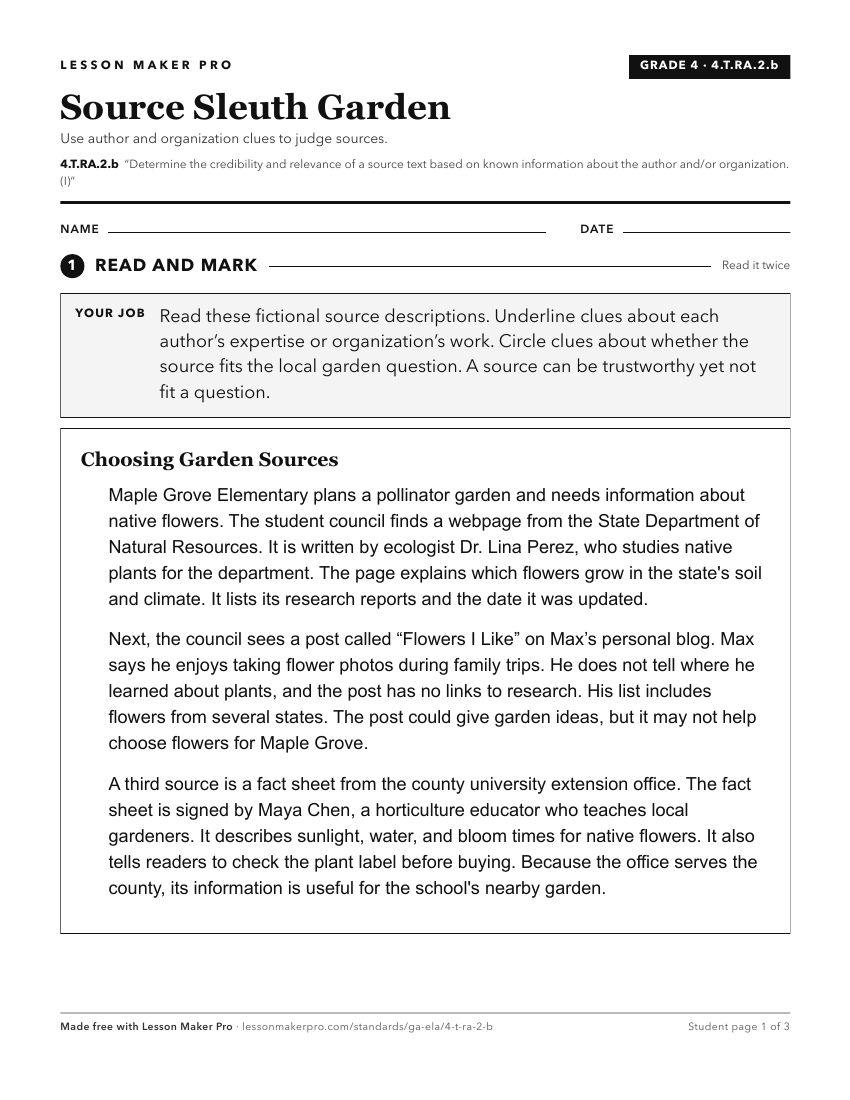
A ready-to-print activity worksheet aligned to 4.T.RA.2.b, with an answer key for the teacher on its own page. No account needed.
PDF, US Letter, prints cleanly in black and white.
Download the worksheetKeep exploring
Related Standards
- 3.T.RA.2.b
Determine what makes a source text credible and relevant and identify examples. (I)
- 7.T.RA.2.b
Analyze print and digital texts for credibility and relevance, determining whether the ideas and information support the topic under investigation. (I)
- 8.T.C.2.b
Identify an author’s bias and determine how that bias impacts text credibility. (I)
- 5.T.RA.2.b
Determine credibility and relevance by assessing the strengths and weaknesses of source texts to support a topic or message. (I)
Turn this exact standard into a lesson
Grade, subject, topic, and the complete standard are prefilled. Create one free, no account needed.
Also for this standard:Make a WorksheetMake a QuizMake a Sub Lesson