Florida SS.6.E.2.1
The Standard
- SS.6.E.2
- Understand the fundamental concepts relevant to the institutions, structure, and functions of a national economy.
Evaluate how civilizations through clans, leaders, and family groups make economic decisions for that civilization providing a framework for future city-state or nation development.
Florida Next Generation Sunshine State Standards for Social Studies
Teacher's field guide
What This Standard Means
What Students Need to Do
- Students identify how clans, families, and leaders decided what to produce, trade, save, and distribute. They judge how those choices helped settlements grow, remain stable, or develop governments.
What Mastery Looks Like
- Students can compare decisions made by households, councils, and rulers. They can use evidence to explain how control of resources, labor, and trade shaped a developing city-state or nation.
Common Misconceptions
- Students may assume rulers made every decision or that all resources were shared equally. They may also confuse economic choices, such as distributing grain, with political choices, such as selecting a leader.
How to Assess It
- Give students a village scenario with limited grain and labor. Ask them to choose who should allocate each resource and explain one likely effect on the settlement’s growth.
Lesson moves
Ways to Teach It
Give groups 20 grain tokens and role cards for elders, families, and leaders; they allocate food, trade, defense, and public works.
Ask students to write: Which decision maker created the fairest and most stable settlement, and what evidence supports your judgment?
Use scenario cards to match drought, surplus, conflict, and migration with likely choices by a clan council, ruler, or household.
Have students compare a family budget, city budget, and national budget, then name who decides and who is affected.
Free download
Printable SS.6.E.2.1 Worksheet
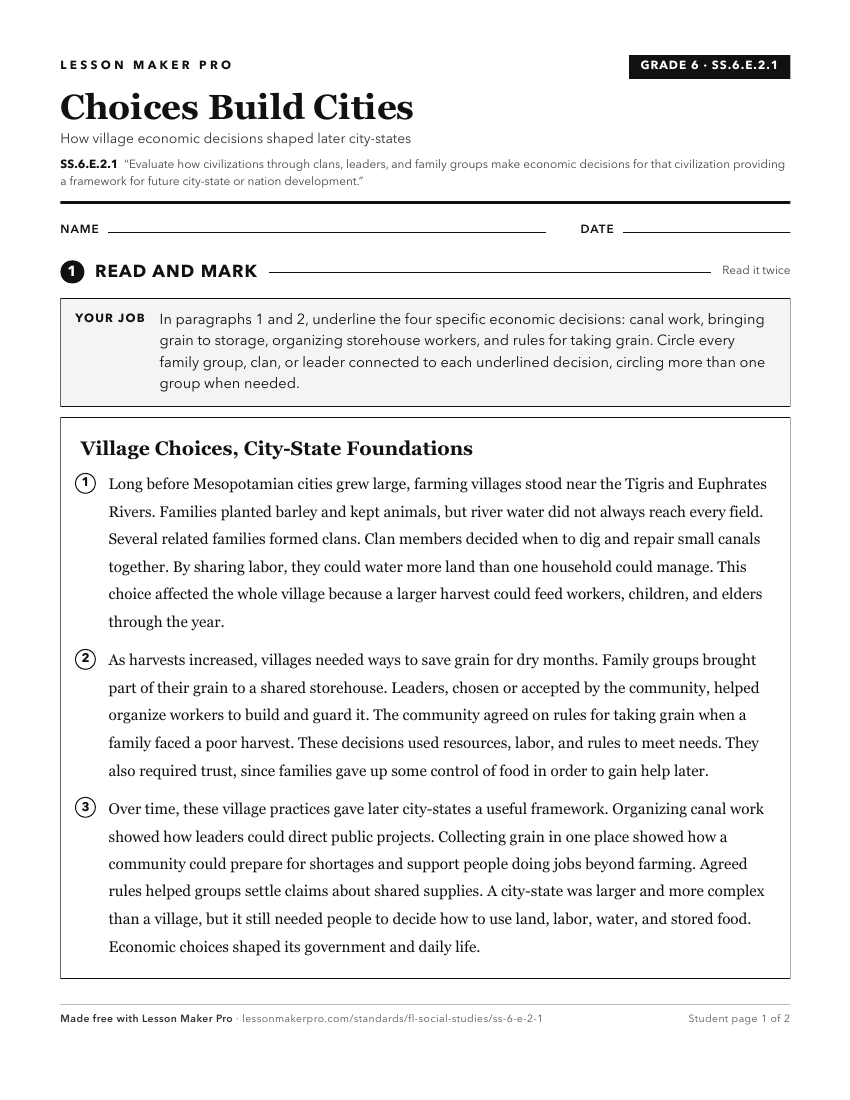
A ready-to-print activity worksheet aligned to SS.6.E.2.1, with an answer key for the teacher on its own page. No account needed.
PDF, US Letter, prints cleanly in black and white.
Download the worksheetKeep exploring
Related Standards
- SS.6.W.2.3
Identify the characteristics of civilization.
- SS.6.W.2.4
Compare the economic, political, social, and religious institutions of ancient river civilizations.
- SS.6.E.1.2
Describe and identify traditional and command economies as they appear in different civilizations.
- SS.6.E.1.3
Describe the following economic concepts as they relate to early civilization: scarcity, opportunity cost, supply and demand, barter, trade, productive resource...
Turn this exact standard into a lesson
Grade, subject, topic, and the complete standard are prefilled. Create one free, no account needed.
Also for this standard:Make a WorksheetMake a QuizMake a Sub Lesson