Florida SS.5.CG.2.2
The Standard
- SS.5.CG.2
- Civic and Political Participation
Compare forms of political participation in the colonial period to today.
Florida Next Generation Sunshine State Standards for Social Studies
Teacher's field guide
What This Standard Means
What Students Need to Do
- Students identify ways colonists took part in public decisions, including voting, town meetings, petitions, boycotts, and protests. They compare those methods with voting, campaigning, contacting officials, attending meetings, petitioning, and protesting today.
What Mastery Looks Like
- Students can name similarities and differences between colonial and modern participation. They also explain that colonial voting rights were limited by race, sex, property ownership, and local laws.
Common Misconceptions
- Students may think all colonists could vote or that colonial governments worked like modern governments. They may also treat petitions, boycotts, and protests as modern inventions. Some confuse political participation with holding elected office.
How to Assess It
- Give students four actions: voting, signing a petition, attending a town meeting, and emailing a representative. Ask them to label each colonial, modern, or both, then explain one choice.
Lesson moves
Ways to Teach It
Sort action cards into colonial, modern, or both, then use source cards to check each choice.
Write a response to this prompt: Which colonial participation method has the clearest modern match, and why?
Play a matching relay where teams pair colonial actions with modern examples and explain each connection.
Examine a current city council agenda and compare public comment today with participation in a colonial town meeting.
Free download
Printable SS.5.CG.2.2 Worksheet
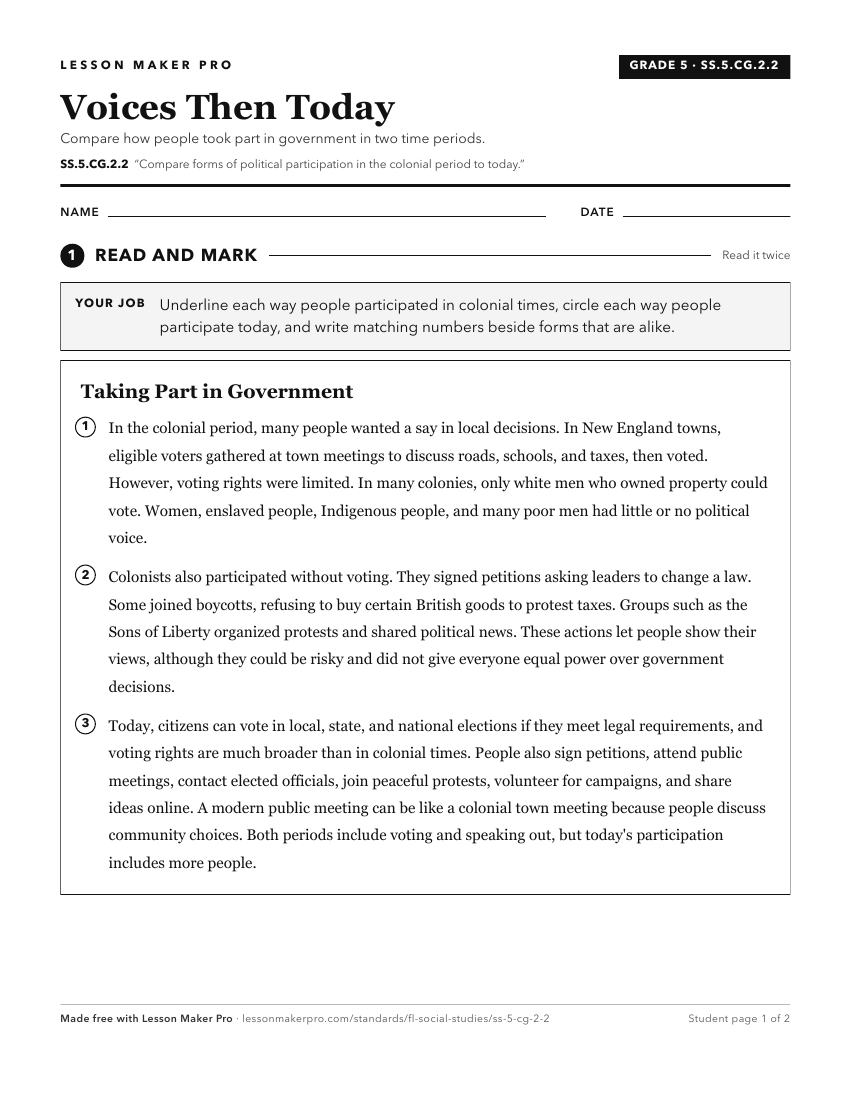
A ready-to-print activity worksheet aligned to SS.5.CG.2.2, with an answer key for the teacher on its own page. No account needed.
PDF, US Letter, prints cleanly in black and white.
Download the worksheetKeep exploring
Related Standards
Turn this exact standard into a lesson
Grade, subject, topic, and the complete standard are prefilled. Create one free, no account needed.
Also for this standard:Make a WorksheetMake a QuizMake a Sub Lesson