Florida SS.5.A.5
Florida Standard (Benchmark Cluster)
American Revolution and Birth of a New Nation
Florida Next Generation Sunshine State Standards for Social Studies
Cluster contents
Benchmarks in This Standard
SS.5.A.5 is a Florida social studies standard. These are the benchmarks under it.
- SS.5.A.5.1
Identify and explain significant events leading up to the American Revolution.
- SS.5.A.5.2
Identify significant individuals and groups who played a role in the American Revolution.
- SS.5.A.5.3
Explain the significance of historical documents including key political concepts, origins of these concepts, and their role in American independence.
- SS.5.A.5.4
Examine and explain the changing roles and impact of significant women during the American Revolution.
- SS.5.A.5.5
Examine and compare major battles and military campaigns of the American Revolution.
- SS.5.A.5.6
Identify the contributions of foreign alliances and individuals to the outcome of the Revolution.
- SS.5.A.5.7
Explain economic, military, and political factors which led to the end of the Revolutionary War.
- SS.5.A.5.8
Evaluate the personal and political hardships resulting from the American Revolution.
- SS.5.A.5.9
Discuss the impact and significance of land policies developed under the Confederation Congress (Northwest Ordinance of 1787).
- SS.5.A.5.10
Examine the significance of the Constitution including its key political concepts, origins of those concepts, and their role in American democracy.
Teacher's field guide
What This Cluster Means
What Students Need to Do
- Students explain why colonists broke from Britain and how the war led to independence. They put key events in order and connect independence to the creation of a new government.
What Mastery Looks Like
- A student can explain how taxes without colonial representation led to protests, then war. They can place the Declaration of Independence before the British surrender at Yorktown and describe why the new nation needed a government.
Common Misconceptions
- Students may think all colonists wanted independence or that the Declaration ended the war. They may also confuse the Declaration of Independence with the Constitution.
How to Assess It
- Give students four event cards: Stamp Act, Declaration of Independence, Yorktown, and Constitution. Ask them to put the cards in order and write one sentence explaining how one event led to the next.
Lesson moves
Ways to Teach It
Give pairs printed event cards and string, then have them build a classroom timeline from the Stamp Act to the Constitution.
Ask students to write two diary entries about the Boston Tea Party, one from a Patriot and one from a Loyalist.
Play timeline relay: teams place event cards in order, then explain one cause-and-effect link to keep each card in place.
Show a photo of a local government meeting and ask students how citizens can voice complaints today compared with colonists under British rule.
Free download
Printable SS.5.A.5 Worksheet
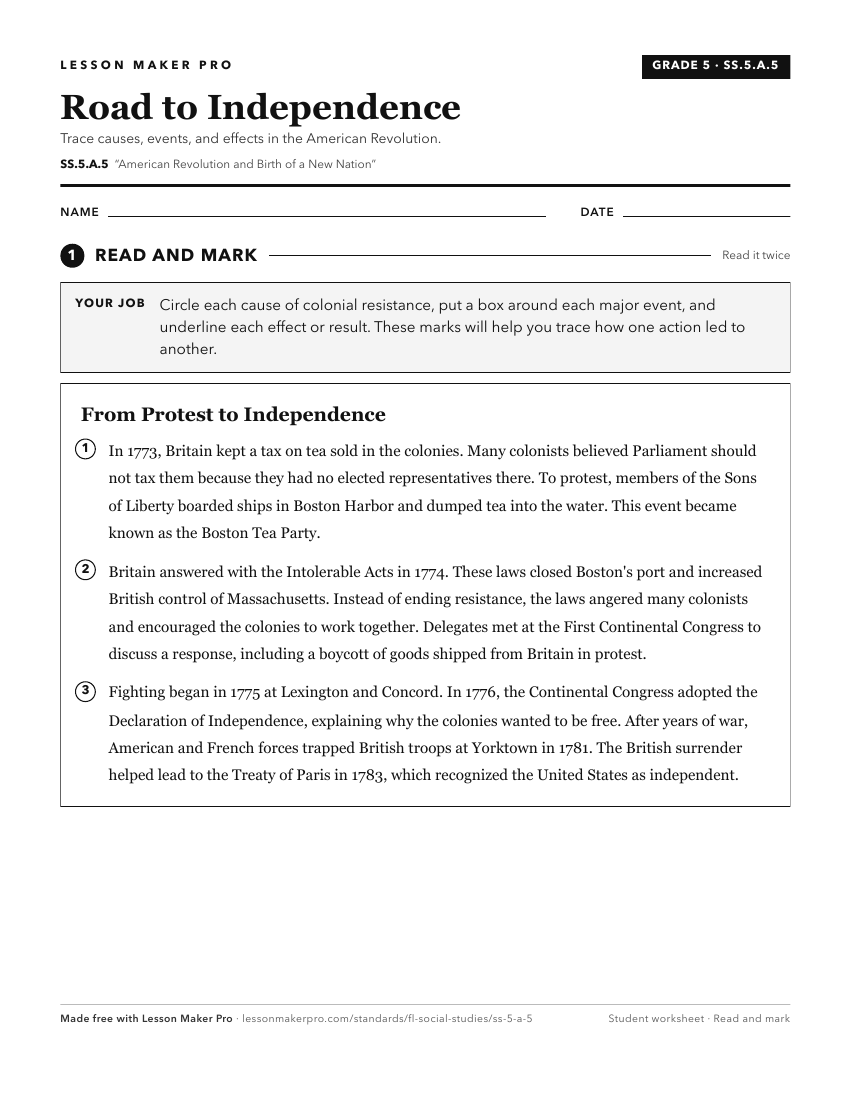
A ready-to-print activity worksheet aligned to SS.5.A.5, with an answer key for the teacher on its own page. No account needed.
PDF, US Letter, prints cleanly in black and white.
Download the worksheetKeep exploring
Related Standards
Turn this cluster into a lesson
Grade, subject, and topic are prefilled; the lesson picks the standards under this heading. Create one free, no account needed.
Also for this cluster:Make a WorksheetMake a QuizMake a Sub Lesson