Florida SS.3.E.1.1
The Standard
- SS.3.E.1
- Beginning Economics
Give examples of how scarcity results in trade.
Florida Next Generation Sunshine State Standards for Social Studies
Teacher's field guide
What This Standard Means
What Students Need to Do
- Students recognize when people do not have enough of a wanted good or resource. They explain why people exchange goods, services, or money to get what they lack.
What Mastery Looks Like
- Given a simple scenario, students identify what is limited, who needs it, and what could be traded. They can explain what each person gains from the exchange.
Common Misconceptions
- Students may think scarcity means nothing is available, rather than less is available than people want. They may also think trade only means swapping objects and does not include money or services.
How to Assess It
- Give students this prompt: “Maya has extra pencils but needs paper. Leo has extra paper but needs pencils. Explain why they might trade.”
Lesson moves
Ways to Teach It
Give pairs uneven sets of pencil, paper, and eraser cards, then let them trade to complete a school supply list.
Ask students to write about something they lacked and what they could offer someone in exchange for it.
Play a scenario sorting game where students label each card as scarcity, trade, both, or neither.
Examine produce labels from a grocery store, then discuss why stores trade with growers in places where those foods are available.
Free download
Printable SS.3.E.1.1 Worksheet
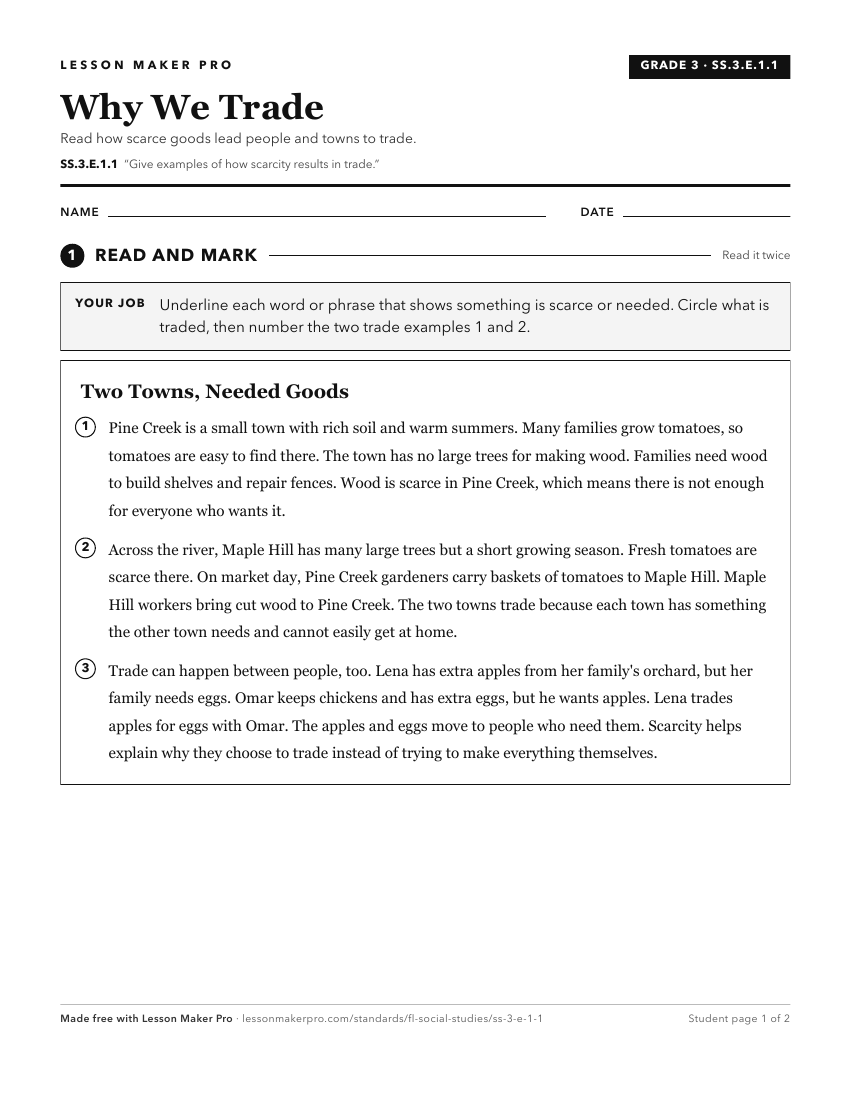
A ready-to-print activity worksheet aligned to SS.3.E.1.1, with an answer key for the teacher on its own page. No account needed.
PDF, US Letter, prints cleanly in black and white.
Download the worksheetKeep exploring
Related Standards
- SS.4.FL.2.2
Explain that people make choices about what goods and services they buy because they can't have everything they want. This requires individuals to prioritize th...
- SS.1.E.1.6
Identify that people need to make choices because of scarce resources.
- SS.6.E.3.2
Categorize products that were traded among civilizations, and give examples of barriers to trade of those products.
- SS.6.E.1.3
Describe the following economic concepts as they relate to early civilization: scarcity, opportunity cost, supply and demand, barter, trade, productive resource...
Turn this exact standard into a lesson
Grade, subject, topic, and the complete standard are prefilled. Create one free, no account needed.
Also for this standard:Make a WorksheetMake a QuizMake a Sub Lesson