Florida SC.8.P.8.1
The Standard
Explore the scientific theory of atoms (also known as atomic theory) by using models to explain the motion of particles in solids, liquids, and gases.
Florida Next Generation Sunshine State Standards for Science
Teacher's field guide
What This Standard Means
What Students Need to Do
- Students use particle diagrams or physical models to show how particles are arranged and move in each state of matter. They connect particle spacing and motion to observable properties such as shape, volume, and compressibility.
What Mastery Looks Like
- Students show solid particles vibrating in fixed positions, liquid particles sliding past one another, and gas particles moving freely in all directions. They use these differences to explain why each state behaves differently.
Common Misconceptions
- Students may think particles in solids do not move or that liquid particles are widely spaced. They may also draw gas particles rising instead of moving randomly in every direction.
How to Assess It
- Exit ticket: Draw 10 particles in three boxes to represent a solid, liquid, and gas. Add motion arrows and explain one difference between the models.
Lesson moves
Ways to Teach It
Use floor spots as particles, then have students vibrate in place, slide past neighbors, or move freely to model each state.
Show three unlabeled particle diagrams and ask students to identify each state and defend their choices using spacing and motion.
Play a card sort matching particle diagrams, motion descriptions, and properties such as fixed shape, flowing, or easy compression.
Compare sealed syringes filled with air and water, then explain the different compression using particle spacing.
Free download
Printable SC.8.P.8.1 Worksheet
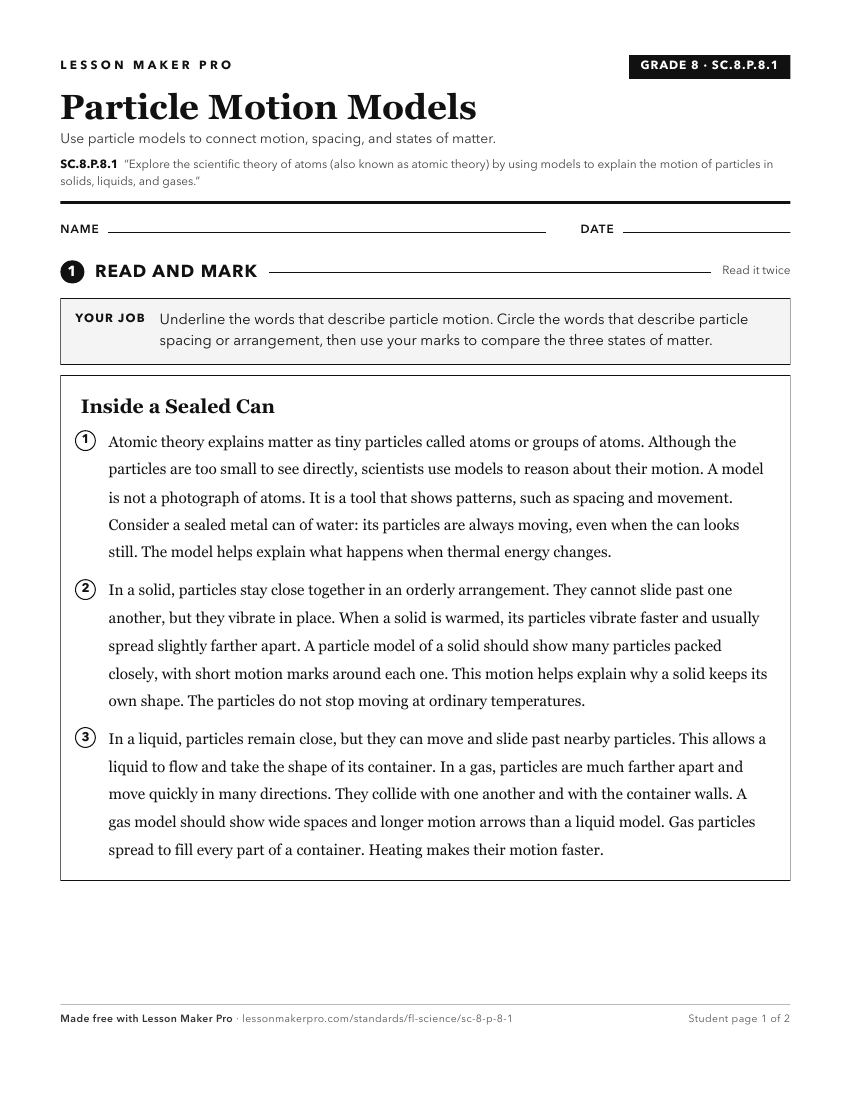
A ready-to-print activity worksheet aligned to SC.8.P.8.1, with an answer key for the teacher on its own page. No account needed.
PDF, US Letter, prints cleanly in black and white.
Download the worksheetKeep exploring
Related Standards
- SC.8.P.8.7
Explore the scientific theory of atoms (also known as atomic theory) by recognizing that atoms are the smallest unit of an element and are composed of sub-atomi...
- SC.3.N.3.2
Recognize that scientists use models to help understand and explain how things work.
- SC.5.E.7.1
Create a model to explain the parts of the water cycle. Water can be a gas, a liquid, or a solid and can go back and forth from one state to another.
- SC.5.P.8.4
Explore the scientific theory of atoms (also called atomic theory) by recognizing that all matter is composed of parts that are too small to be seen without mag...
Turn this exact standard into a lesson
Grade, subject, topic, and the complete standard are prefilled. Create one free, no account needed.
Also for this standard:Make a WorksheetMake a QuizMake a Sub Lesson