Florida SC.5.E.7.1
The Standard
Create a model to explain the parts of the water cycle. Water can be a gas, a liquid, or a solid and can go back and forth from one state to another.
Florida Next Generation Sunshine State Standards for Science
Teacher's field guide
What This Standard Means
What Students Need to Do
- Students build and label a diagram or physical model that tracks water through evaporation, condensation, precipitation, collection, and runoff. They explain how heating and cooling change water among ice, liquid water, and water vapor.
What Mastery Looks Like
- A student can trace more than one path water may take through the cycle. The model uses accurate arrows, labels, and explanations of each change of state.
Common Misconceptions
- Students often think water disappears during evaporation or that clouds are made of invisible water vapor. They may think the cycle follows one fixed order, condensation means rain, or water must boil to evaporate.
How to Assess It
- Give students a blank landscape diagram with a lake, cloud, mountain, and Sun. Ask them to add arrows, label four processes, and explain two state changes.
Lesson moves
Ways to Teach It
Tape a sealed bag with colored water to a sunny window, then have students mark evaporation, condensation, and collection over two days.
Ask students to explain how one water droplet could move from a puddle to a cloud and return as snow.
Give groups process and state cards to arrange into several valid water cycle paths, then defend each sequence.
Have students observe a cold drink outdoors and connect the droplets, melting ice, and nearby puddles to water cycle processes.
Free download
Printable SC.5.E.7.1 Worksheet
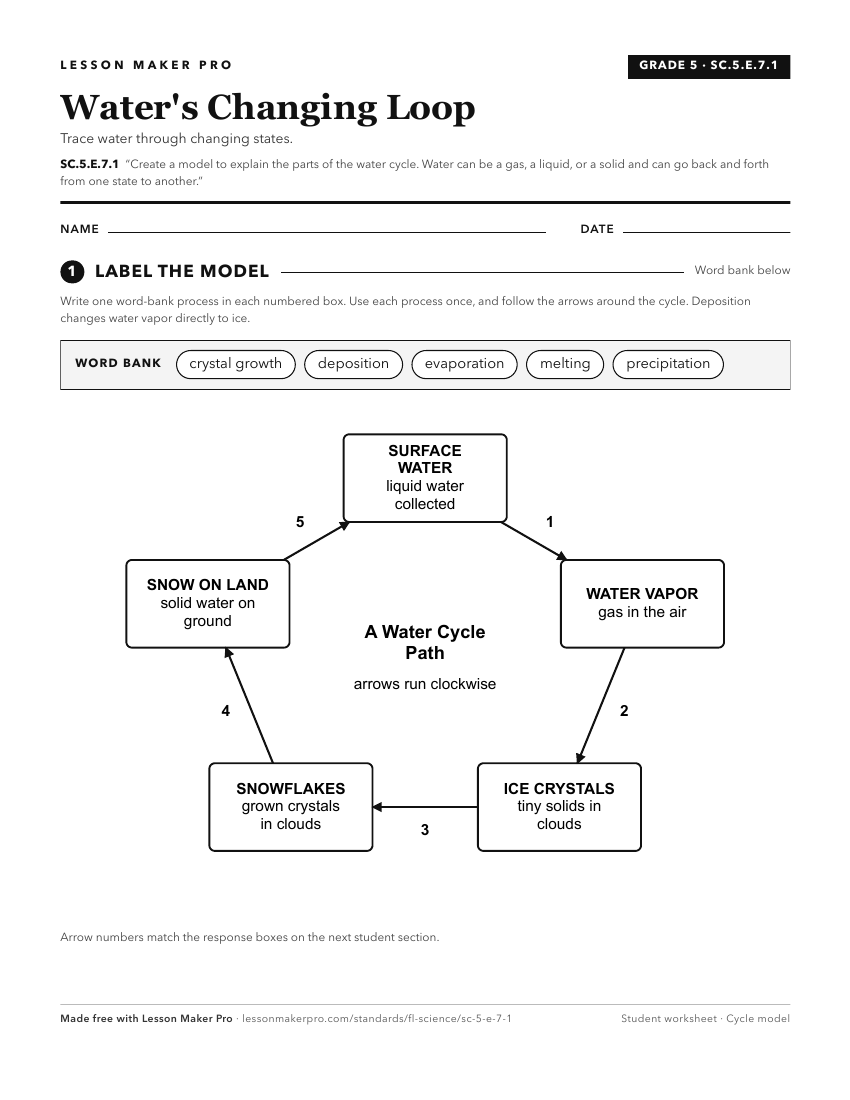
A ready-to-print activity worksheet aligned to SC.5.E.7.1, with an answer key for the teacher on its own page. No account needed.
PDF, US Letter, prints cleanly in black and white.
Download the worksheetKeep exploring
Related Standards
- SC.6.E.7.2
Investigate and apply how the cycling of water between the atmosphere and hydrosphere has an effect on weather patterns and climate.
- SC.3.P.9.1
Describe the changes water undergoes when it changes state through heating and cooling by using familiar scientific terms such as melting, freezing, boiling, ev...
- SC.8.L.18.3
Construct a scientific model of the carbon cycle to show how matter and energy are continuously transferred within and between organisms and their physical envi...
- SC.2.P.8.4
Observe and describe water in its solid, liquid, and gaseous states.
Turn this exact standard into a lesson
Grade, subject, topic, and the complete standard are prefilled. Create one free, no account needed.
Also for this standard:Make a WorksheetMake a QuizMake a Sub Lesson