Florida SC.3.P.9.1
The Standard
Describe the changes water undergoes when it changes state through heating and cooling by using familiar scientific terms such as melting, freezing, boiling, evaporation, and condensation.
Florida Next Generation Sunshine State Standards for Science
Teacher's field guide
What This Standard Means
What Students Need to Do
- Students identify what happens to water as it gains or loses heat. They connect melting, freezing, boiling, evaporation, and condensation to the starting and ending state of water.
What Mastery Looks Like
- Given a picture or everyday event, students name the water change and tell whether heating or cooling caused it. They distinguish surface evaporation from boiling throughout a liquid.
Common Misconceptions
- Students may call melting dissolving or think evaporated water disappears. They may think evaporation happens only during boiling or that droplets outside a cold glass leaked through it.
How to Assess It
- Exit ticket: Label these changes and mark heating or cooling: ice to liquid, liquid to ice, bubbling liquid to gas, puddle to gas, gas to droplets.
Lesson moves
Ways to Teach It
Place an ice cube in a clear cup, observe melting and outside droplets, then label each change and identify heating or cooling.
Ask students to explain, in three sentences, what happens to water in an ice tray, kettle, and bathroom mirror.
Play a card sort matching melting, freezing, boiling, evaporation, and condensation to picture cards and heating or cooling cards.
Have students trace water changes while making ice pops, from liquid mixture to frozen pop and back to melting drips.
Free download
Printable SC.3.P.9.1 Worksheet
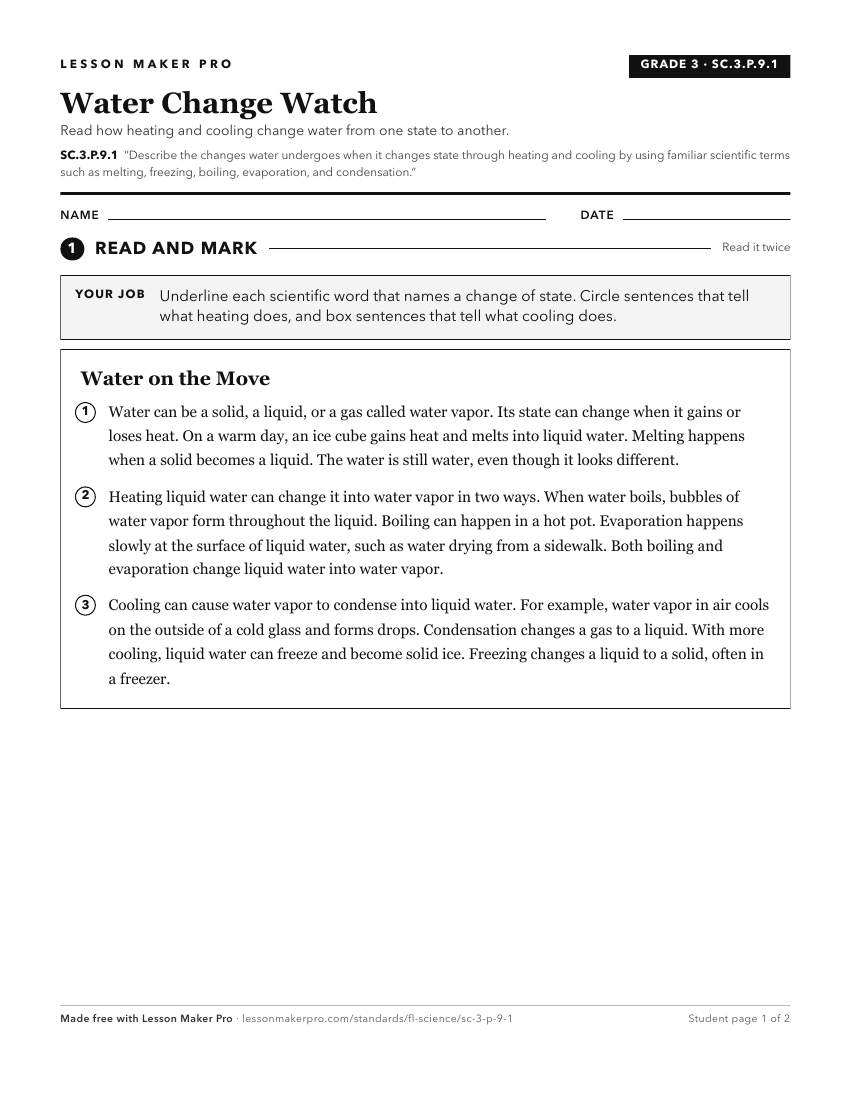
A ready-to-print activity worksheet aligned to SC.3.P.9.1, with an answer key for the teacher on its own page. No account needed.
PDF, US Letter, prints cleanly in black and white.
Download the worksheetKeep exploring
Related Standards
- SC.7.P.11.1
Recognize that adding heat to or removing heat from a system may result in a temperature change and possibly a change of state.
- SC.5.E.7.1
Create a model to explain the parts of the water cycle. Water can be a gas, a liquid, or a solid and can go back and forth from one state to another.
- SC.2.P.8.4
Observe and describe water in its solid, liquid, and gaseous states.
- SC.5.P.9.1
Investigate and describe that many physical and chemical changes are affected by temperature.
Turn this exact standard into a lesson
Grade, subject, topic, and the complete standard are prefilled. Create one free, no account needed.
Also for this standard:Make a WorksheetMake a QuizMake a Sub Lesson