Florida SC.5.P.9.1
The Standard
Investigate and describe that many physical and chemical changes are affected by temperature.
Florida Next Generation Sunshine State Standards for Science
Teacher's field guide
What This Standard Means
What Students Need to Do
- Students change temperature in a fair test and observe what happens to matter. They compare melting, freezing, dissolving, and chemical reactions, then describe how temperature affects each change.
What Mastery Looks Like
- A student can keep amounts and materials the same while changing only temperature. They use observations and measurements to explain how warming or cooling changed the state or rate of a change.
Common Misconceptions
- Students may call melting chemical because the material looks different, or call fizzing physical because it happens in water. They may assume cooling always reverses a change or forget to control other variables.
How to Assess It
- Exit ticket: An ice cube melts faster on a warm plate, while an equal effervescent tablet fizzes faster in warm water. Label each change and state how temperature affected it.
Lesson moves
Ways to Teach It
Place equal effervescent tablets in cold, room-temperature, and warm water, then time the fizzing and record observations in a table.
Ask students to write: How can temperature change matter without creating a new substance, and when might a new substance form?
Teams sort scenario cards by physical or chemical change, then match each card with a likely warming or cooling effect.
Read storage directions on three food packages, then explain how refrigeration changes the rate of spoilage.
Free download
Printable SC.5.P.9.1 Worksheet
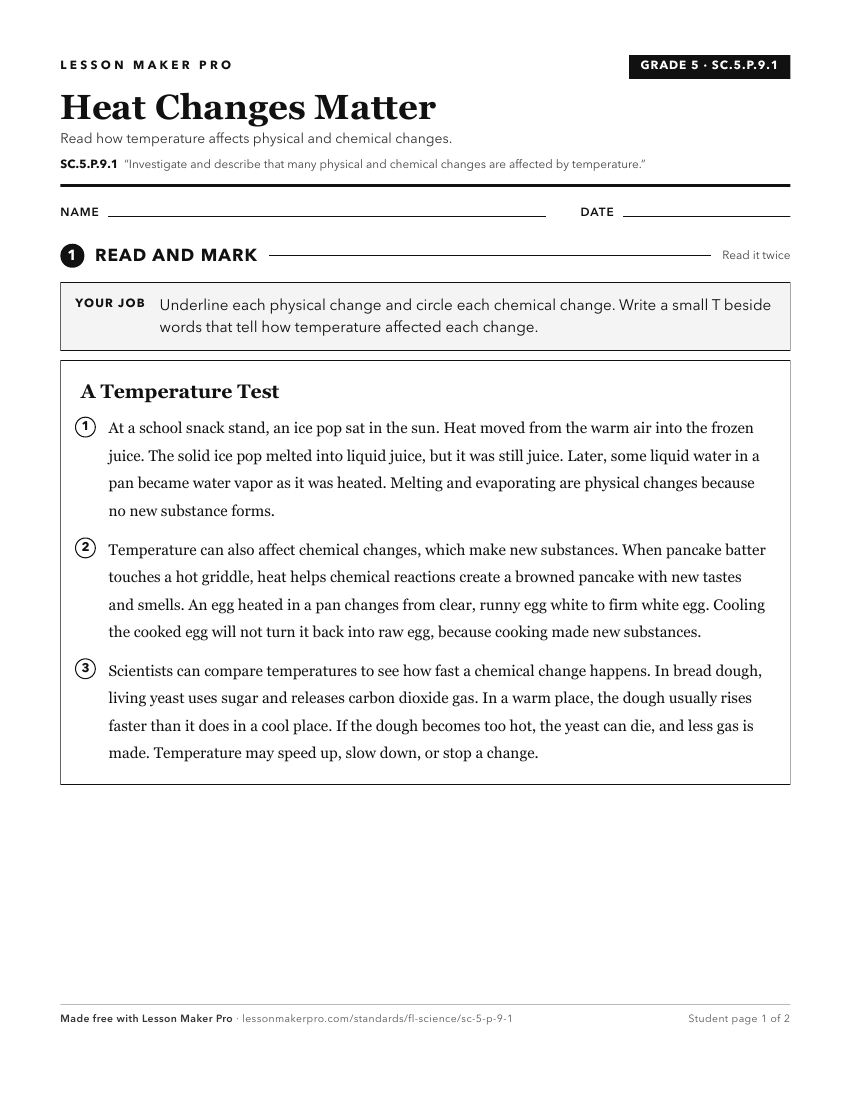
A ready-to-print activity worksheet aligned to SC.5.P.9.1, with an answer key for the teacher on its own page. No account needed.
PDF, US Letter, prints cleanly in black and white.
Download the worksheetKeep exploring
Related Standards
- SC.8.P.9.2
Differentiate between physical changes and chemical changes.
- SC.7.P.11.1
Recognize that adding heat to or removing heat from a system may result in a temperature change and possibly a change of state.
- SC.8.P.9.3
Investigate and describe how temperature influences chemical changes.
- SC.4.P.10.2
Investigate and describe that energy has the ability to cause motion or create change.
Turn this exact standard into a lesson
Grade, subject, topic, and the complete standard are prefilled. Create one free, no account needed.
Also for this standard:Make a WorksheetMake a QuizMake a Sub Lesson