Florida SC.8.P.9.3
The Standard
Investigate and describe how temperature influences chemical changes.
Florida Next Generation Sunshine State Standards for Science
Teacher's field guide
What This Standard Means
What Students Need to Do
- Students compare reaction rates at different temperatures while keeping the amounts of reactants and other conditions the same. They collect timed observations and use the data to explain the pattern.
What Mastery Looks Like
- Students can plan a fair test using cold, room-temperature, and warm conditions. They identify evidence of chemical change and explain that many reactions occur faster when particles move faster and collide with more energy.
Common Misconceptions
- Students may think any temperature change proves a chemical change occurred. They may assume heating always creates more product rather than changing the reaction rate. Some think cooling stops a reaction permanently.
How to Assess It
- Give students reaction times from three water temperatures. Ask them to identify the temperature with the fastest reaction and support their answer with one data point.
Lesson moves
Ways to Teach It
Time identical effervescent tablets reacting in equal amounts of cold, room-temperature, and warm water, then graph the results.
Write a claim explaining how temperature affected the reaction rate, using one observation and one measurement as evidence.
Match reaction-time cards to temperature cards, then defend each match using particle motion and collision ideas.
Compare food storage in a refrigerator and on a counter, then explain how temperature affects chemical changes involved in spoilage.
Free download
Printable SC.8.P.9.3 Worksheet
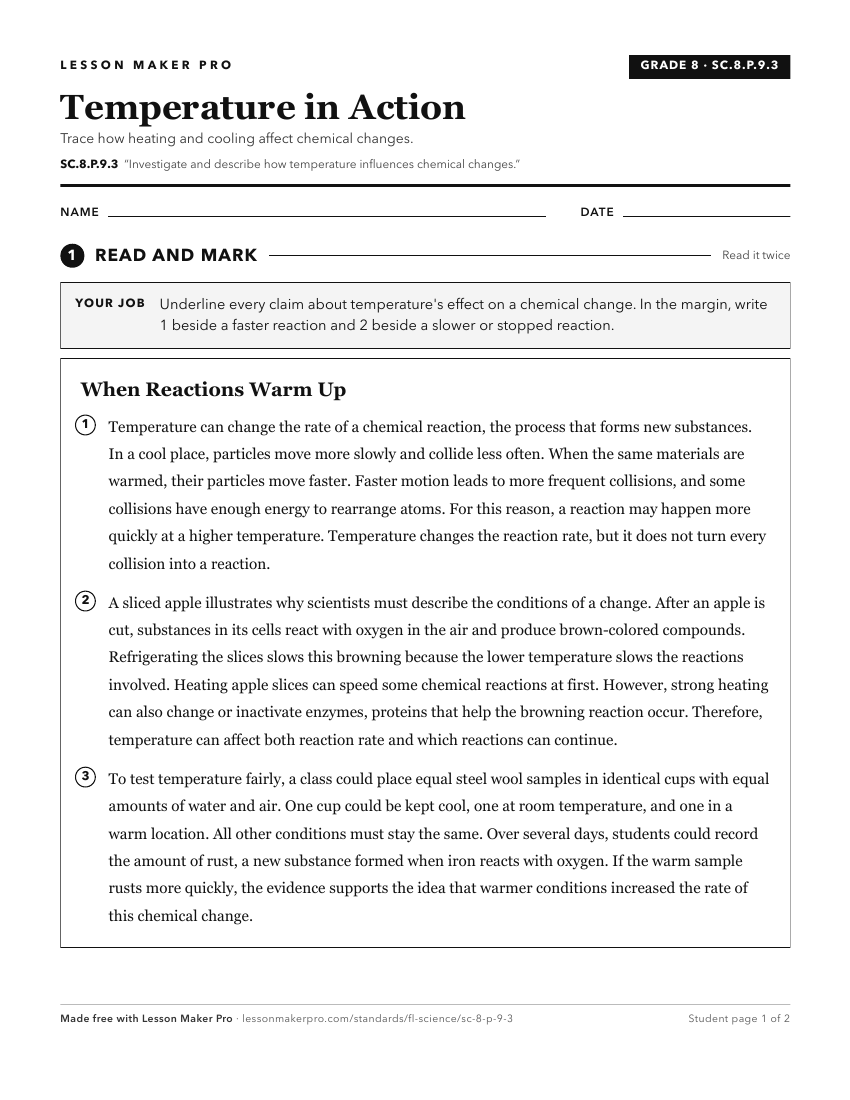
A ready-to-print activity worksheet aligned to SC.8.P.9.3, with an answer key for the teacher on its own page. No account needed.
PDF, US Letter, prints cleanly in black and white.
Download the worksheetKeep exploring
Related Standards
- SC.7.P.11.1
Recognize that adding heat to or removing heat from a system may result in a temperature change and possibly a change of state.
- SC.7.P.11.2
Investigate and describe the transformation of energy from one form to another.
- SC.3.P.11.2
Investigate, observe, and explain that heat is produced when one object rubs against another, such as rubbing one's hands together.
- SC.5.P.9.1
Investigate and describe that many physical and chemical changes are affected by temperature.
Turn this exact standard into a lesson
Grade, subject, topic, and the complete standard are prefilled. Create one free, no account needed.
Also for this standard:Make a WorksheetMake a QuizMake a Sub Lesson