Florida SC.3.P.11.2
The Standard
Investigate, observe, and explain that heat is produced when one object rubs against another, such as rubbing one's hands together.
Florida Next Generation Sunshine State Standards for Science
Teacher's field guide
What This Standard Means
What Students Need to Do
- Students test what happens when two surfaces rub together. They observe a temperature change and connect the warming to friction between the surfaces.
What Mastery Looks Like
- Students can conduct a simple rubbing test and record evidence of warming. They can explain that friction at the touching surfaces produces heat.
Common Misconceptions
- Students may think movement alone causes warming, even when surfaces do not rub. They may also think only one surface warms or that the heat comes from the surrounding air.
How to Assess It
- Exit ticket: Sam rubs an eraser across carpet for 30 seconds. Predict what happens to its temperature and explain why.
Lesson moves
Ways to Teach It
Have pairs use an infrared thermometer to check an eraser, rub it on carpet for 30 seconds, then check it again.
Ask students to compare how warm their hands feel after rubbing them and holding them together still, then explain how rubbing produces heat through friction.
Play a matching game with action cards, observation cards, and explanation cards showing where rubbing produces heat.
Examine bicycle brake pads and discuss why they warm when they press against a moving wheel.
Free download
Printable SC.3.P.11.2 Worksheet
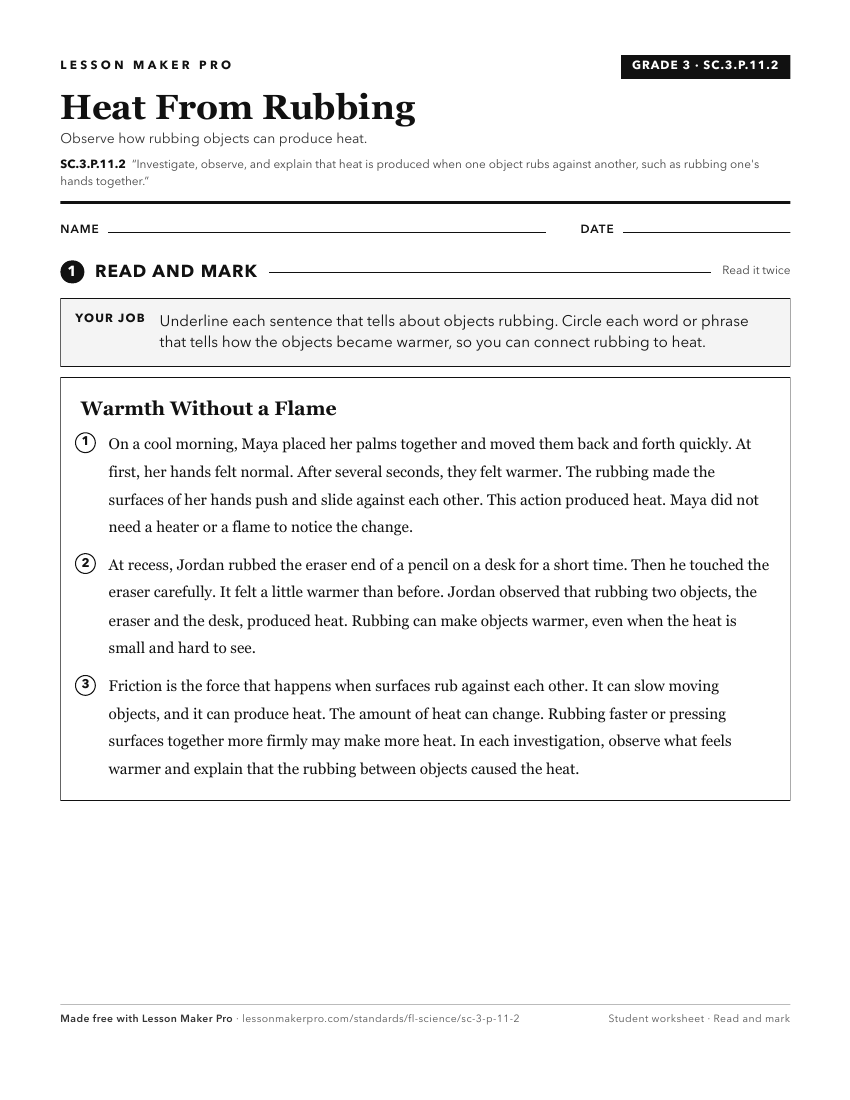
A ready-to-print activity worksheet aligned to SC.3.P.11.2, with an answer key for the teacher on its own page. No account needed.
PDF, US Letter, prints cleanly in black and white.
Download the worksheetKeep exploring
Related Standards
- SC.3.P.11.1
Investigate, observe, and explain that things that give off light often also give off heat.
- SC.5.P.10.4
Investigate and explain that electrical energy can be transformed into heat, light, and sound energy, as well as the energy of motion.
- SC.7.P.11.4
Observe and describe that heat flows in predictable ways, moving from warmer objects to cooler ones until they reach the same temperature.
- SC.5.P.10.2
Investigate and explain that energy has the ability to cause motion or create change.
Turn this exact standard into a lesson
Grade, subject, topic, and the complete standard are prefilled. Create one free, no account needed.
Also for this standard:Make a WorksheetMake a QuizMake a Sub Lesson