Florida SC.3.P.11.1
The Standard
Investigate, observe, and explain that things that give off light often also give off heat.
Florida Next Generation Sunshine State Standards for Science
Teacher's field guide
What This Standard Means
What Students Need to Do
- Students test several light sources and check for a temperature change near each one. They use recorded observations to explain that a source can release light energy and thermal energy together.
What Mastery Looks Like
- Students safely compare temperatures before and after a light source operates. They cite measurements as evidence and recognize that different sources release different amounts of heat.
Common Misconceptions
- Students may think every light source becomes equally hot, or that a brighter source must always be hotter. They may confuse heat released by a source with the warming of an object that absorbs light.
How to Assess It
- Exit ticket: A lamp measured 22°C before use and 31°C after five minutes. What two forms of energy did it release, and what is your evidence?
Lesson moves
Ways to Teach It
Use infrared thermometers to record temperatures of an LED flashlight and incandescent lamp before and after five minutes of operation.
Discuss: A lamp shines and its bulb warms. What observations show that it releases two forms of energy?
Play Evidence Match by pairing source cards with observation cards labeled light seen, temperature rose, or no change, then justify each pair.
Examine LED and incandescent bulb packages, then recommend one for a reading lamp using brightness and heat observations.
Free download
Printable SC.3.P.11.1 Worksheet
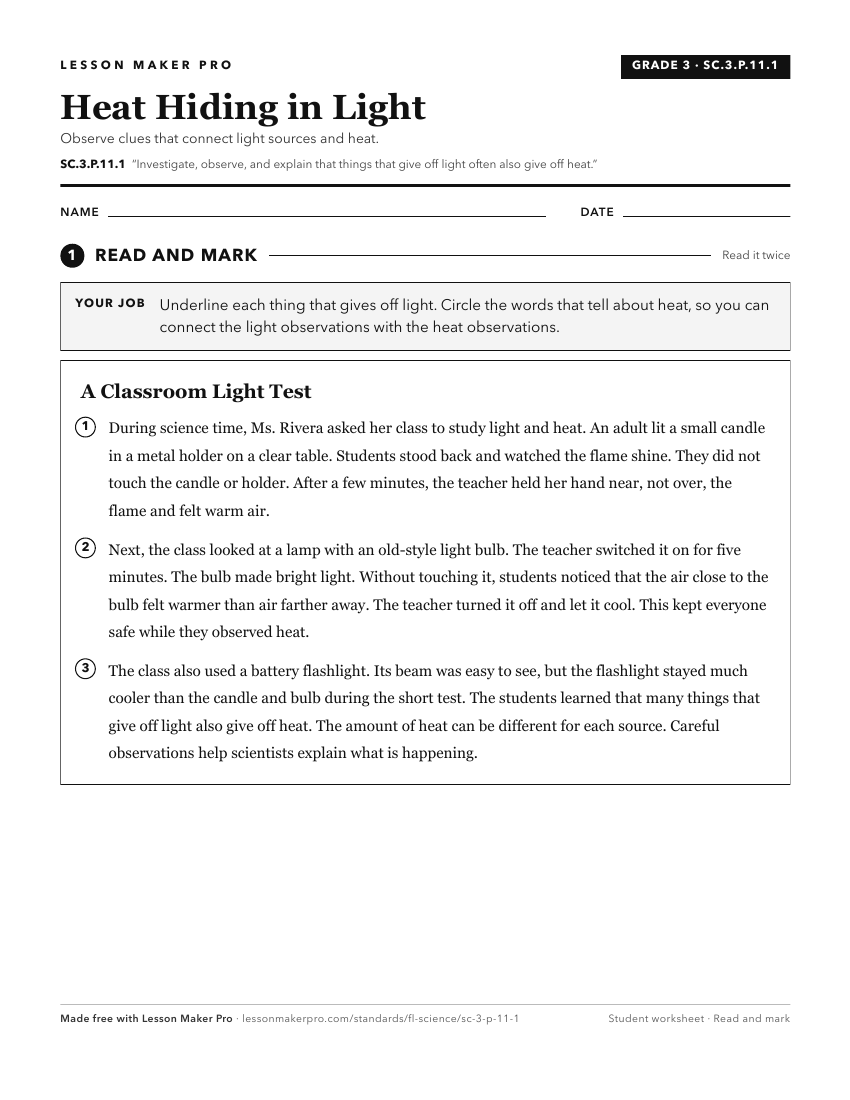
A ready-to-print activity worksheet aligned to SC.3.P.11.1, with an answer key for the teacher on its own page. No account needed.
PDF, US Letter, prints cleanly in black and white.
Download the worksheetKeep exploring
Related Standards
- SC.2.E.7.2
Investigate by observing and measuring, that the Sun's energy directly and indirectly warms the water, land, and air.
- SC.3.P.11.2
Investigate, observe, and explain that heat is produced when one object rubs against another, such as rubbing one's hands together.
- SC.5.P.10.1
Investigate and describe some basic forms of energy, including light, heat, sound, electrical, chemical, and mechanical.
- SC.5.P.10.4
Investigate and explain that electrical energy can be transformed into heat, light, and sound energy, as well as the energy of motion.
Turn this exact standard into a lesson
Grade, subject, topic, and the complete standard are prefilled. Create one free, no account needed.
Also for this standard:Make a WorksheetMake a QuizMake a Sub Lesson