Florida SC.2.E.7.2
The Standard
Investigate by observing and measuring, that the Sun's energy directly and indirectly warms the water, land, and air.
Florida Next Generation Sunshine State Standards for Science
Teacher's field guide
What This Standard Means
What Students Need to Do
- Students observe soil, water, and air before and after time in sunlight. They measure temperature changes and describe how heat can move from warmed land or water into the air.
What Mastery Looks Like
- Students record thermometer readings correctly and compare starting and ending temperatures. They use evidence to explain that sunlight warms surfaces, and warmed surfaces can then warm nearby air.
Common Misconceptions
- Students may think the Sun heats the air first, then the air heats land and water. They may rely on touch instead of measurements or assume every material warms at the same rate.
How to Assess It
- Give an exit ticket with these readings: soil 22°C to 31°C, water 22°C to 26°C, air 22°C to 24°C. Ask students to circle what warmed most and draw arrows showing how energy moved.
Lesson moves
Ways to Teach It
Set cups of soil and water beside an air thermometer, then record temperatures before and after 20 minutes in sunlight.
Ask students to write two sentences explaining why air near a sunny playground surface may become warmer.
Students match picture cards of sunlight, warm soil, warm water, and air to make correct energy paths.
Measure sunny and shaded playground surfaces, then discuss where students would choose to sit on a hot day and why.
Free download
Printable SC.2.E.7.2 Worksheet
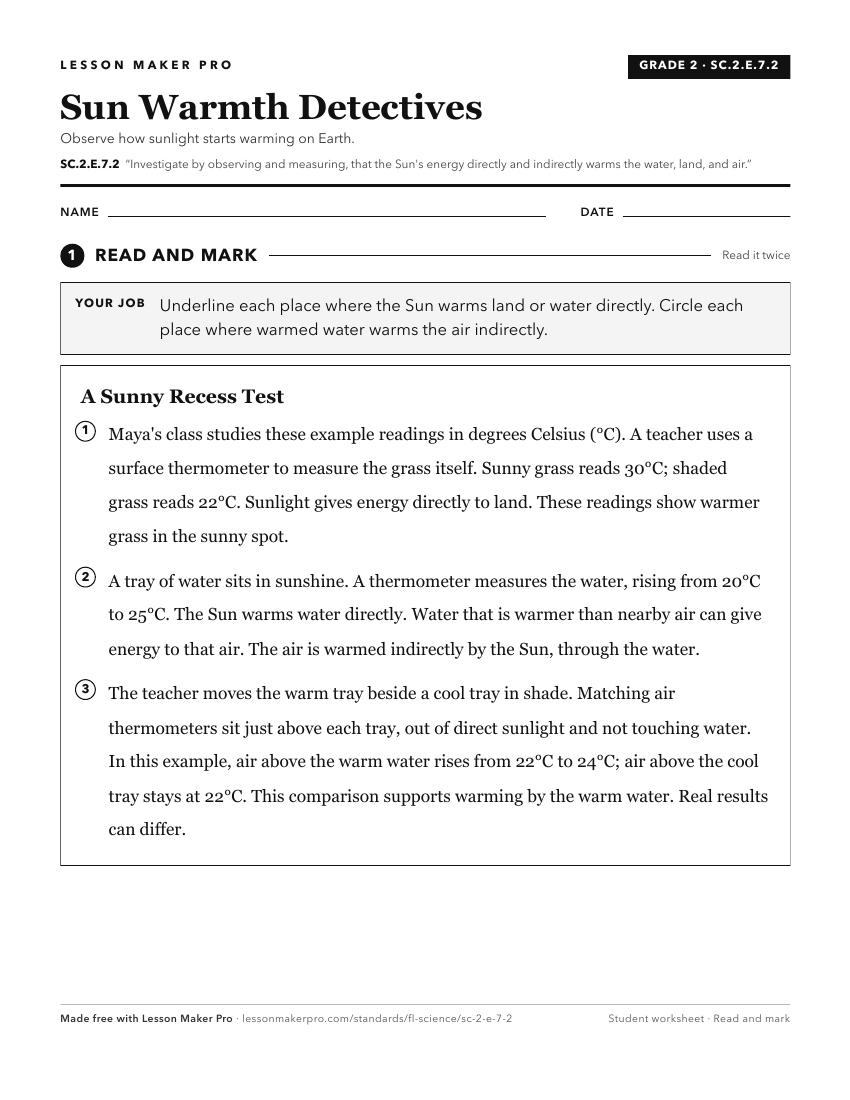
A ready-to-print activity worksheet aligned to SC.2.E.7.2, with an answer key for the teacher on its own page. No account needed.
PDF, US Letter, prints cleanly in black and white.
Download the worksheetKeep exploring
Related Standards
- SC.6.E.7.5
Explain how energy provided by the sun influences global patterns of atmospheric movement and the temperature differences between air, water, and land.
- SC.3.P.11.1
Investigate, observe, and explain that things that give off light often also give off heat.
- SC.6.E.7.2
Investigate and apply how the cycling of water between the atmosphere and hydrosphere has an effect on weather patterns and climate.
- SC.3.E.6.1
Demonstrate that radiant energy from the Sun can heat objects and when the Sun is not present, heat may be lost.
Turn this exact standard into a lesson
Grade, subject, topic, and the complete standard are prefilled. Create one free, no account needed.
Also for this standard:Make a WorksheetMake a QuizMake a Sub Lesson