Florida SC.3.E.6.1
The Standard
Demonstrate that radiant energy from the Sun can heat objects and when the Sun is not present, heat may be lost.
Florida Next Generation Sunshine State Standards for Science
Teacher's field guide
What This Standard Means
What Students Need to Do
- Students observe and measure how sunlight changes an object's temperature. They also track how the object cools after it is moved into shade or after sunlight fades.
What Mastery Looks Like
- Students can use thermometer readings to show that an object warms in sunlight and cools without it. They can describe the temperature change using evidence from their measurements.
Common Misconceptions
- Students may think sunlight heats only living things or that light and heat are the same thing. They may also think an object stops losing heat once it enters shade.
How to Assess It
- Give students temperature data for a cup placed in sunlight, then moved into shade. Ask them to identify when heating and cooling occurred and cite two readings.
Lesson moves
Ways to Teach It
Place identical cups of water in sunlight and shade, then record each temperature every five minutes.
Ask students to explain why playground equipment feels warmer at noon than after sunset, using observations as evidence.
Play a sorting game with scenario cards labeled likely warming, likely cooling, or no clear change.
Compare sunny and shaded parking spots, then write advice for keeping a parked car cooler.
Free download
Printable SC.3.E.6.1 Worksheet
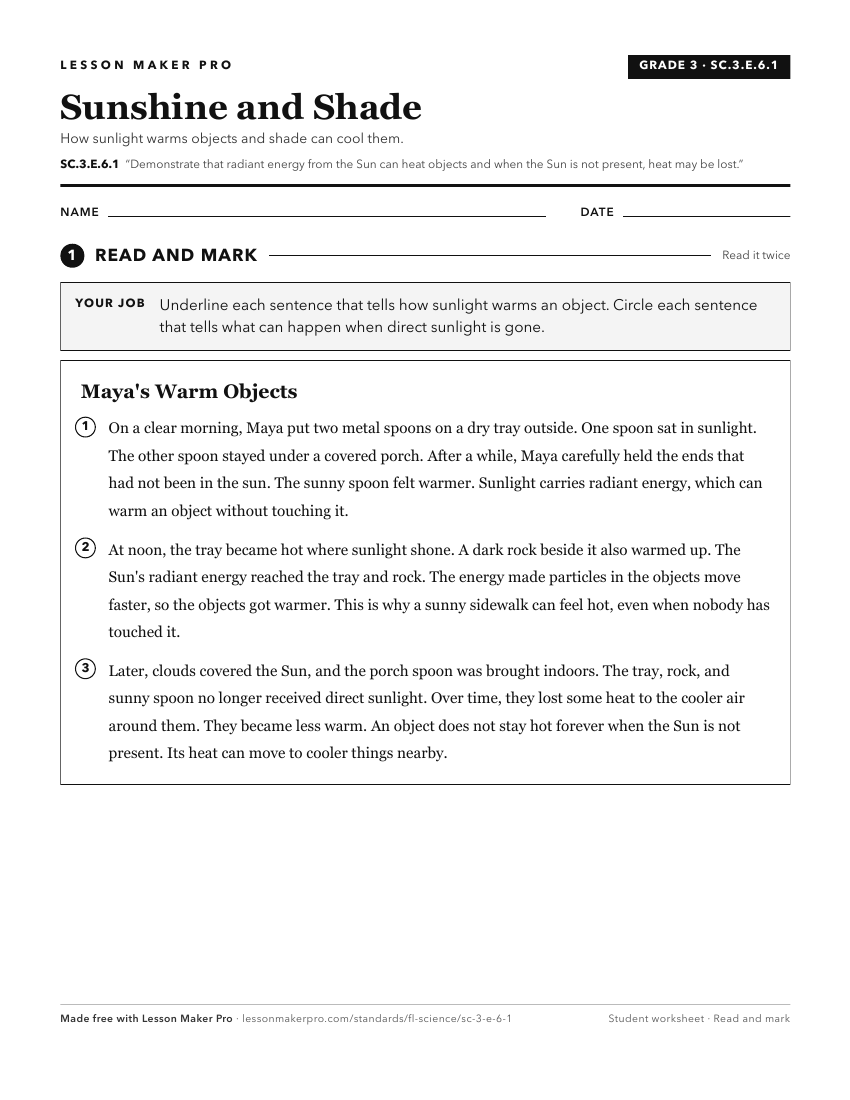
A ready-to-print activity worksheet aligned to SC.3.E.6.1, with an answer key for the teacher on its own page. No account needed.
PDF, US Letter, prints cleanly in black and white.
Download the worksheetKeep exploring
Related Standards
- SC.2.E.7.2
Investigate by observing and measuring, that the Sun's energy directly and indirectly warms the water, land, and air.
- SC.3.P.11.1
Investigate, observe, and explain that things that give off light often also give off heat.
- SC.3.E.5.2
Identify the Sun as a star that emits energy; some of it in the form of light.
- SC.4.P.11.1
Recognize that heat flows from a hot object to a cold object and that heat flow may cause materials to change temperature.
Turn this exact standard into a lesson
Grade, subject, topic, and the complete standard are prefilled. Create one free, no account needed.
Also for this standard:Make a WorksheetMake a QuizMake a Sub Lesson