Florida SC.6.E.7.2
The Standard
Investigate and apply how the cycling of water between the atmosphere and hydrosphere has an effect on weather patterns and climate.
Florida Next Generation Sunshine State Standards for Science
Teacher's field guide
What This Standard Means
What Students Need to Do
- Students trace water as it evaporates, condenses, forms clouds, and returns as precipitation. They use models and data to explain how these processes affect humidity, rainfall, storms, and long-term climate patterns.
What Mastery Looks Like
- Students can interpret a diagram or weather data and connect changes in water vapor to clouds and precipitation. They can explain why oceans influence nearby weather and climate.
Common Misconceptions
- Students may think evaporated water disappears or that clouds are made of water vapor. They may confuse daily weather with climate or assume the hydrosphere includes only oceans.
How to Assess It
- Give students a diagram showing a warm ocean, rising moist air, clouds, and rain. Ask them to label three water cycle processes and explain one likely weather effect.
Lesson moves
Ways to Teach It
Place warm water in a clear cup, cover it with plastic wrap and ice, then observe evaporation, condensation, and dripping water.
Ask students to explain how warmer ocean water could change humidity, cloud formation, rainfall, and climate over time.
Give teams process cards and condition cards to match evaporation, condensation, and precipitation with temperature, humidity, clouds, and rainfall.
Compare monthly rainfall and humidity data from coastal Miami and inland Orlando, then write how nearby ocean water may explain the patterns.
Free download
Printable SC.6.E.7.2 Worksheet
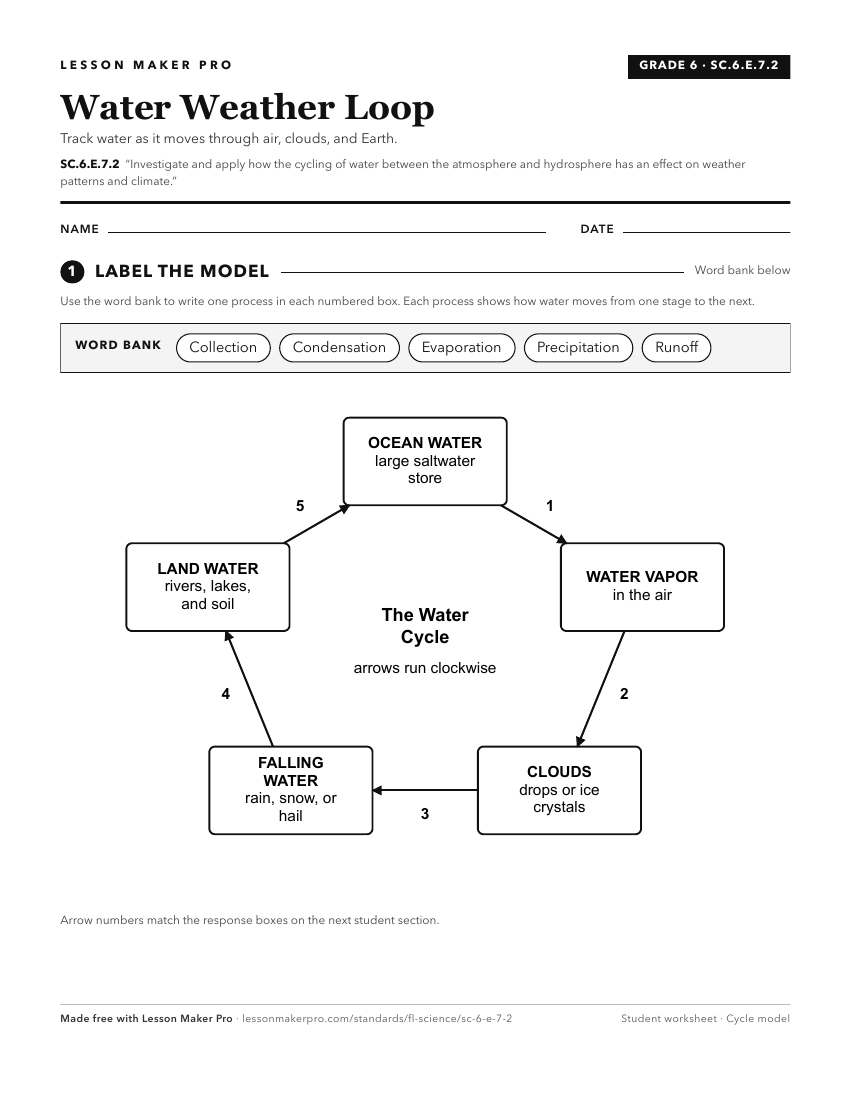
A ready-to-print activity worksheet aligned to SC.6.E.7.2, with an answer key for the teacher on its own page. No account needed.
PDF, US Letter, prints cleanly in black and white.
Download the worksheetKeep exploring
Related Standards
- SC.2.E.7.2
Investigate by observing and measuring, that the Sun's energy directly and indirectly warms the water, land, and air.
- SC.6.E.7.3
Describe how global patterns such as the jet stream and ocean currents influence local weather in measurable terms such as temperature, air pressure, wind direc...
- SC.6.E.7.4
Differentiate and show interactions among the geosphere, hydrosphere, cryosphere, atmosphere, and biosphere.
- SC.2.E.7.1
Compare and describe changing patterns in nature that repeat themselves, such as weather conditions including temperature and precipitation, day to day and seas...
Turn this exact standard into a lesson
Grade, subject, topic, and the complete standard are prefilled. Create one free, no account needed.
Also for this standard:Make a WorksheetMake a QuizMake a Sub Lesson