Florida SC.6.E.7.5
The Standard
Explain how energy provided by the sun influences global patterns of atmospheric movement and the temperature differences between air, water, and land.
Florida Next Generation Sunshine State Standards for Science
Teacher's field guide
What This Standard Means
What Students Need to Do
- Students compare how quickly land and water warm and cool, then connect surface temperatures to the air above them. They explain how uneven solar heating causes air to rise, sink, and circulate across Earth.
What Mastery Looks Like
- Students can use a diagram or temperature data to trace warm air rising and cooler air sinking. They can explain why land changes temperature faster than water and how that difference creates moving air.
Common Misconceptions
- Students may think sunlight directly pushes air or heats every part of Earth equally. They may also think warm air sinks, or that land and water warm at the same rate.
How to Assess It
- Give students a diagram showing stronger sunlight near the equator, weaker sunlight near the poles, and a coastline at noon. Ask them to add air movement arrows and explain the temperature differences.
Lesson moves
Ways to Teach It
Place equal cups of sand and water under a lamp, record each temperature every two minutes, then repeat during cooling.
Ask students why a sunny beach can have hot sand, cool water, and moving air at the same time.
Teams race to arrange equator, poles, warm air, cool air, and arrow cards into a cause-and-effect circulation chain.
Examine coastal weather data and connect afternoon sea breezes to faster warming of land than water.
Free download
Printable SC.6.E.7.5 Worksheet
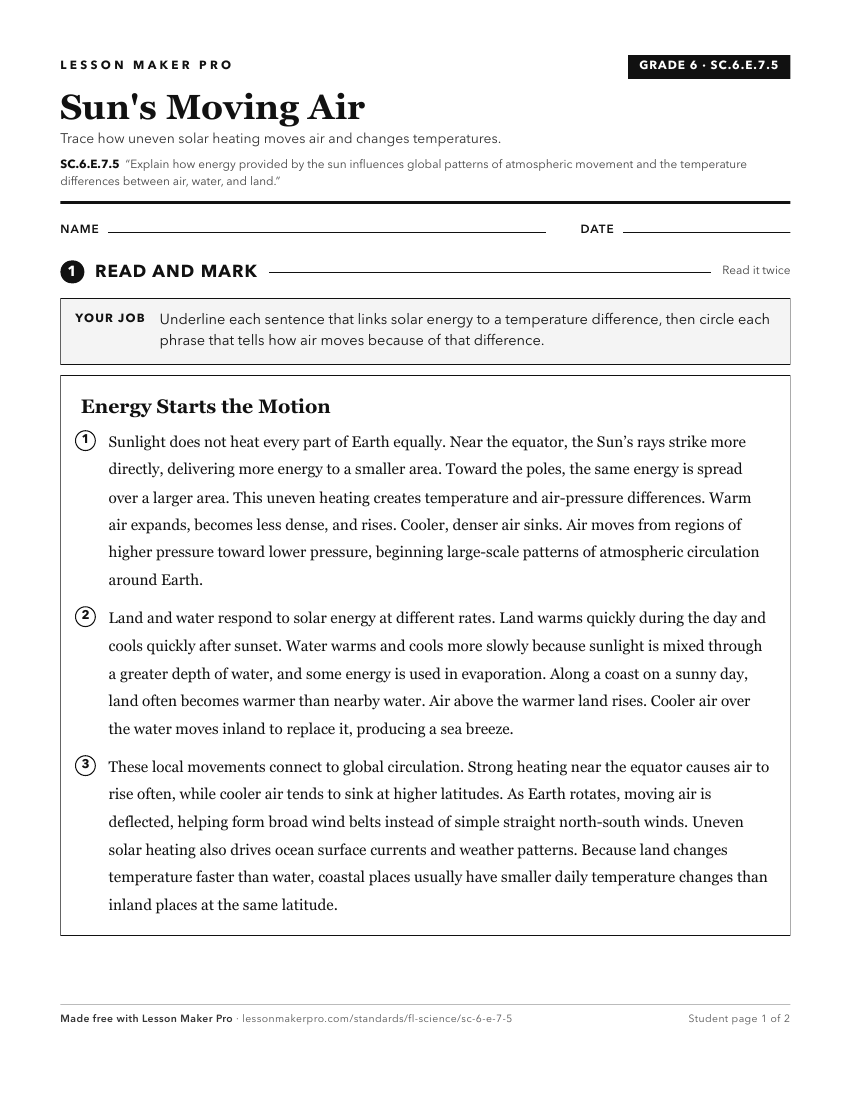
A ready-to-print activity worksheet aligned to SC.6.E.7.5, with an answer key for the teacher on its own page. No account needed.
PDF, US Letter, prints cleanly in black and white.
Download the worksheetKeep exploring
Related Standards
- SC.2.E.7.2
Investigate by observing and measuring, that the Sun's energy directly and indirectly warms the water, land, and air.
- SC.6.E.7.3
Describe how global patterns such as the jet stream and ocean currents influence local weather in measurable terms such as temperature, air pressure, wind direc...
- SC.6.E.7.2
Investigate and apply how the cycling of water between the atmosphere and hydrosphere has an effect on weather patterns and climate.
- SC.4.L.17.3
Trace the flow of energy from the Sun as it is transferred along the food chain through the producers to the consumers.
Turn this exact standard into a lesson
Grade, subject, topic, and the complete standard are prefilled. Create one free, no account needed.
Also for this standard:Make a WorksheetMake a QuizMake a Sub Lesson