Florida SC.7.P.11.4
The Standard
Observe and describe that heat flows in predictable ways, moving from warmer objects to cooler ones until they reach the same temperature.
Florida Next Generation Sunshine State Standards for Science
Teacher's field guide
What This Standard Means
What Students Need to Do
- Students compare the temperatures of two objects and predict which way heat will flow. They use temperature data to describe how both objects approach the same temperature.
What Mastery Looks Like
- A student correctly identifies the warmer object as the energy source and the cooler object as the energy receiver. The student explains that net heat transfer stops when both reach the same temperature.
Common Misconceptions
- Students may say that cold moves into a warmer object or that heat and temperature mean the same thing. They may also assume the final temperature is always exactly halfway between the starting temperatures.
How to Assess It
- Give students this exit ticket: A 22°C spoon is placed in 70°C water. State the direction of heat flow and describe how both temperatures change.
Lesson moves
Ways to Teach It
Place a metal spoon in warm water, measure both temperatures every minute, and graph the readings until they nearly match.
Write: Why does cold soda warm while hot cocoa cools on the same desk? Include the direction of heat flow.
Sort scenario cards into A to B, B to A, or no net transfer, then justify each choice.
Explain how a cooler slows heat transfer from warm outdoor air to cold food, and why the food eventually warms.
Free download
Printable SC.7.P.11.4 Worksheet
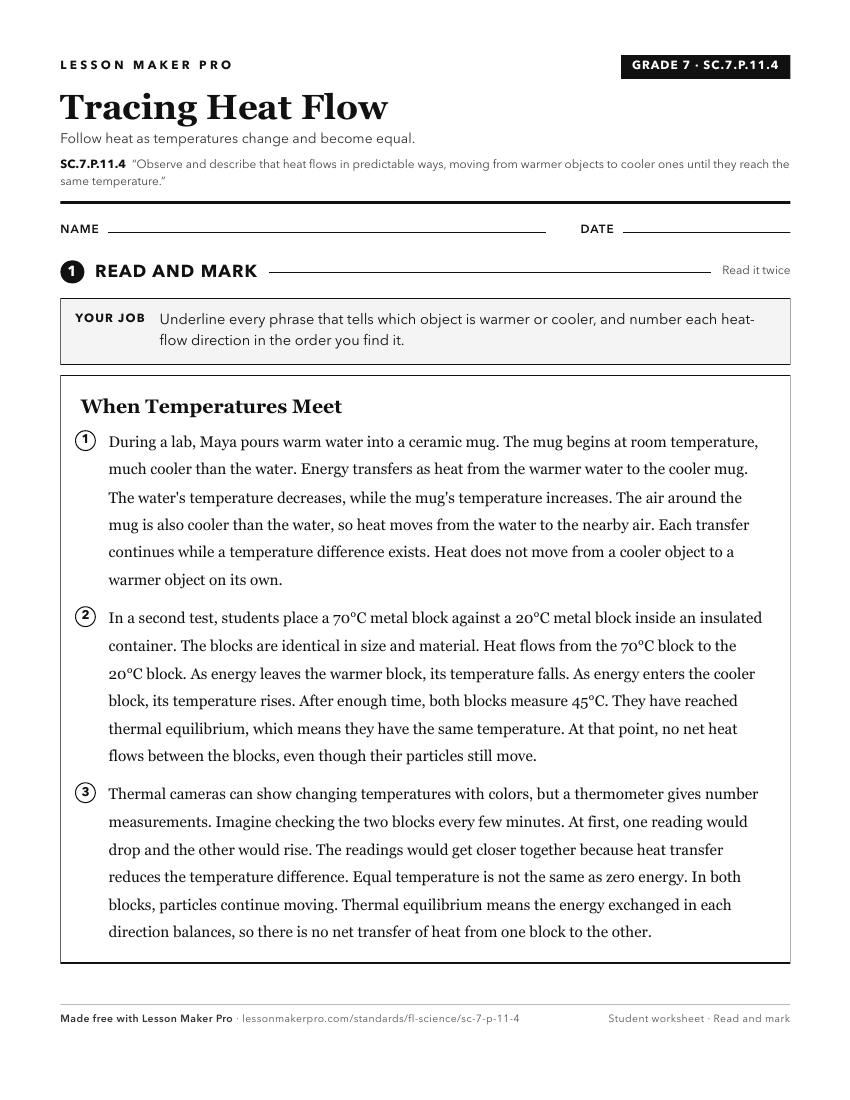
A ready-to-print activity worksheet aligned to SC.7.P.11.4, with an answer key for the teacher on its own page. No account needed.
PDF, US Letter, prints cleanly in black and white.
Download the worksheetKeep exploring
Related Standards
- SC.3.P.11.1
Investigate, observe, and explain that things that give off light often also give off heat.
- SC.3.P.11.2
Investigate, observe, and explain that heat is produced when one object rubs against another, such as rubbing one's hands together.
- SC.4.P.11.1
Recognize that heat flows from a hot object to a cold object and that heat flow may cause materials to change temperature.
- SC.5.P.9.1
Investigate and describe that many physical and chemical changes are affected by temperature.
Turn this exact standard into a lesson
Grade, subject, topic, and the complete standard are prefilled. Create one free, no account needed.
Also for this standard:Make a WorksheetMake a QuizMake a Sub Lesson