Florida SC.7.P.11.1
The Standard
Recognize that adding heat to or removing heat from a system may result in a temperature change and possibly a change of state.
Florida Next Generation Sunshine State Standards for Science
Teacher's field guide
What This Standard Means
What Students Need to Do
- Students predict what happens when thermal energy enters or leaves a substance. They use observations or heating curves to identify changes in temperature and physical state.
What Mastery Looks Like
- Students correctly describe melting, freezing, boiling, and cooling examples. They identify the direction of energy transfer and explain whether temperature, state, or both change during the process.
Common Misconceptions
- Students may treat heat and temperature as the same thing or say that cold flows into an object. They may also assume temperature must change continuously during melting or boiling.
How to Assess It
- Give students two cases: water cooling from 25°C to 15°C, and ice melting at 0°C. Ask them to identify the energy transfer and each change observed.
Lesson moves
Ways to Teach It
Heat crushed ice in a beaker, recording temperature and physical state every minute until liquid water forms.
Ask students to explain in writing how ice can absorb energy while remaining at 0°C as it melts.
Sort scenario cards into temperature change only, state change only, or both, then defend each placement.
Compare making ice in a freezer with boiling water on a stove, noting energy direction, temperature, and state changes.
Free download
Printable SC.7.P.11.1 Worksheet
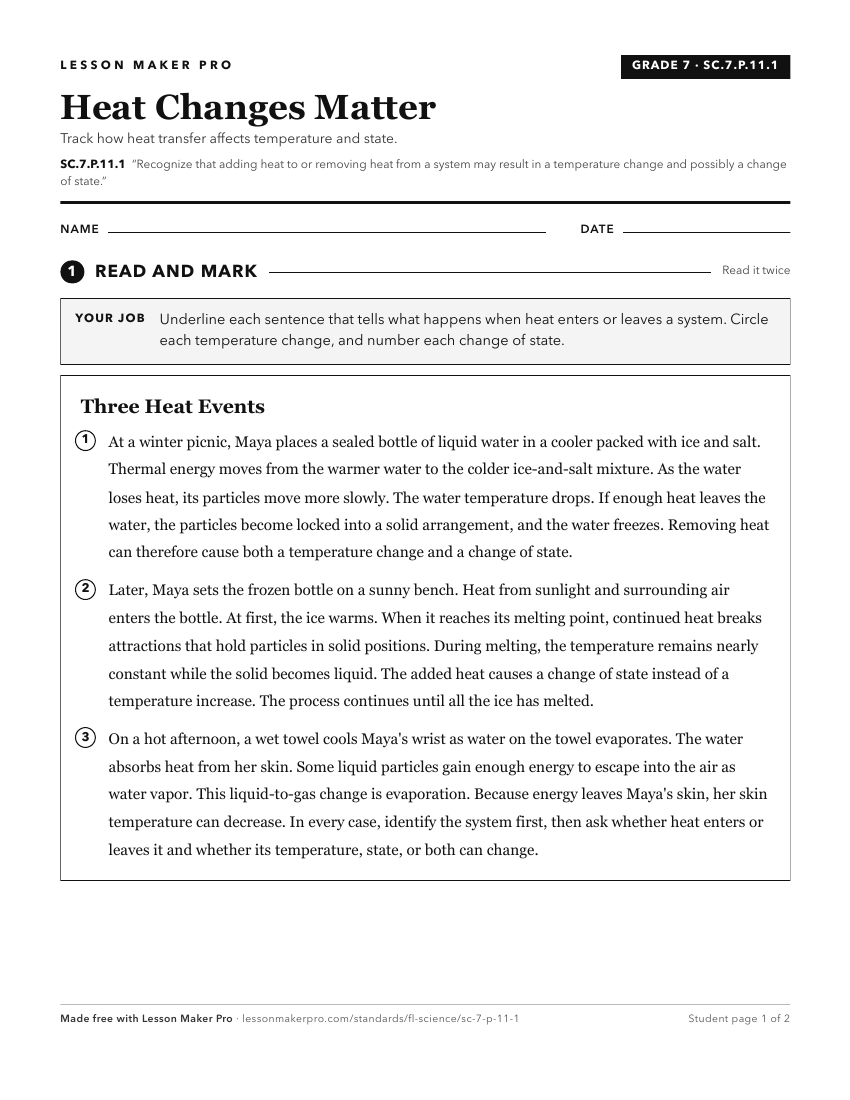
A ready-to-print activity worksheet aligned to SC.7.P.11.1, with an answer key for the teacher on its own page. No account needed.
PDF, US Letter, prints cleanly in black and white.
Download the worksheetKeep exploring
Related Standards
- SC.3.P.9.1
Describe the changes water undergoes when it changes state through heating and cooling by using familiar scientific terms such as melting, freezing, boiling, ev...
- SC.4.P.11.1
Recognize that heat flows from a hot object to a cold object and that heat flow may cause materials to change temperature.
- SC.8.P.9.3
Investigate and describe how temperature influences chemical changes.
- SC.5.P.9.1
Investigate and describe that many physical and chemical changes are affected by temperature.
Turn this exact standard into a lesson
Grade, subject, topic, and the complete standard are prefilled. Create one free, no account needed.
Also for this standard:Make a WorksheetMake a QuizMake a Sub Lesson