Florida SC.8.L.18.3
The Standard
Construct a scientific model of the carbon cycle to show how matter and energy are continuously transferred within and between organisms and their physical environment.
Florida Next Generation Sunshine State Standards for Science
Teacher's field guide
What This Standard Means
What Students Need to Do
- Students build and explain a model that tracks carbon through the atmosphere, plants, animals, decomposers, soil, oceans, and fuels. They label photosynthesis, feeding, respiration, decomposition, and combustion, then show where energy enters and changes form.
What Mastery Looks Like
- A student can follow one carbon atom through several reservoirs and justify each arrow with a process. The model conserves matter and shows sunlight entering, chemical energy moving through food, and heat leaving.
Common Misconceptions
- Students may show carbon disappearing after organisms die or fuels burn. They may think plants get carbon from soil or that only animals respire. Some also show energy cycling instead of leaving as heat.
How to Assess It
- On an exit ticket, ask: "Trace one carbon atom from atmospheric carbon dioxide into a rabbit, then back to the atmosphere. Label each process and show energy transfers."
Lesson moves
Ways to Teach It
Give groups colored beads as carbon atoms and reservoir cups; students move beads using photosynthesis, feeding, respiration, decomposition, and combustion cards.
Ask students to write: "Why can carbon cycle repeatedly while energy eventually leaves the system as heat?"
Play Carbon Cycle Relay: teams arrange reservoir and process cards into valid pathways, then explain every arrow for a point.
Use a school lunch to trace carbon from atmospheric carbon dioxide to crops, food, student respiration, waste, and decomposition.
Free download
Printable SC.8.L.18.3 Worksheet
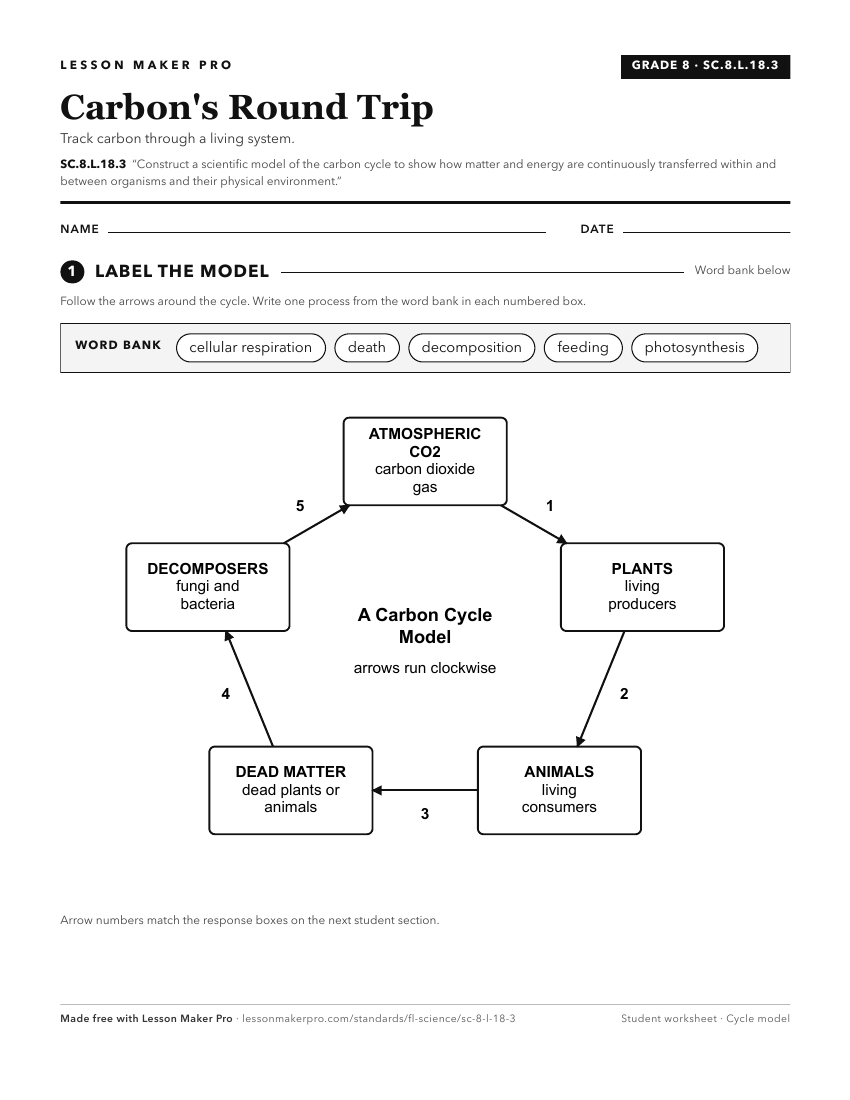
A ready-to-print activity worksheet aligned to SC.8.L.18.3, with an answer key for the teacher on its own page. No account needed.
PDF, US Letter, prints cleanly in black and white.
Download the worksheetKeep exploring
Related Standards
- SC.4.L.17.3
Trace the flow of energy from the Sun as it is transferred along the food chain through the producers to the consumers.
- SC.5.E.7.1
Create a model to explain the parts of the water cycle. Water can be a gas, a liquid, or a solid and can go back and forth from one state to another.
- SC.6.L.14.3
Recognize and explore how cells of all organisms undergo similar processes to maintain homeostasis, including extracting energy from food, getting rid of waste,...
- SC.8.L.18.4
Cite evidence that living systems follow the Laws of Conservation of Mass and Energy.
Turn this exact standard into a lesson
Grade, subject, topic, and the complete standard are prefilled. Create one free, no account needed.
Also for this standard:Make a WorksheetMake a QuizMake a Sub Lesson