Florida SC.8.L.18.4
The Standard
Cite evidence that living systems follow the Laws of Conservation of Mass and Energy.
Florida Next Generation Sunshine State Standards for Science
Teacher's field guide
What This Standard Means
What Students Need to Do
- Students trace matter and energy into, through, and out of living systems. They use measurements, diagrams, or observations to show that matter and energy change form rather than appear or vanish.
What Mastery Looks Like
- Students can account for atoms in processes such as photosynthesis, respiration, digestion, and decomposition. They can cite data showing energy entering as light or food and leaving as heat, motion, or stored chemical energy.
Common Misconceptions
- Students may think plants create matter from nothing or that organisms destroy food after using it. They may also think energy cycles through ecosystems unchanged, rather than changing form and spreading as heat.
How to Assess It
- Give students this prompt: A terrarium receives 500 J of light, releases 350 J as heat, stores 150 J in biomass, and keeps the same total mass. Explain how the data support conservation of mass and energy.
Lesson moves
Ways to Teach It
Weigh a sealed bag containing yeast, sugar, and warm water before and after gas forms, then explain why the total mass stays unchanged.
Write an explanation of where a growing plant's added mass comes from, using carbon dioxide, water, and glucose as evidence.
Sort photosynthesis, respiration, digestion, and decomposition cards by matter inputs, matter outputs, and energy transformations, then check each pathway.
Analyze a warm compost pile by tracing food scraps into gases, water, soil materials, microbial biomass, and released heat.
Free download
Printable SC.8.L.18.4 Worksheet
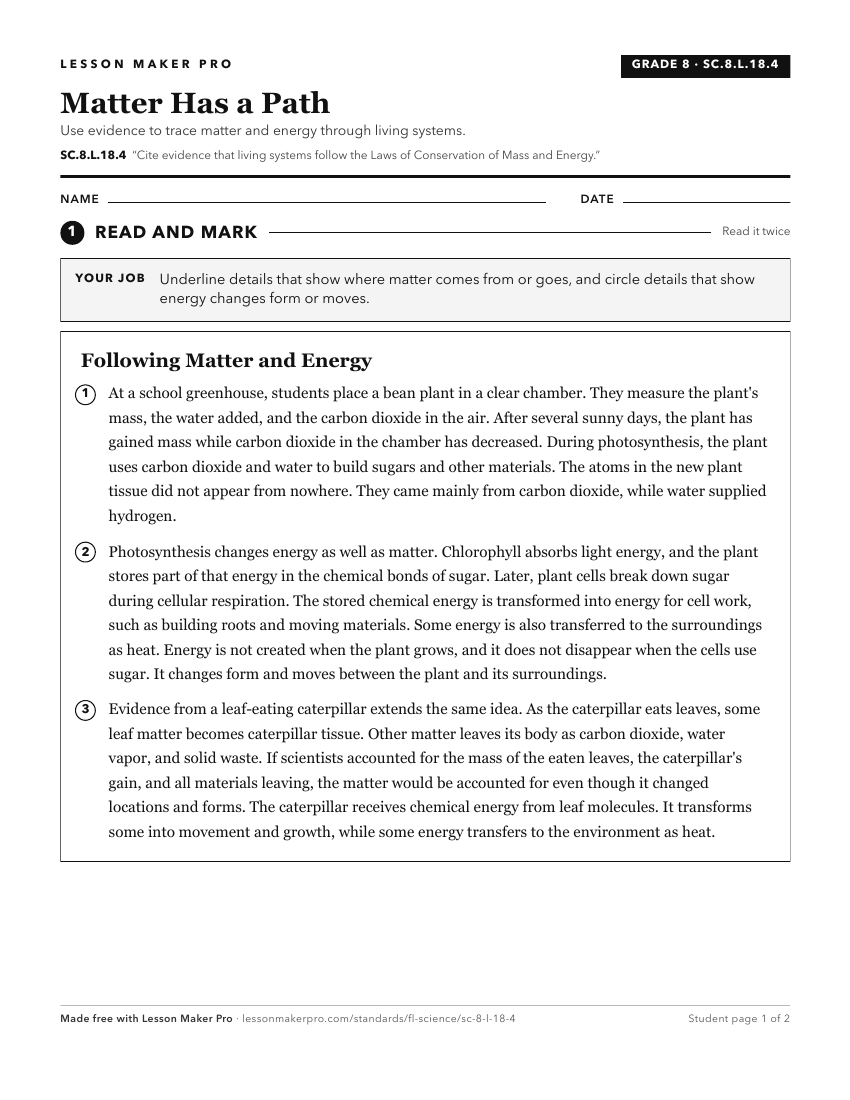
A ready-to-print activity worksheet aligned to SC.8.L.18.4, with an answer key for the teacher on its own page. No account needed.
PDF, US Letter, prints cleanly in black and white.
Download the worksheetKeep exploring
Related Standards
- SC.8.P.9.1
Explore the Law of Conservation of Mass by demonstrating and concluding that mass is conserved when substances undergo physical and chemical changes.
- SC.7.P.11.3
Cite evidence to explain that energy cannot be created nor destroyed, only changed from one form to another.
- SC.4.P.8.3
Explore the Law of Conservation of Mass by demonstrating that the mass of a whole object is always the same as the sum of the masses of its parts.
- SC.8.L.18.3
Construct a scientific model of the carbon cycle to show how matter and energy are continuously transferred within and between organisms and their physical envi...
Turn this exact standard into a lesson
Grade, subject, topic, and the complete standard are prefilled. Create one free, no account needed.
Also for this standard:Make a WorksheetMake a QuizMake a Sub Lesson