Florida SC.6.L.14.3
The Standard
Recognize and explore how cells of all organisms undergo similar processes to maintain homeostasis, including extracting energy from food, getting rid of waste, and reproducing.
Florida Next Generation Sunshine State Standards for Science
Teacher's field guide
What This Standard Means
What Students Need to Do
- Students identify common cell processes that keep organisms alive. They explain how cells release energy from nutrients, remove wastes, and make new cells through cell division.
What Mastery Looks Like
- Students can compare these processes in plant, animal, and single-celled organisms. They can connect each process to stable internal conditions and predict what happens when one process fails.
Common Misconceptions
- Students may think only animals use food for energy or produce waste. They may confuse cell division with an organism having offspring, or think cellular waste means only feces.
How to Assess It
- Give students this exit prompt: “Choose one cell process and explain how it helps maintain stable internal conditions. What could happen if it stopped?”
Lesson moves
Ways to Teach It
Mix yeast, warm water, and sugar in a bottle with a balloon, then observe gas production as evidence of cellular energy release.
Write a claim explaining why a plant cell must release energy and remove waste even though the plant makes sugar.
Sort process, example, and outcome cards to match energy release, waste removal, and cell division with their roles in homeostasis.
Trace how muscle cells use glucose and oxygen during exercise, then connect carbon dioxide waste to faster breathing.
Free download
Printable SC.6.L.14.3 Worksheet
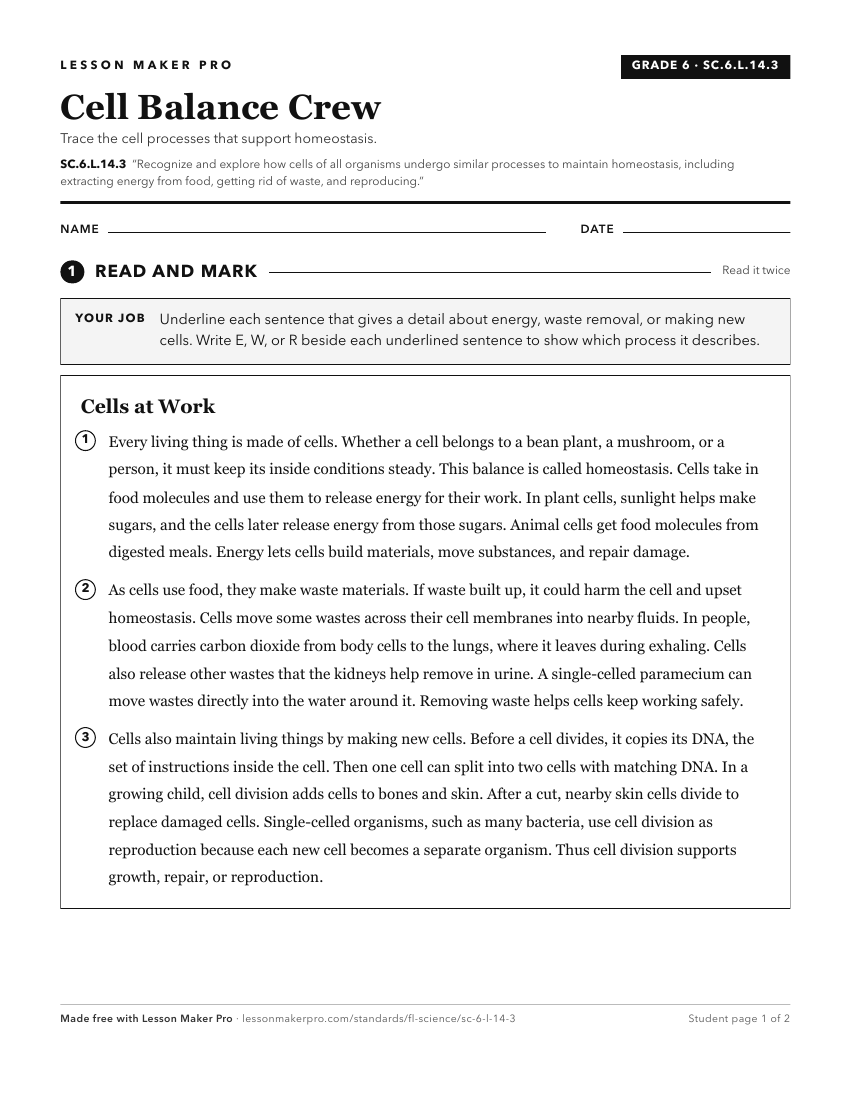
A ready-to-print activity worksheet aligned to SC.6.L.14.3, with an answer key for the teacher on its own page. No account needed.
PDF, US Letter, prints cleanly in black and white.
Download the worksheetKeep exploring
Related Standards
- SC.6.L.14.5
Identify and investigate the general functions of the major systems of the human body (digestive, respiratory, circulatory, reproductive, excretory, immune, ner...
- SC.6.L.14.1
Describe and identify patterns in the hierarchical organization of organisms from atoms to molecules and cells to tissues to organs to organ systems to organism...
- SC.1.L.17.1
Through observation, recognize that all plants and animals, including humans, need the basic necessities of air, water, food, and space.
- SC.6.L.14.2
Investigate and explain the components of the scientific theory of cells (cell theory): all organisms are composed of cells (single-celled or multi-cellular), a...
Turn this exact standard into a lesson
Grade, subject, topic, and the complete standard are prefilled. Create one free, no account needed.
Also for this standard:Make a WorksheetMake a QuizMake a Sub Lesson