Florida SC.6.L.14.2
The Standard
Investigate and explain the components of the scientific theory of cells (cell theory): all organisms are composed of cells (single-celled or multi-cellular), all cells come from pre-existing cells, and cells are the basic unit of life.
Florida Next Generation Sunshine State Standards for Science
Teacher's field guide
What This Standard Means
What Students Need to Do
- Students examine microscope images, prepared slides, and cell division sequences. They use the evidence to explain how cells relate to living things, growth, and reproduction.
What Mastery Looks Like
- Students can identify single-celled and multicellular organisms and explain that tissues are made of cells. They can use cell division as evidence that new cells form from existing cells.
Common Misconceptions
- Students may think only plants and animals have cells, or that cells appear from nonliving material. They may also confuse cells with atoms, organs, or organisms.
How to Assess It
- Give students three images: pond bacteria, muscle tissue, and a dividing cell. Ask them to write which cell theory idea each image supports and why.
Lesson moves
Ways to Teach It
View onion skin, cheek cells, and pond water under microscopes, then record whether each sample shows one cell or many cells.
Write a response to this prompt: What evidence would convince someone that every living organism is made of cells?
Sort organism, tissue, cell division, and nonliving object cards into the cell theory idea each card supports.
Connect cell division to a scraped knee by explaining how existing skin cells produce new cells during healing.
Free download
Printable SC.6.L.14.2 Worksheet
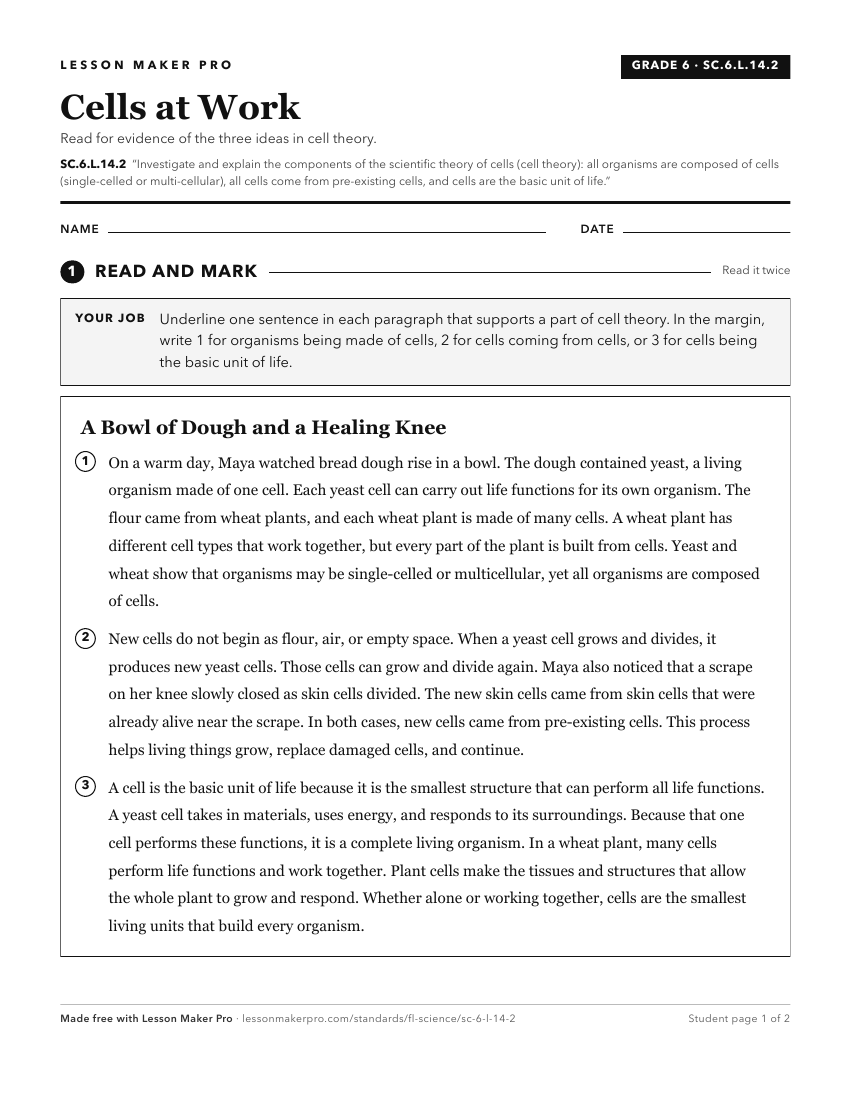
A ready-to-print activity worksheet aligned to SC.6.L.14.2, with an answer key for the teacher on its own page. No account needed.
PDF, US Letter, prints cleanly in black and white.
Download the worksheetKeep exploring
Related Standards
- SC.6.L.14.1
Describe and identify patterns in the hierarchical organization of organisms from atoms to molecules and cells to tissues to organs to organ systems to organism...
- SC.8.P.8.7
Explore the scientific theory of atoms (also known as atomic theory) by recognizing that atoms are the smallest unit of an element and are composed of sub-atomi...
- SC.6.L.14.3
Recognize and explore how cells of all organisms undergo similar processes to maintain homeostasis, including extracting energy from food, getting rid of waste,...
- SC.5.P.8.4
Explore the scientific theory of atoms (also called atomic theory) by recognizing that all matter is composed of parts that are too small to be seen without mag...
Turn this exact standard into a lesson
Grade, subject, topic, and the complete standard are prefilled. Create one free, no account needed.
Also for this standard:Make a WorksheetMake a QuizMake a Sub Lesson