Florida SC.6.L.14.1
The Standard
Describe and identify patterns in the hierarchical organization of organisms from atoms to molecules and cells to tissues to organs to organ systems to organisms.
Florida Next Generation Sunshine State Standards for Science
Teacher's field guide
What This Standard Means
What Students Need to Do
- Students place biological structures in order from smallest to largest. They explain how units at each level combine and work together to form the next level.
What Mastery Looks Like
- A student can correctly sequence atoms, molecules, cells, tissues, organs, organ systems, and organisms. Given related examples, the student labels each level and explains how the levels connect.
Common Misconceptions
- Students often treat cells and tissues as interchangeable, or confuse organs with organ systems. They may place molecules below atoms or assume every molecule is living. Some think larger organisms have larger cells rather than more cells.
How to Assess It
- Give students these cards: oxygen atom, water molecule, muscle cell, muscle tissue, heart, circulatory system, human. Ask them to order and label the cards, then explain two neighboring links.
Lesson moves
Ways to Teach It
Give pairs labeled picture cards and have them build a smallest-to-largest human body chain, then justify every link.
Ask students to write: How is a heart related to a muscle cell, and what levels connect them?
Play Hierarchy Relay: teams race to sort mixed example cards, earning a point only when they explain each placement.
Trace a soccer kick from molecules in muscle cells to muscle tissue, a leg muscle organ, body systems, and the whole player.
Free download
Printable SC.6.L.14.1 Worksheet
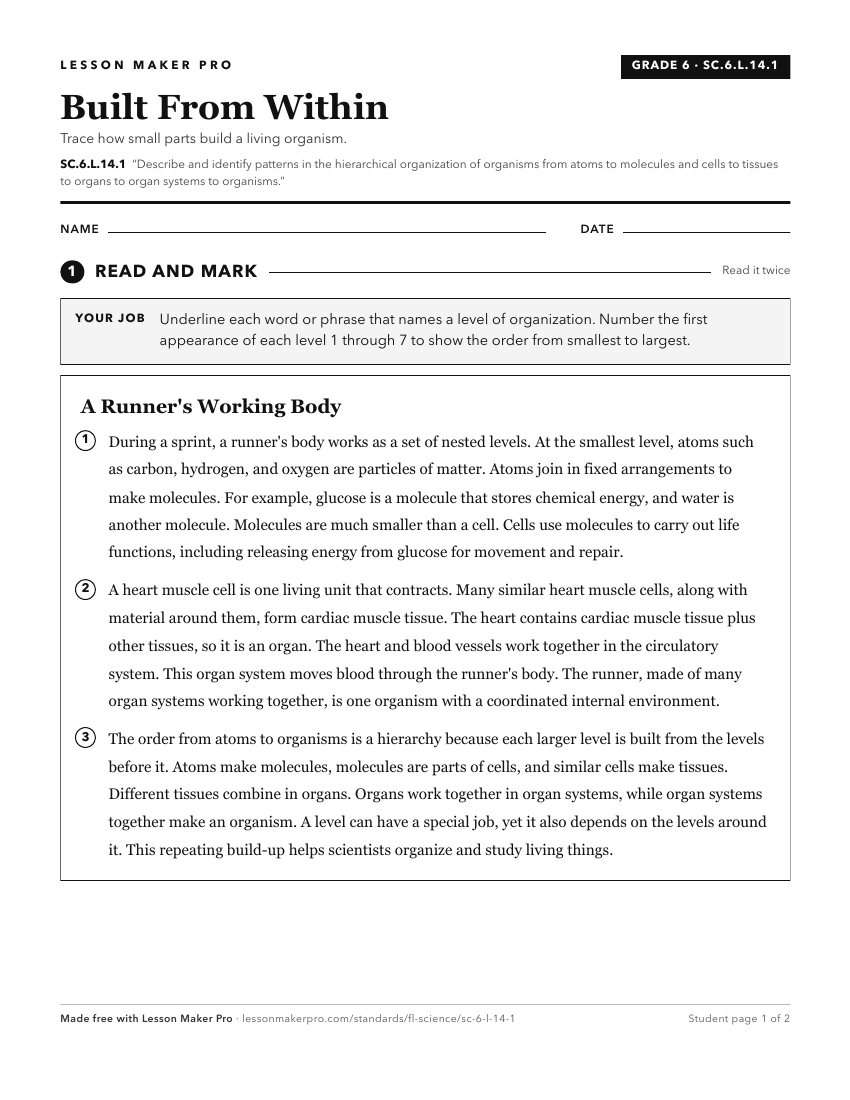
A ready-to-print activity worksheet aligned to SC.6.L.14.1, with an answer key for the teacher on its own page. No account needed.
PDF, US Letter, prints cleanly in black and white.
Download the worksheetKeep exploring
Related Standards
- SC.6.L.14.5
Identify and investigate the general functions of the major systems of the human body (digestive, respiratory, circulatory, reproductive, excretory, immune, ner...
- SC.6.L.15.1
Analyze and describe how and why organisms are classified according to shared characteristics with emphasis on the Linnaean system combined with the concept of ...
- SC.2.L.14.1
Distinguish human body parts (brain, heart, lungs, stomach, muscles, and skeleton) and their basic functions.
- SC.6.L.14.3
Recognize and explore how cells of all organisms undergo similar processes to maintain homeostasis, including extracting energy from food, getting rid of waste,...
Turn this exact standard into a lesson
Grade, subject, topic, and the complete standard are prefilled. Create one free, no account needed.
Also for this standard:Make a WorksheetMake a QuizMake a Sub Lesson