Florida SC.2.L.14.1
The Standard
Distinguish human body parts (brain, heart, lungs, stomach, muscles, and skeleton) and their basic functions.
Florida Next Generation Sunshine State Standards for Science
Teacher's field guide
What This Standard Means
What Students Need to Do
- Students locate six major body parts on a simple diagram. They explain how each part helps the body think, breathe, circulate blood, digest food, move, or stay supported.
What Mastery Looks Like
- Given an unlabeled body picture, a student correctly labels all six parts. The student describes each job in clear words and connects muscles to movement and the skeleton to support and protection.
Common Misconceptions
- Students may say the heart creates feelings or the lungs pump blood. They may think digestion only means storing food, muscles exist only in arms, or the skeleton does not change or move.
How to Assess It
- Give students a body outline with six arrows. Have them label each part and write one short job beside it.
Lesson moves
Ways to Teach It
Trace a student on butcher paper, then place six labeled body-part cards and add one job sentence beside each.
Students write how the brain, heart, lungs, muscles, and skeleton work together during a playground run.
Play a matching relay where teams pair body-part cards with function cards, then explain each match aloud.
Students count breaths and pulse beats before and after jumping, then explain what the heart, lungs, and muscles were doing.
Free download
Printable SC.2.L.14.1 Worksheet
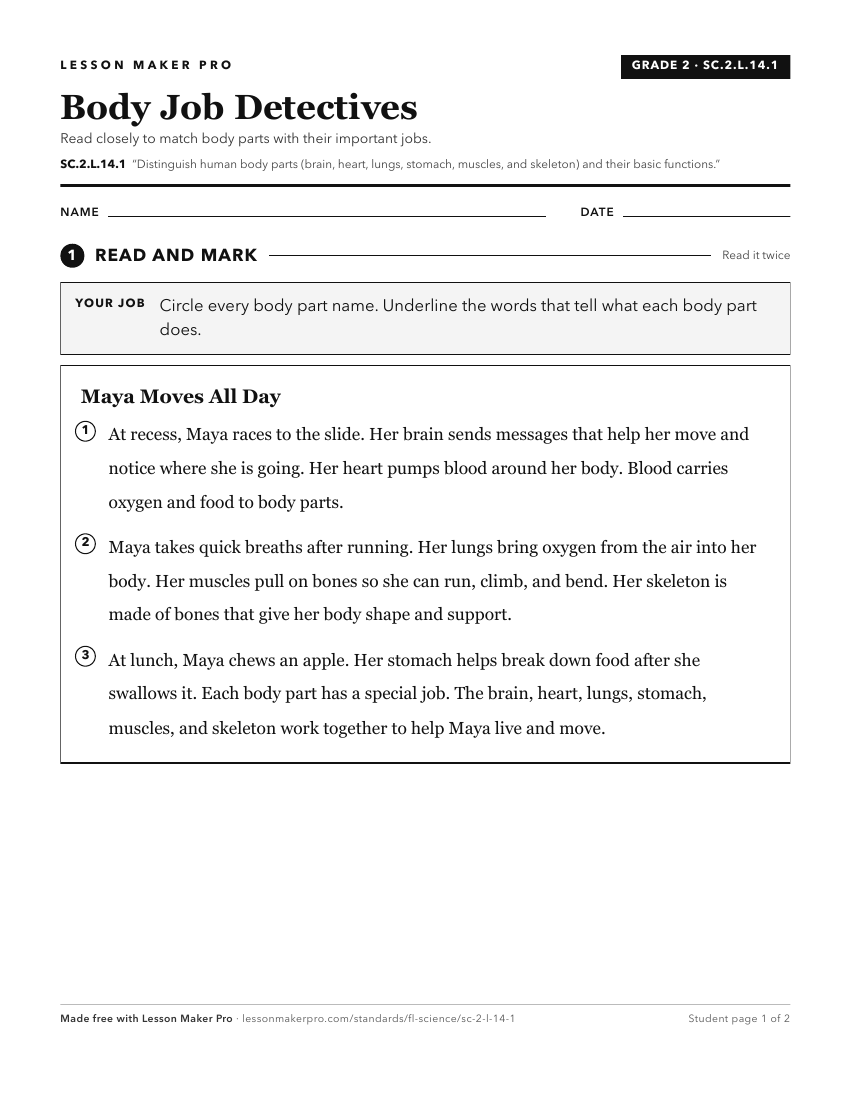
A ready-to-print activity worksheet aligned to SC.2.L.14.1, with an answer key for the teacher on its own page. No account needed.
PDF, US Letter, prints cleanly in black and white.
Download the worksheetKeep exploring
Related Standards
- SC.6.L.14.5
Identify and investigate the general functions of the major systems of the human body (digestive, respiratory, circulatory, reproductive, excretory, immune, ner...
- SC.5.L.14.2
Compare and contrast the function of organs and other physical structures of plants and animals, including humans, for example: some animals have skeletons for ...
- SC.K.L.14.1
Recognize the five senses and related body parts.
- SC.5.L.14.1
Identify the organs in the human body and describe their functions, including the skin, brain, heart, lungs, stomach, liver, intestines, pancreas, muscles and s...
Turn this exact standard into a lesson
Grade, subject, topic, and the complete standard are prefilled. Create one free, no account needed.
Also for this standard:Make a WorksheetMake a QuizMake a Sub Lesson