Florida SC.5.L.14.1
The Standard
Identify the organs in the human body and describe their functions, including the skin, brain, heart, lungs, stomach, liver, intestines, pancreas, muscles and skeleton, reproductive organs, kidneys, bladder, and sensory organs.
Florida Next Generation Sunshine State Standards for Science
Teacher's field guide
What This Standard Means
What Students Need to Do
- Students name and locate the main organs of the human body. They explain each organ’s job and distinguish organs with related roles, such as the kidneys and bladder.
What Mastery Looks Like
- Students accurately label the target organs on a body diagram and match each one to its function. They explain how organs work together without mixing up their separate jobs.
Common Misconceptions
- Students may say the stomach completes all digestion, the kidneys store urine, or the bladder makes urine. They often confuse the liver and pancreas or think each organ works alone.
How to Assess It
- Give students a blank body outline. Ask them to label the heart, lungs, stomach, kidneys, and bladder, then write one function for each.
Lesson moves
Ways to Teach It
Place organ cards on a life-size paper body, then match each card with a prepared function strip.
Ask students to explain which organs help after eating a sandwich and how each one contributes.
Play organ-function memory with paired cards, requiring students to explain every match before keeping it.
Use a hydration scenario to trace water through the intestines, blood, kidneys, and bladder.
Free download
Printable SC.5.L.14.1 Worksheet
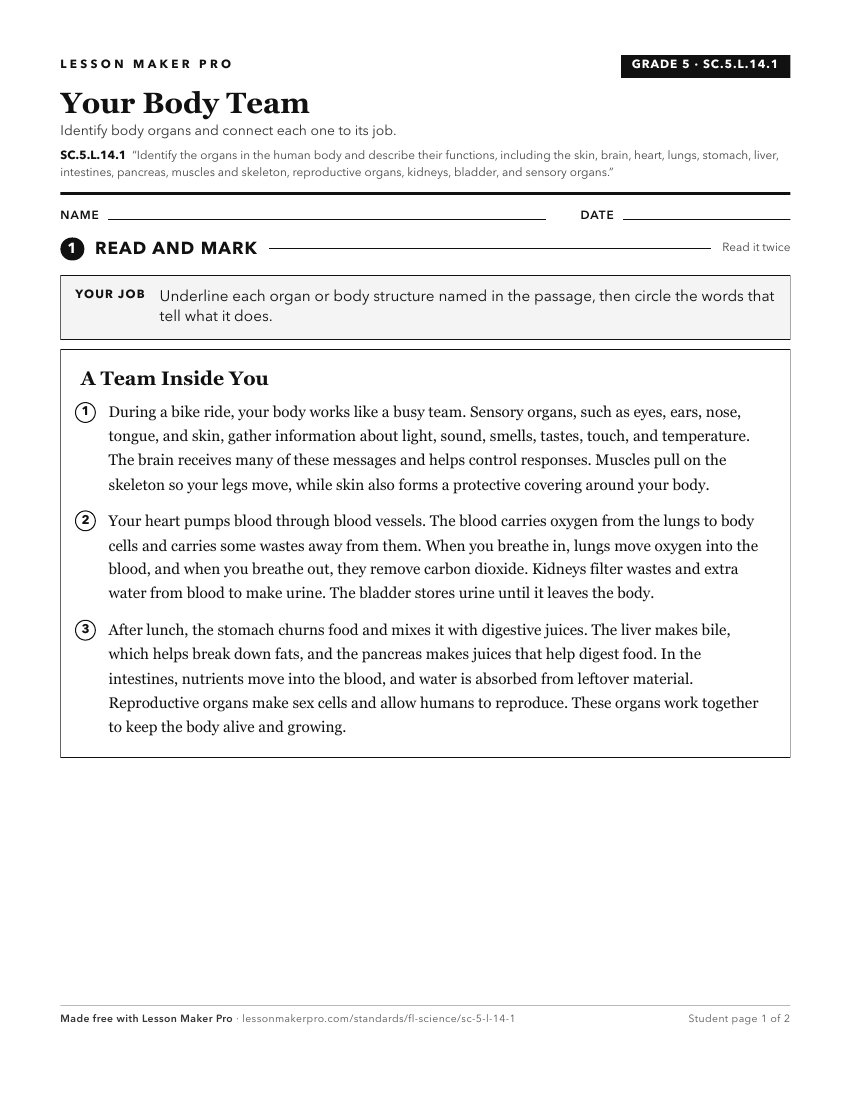
A ready-to-print activity worksheet aligned to SC.5.L.14.1, with an answer key for the teacher on its own page. No account needed.
PDF, US Letter, prints cleanly in black and white.
Download the worksheetKeep exploring
Related Standards
- SC.6.L.14.5
Identify and investigate the general functions of the major systems of the human body (digestive, respiratory, circulatory, reproductive, excretory, immune, ner...
- SC.6.L.14.1
Describe and identify patterns in the hierarchical organization of organisms from atoms to molecules and cells to tissues to organs to organ systems to organism...
- SC.2.L.14.1
Distinguish human body parts (brain, heart, lungs, stomach, muscles, and skeleton) and their basic functions.
- SC.K.L.14.1
Recognize the five senses and related body parts.
Turn this exact standard into a lesson
Grade, subject, topic, and the complete standard are prefilled. Create one free, no account needed.
Also for this standard:Make a WorksheetMake a QuizMake a Sub Lesson